Graph Transformations

From Math Wiki
Jump to navigation Jump to search

Introduction

In this section we will learn how to graph modified versions of the functions from the library of functions. The transformations we will be focusing on are left/right shifts, up/down shifts, and vertical stretching/compression. Even though these properties hold for functions in general, we will focus on functions from the library of functions.

Vertical shift

A vertical shift comes from taking a graph and moving every point up, or down, by some uniform amount. Algebraically, we take a point (x, f(x)) and move it to (x, f(x) + c), where c is the shift up or down. This means the function f(x) + c is a shift up by c units if c is positive, and down by c units if c is negative.

Example: Graph Failed to parse (MathML with SVG or PNG fallback (recommended for modern browsers and accessibility tools): Invalid response ("Math extension cannot connect to Restbase.") from server "https://wikimedia.org/api/rest_v1/":): {\displaystyle f(x) = x^2 + 4}
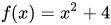
Here we can recognize that the function from the library of functions is Failed to parse (MathML with SVG or PNG fallback (recommended for modern browsers and accessibility tools): Invalid response ("Math extension cannot connect to Restbase.") from server "https://wikimedia.org/api/rest_v1/":): {\displaystyle x^2} . This tells us that the graph of f(x) will have the same shape as Failed to parse (MathML with SVG or PNG fallback (recommended for modern browsers and accessibility tools): Invalid response ("Math extension cannot connect to Restbase.") from server "https://wikimedia.org/api/rest_v1/":): {\displaystyle x^2} . Since we are in the vertical shift section, we can guess that the function has been shifted vertically by some amount. Since we are adding 4 to the output of every point from Failed to parse (MathML with SVG or PNG fallback (recommended for modern browsers and accessibility tools): Invalid response ("Math extension cannot connect to Restbase.") from server "https://wikimedia.org/api/rest_v1/":): {\displaystyle x^2} the graph of Failed to parse (MathML with SVG or PNG fallback (recommended for modern browsers and accessibility tools): Invalid response ("Math extension cannot connect to Restbase.") from server "https://wikimedia.org/api/rest_v1/":): {\displaystyle x^2 + 4} is the graph of Failed to parse (MathML with SVG or PNG fallback (recommended for modern browsers and accessibility tools): Invalid response ("Math extension cannot connect to Restbase.") from server "https://wikimedia.org/api/rest_v1/":): {\displaystyle x^2} shifted up by 4 units.

Horizontal Shift

Horizontal shifts are a little harder to describe algebraically. Graphically, it is exactly what you think it is. We take the graph of f(x) and move all of the points horizontally by a uniform amount. For identifying horizontal shifts start by attempting which function from the library of functions is the base function. Then observe where a point on the base function moves. I usually keep track of the y-intercept. So the approach is focused on determining what value of x is required to plug into the shifted function to get the same value that evaluating the base function at 0 is.

Example:

Graph Failed to parse (MathML with SVG or PNG fallback (recommended for modern browsers and accessibility tools): Invalid response ("Math extension cannot connect to Restbase.") from server "https://wikimedia.org/api/rest_v1/":): {\displaystyle f(x) = (x - 5)^3}

The first thing to notice is the base function from the library of functions is Failed to parse (MathML with SVG or PNG fallback (recommended for modern browsers and accessibility tools): Invalid response ("Math extension cannot connect to Restbase.") from server "https://wikimedia.org/api/rest_v1/":): {\displaystyle x^3.} The y-intercept is (0, 0). Now we want to find a value of x such that Failed to parse (MathML with SVG or PNG fallback (recommended for modern browsers and accessibility tools): Invalid response ("Math extension cannot connect to Restbase.") from server "https://wikimedia.org/api/rest_v1/":): {\displaystyle (x - 5)^3 = 0} . Solving this we find that we need x = 5. This means the point (0, 0) moved to (5, 0) and every point moved to the right 5 units.


Return to Topics Page