Math 22 Partial Derivatives
Jump to navigation
Jump to search
Partial Derivatives of a Function of Two Variables
If , then the first partial derivatives of with respect to and are the functions and , defined as shown. We can denote as and as
Example: Find and of:
1)
| Solution: |
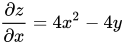
|---|
| Failed to parse (MathML with SVG or PNG fallback (recommended for modern browsers and accessibility tools): Invalid response ("Math extension cannot connect to Restbase.") from server "https://wikimedia.org/api/rest_v1/":): {\displaystyle \frac{\partial z}{\partial x}=4x^2-4y} |
| Failed to parse (MathML with SVG or PNG fallback (recommended for modern browsers and accessibility tools): Invalid response ("Math extension cannot connect to Restbase.") from server "https://wikimedia.org/api/rest_v1/":): {\displaystyle \frac{\partial z}{\partial y}=-4x} |
1) Failed to parse (MathML with SVG or PNG fallback (recommended for modern browsers and accessibility tools): Invalid response ("Math extension cannot connect to Restbase.") from server "https://wikimedia.org/api/rest_v1/":): {\displaystyle z=f(x,y)=x^2y^3}
| Solution: |
|---|
| Failed to parse (MathML with SVG or PNG fallback (recommended for modern browsers and accessibility tools): Invalid response ("Math extension cannot connect to Restbase.") from server "https://wikimedia.org/api/rest_v1/":): {\displaystyle \frac{\partial z}{\partial y}=3x^2y^2} |
This page were made by Tri Phan


