Difference between revisions of "Math 22 Partial Derivatives"
Jump to navigation
Jump to search
| Line 5: | Line 5: | ||
<math>\frac{\partial z}{\partial y}=\lim_{\Delta y\to 0}\frac{f(x,y+\Delta y)-f(x,y)}{\Delta y}</math> | <math>\frac{\partial z}{\partial y}=\lim_{\Delta y\to 0}\frac{f(x,y+\Delta y)-f(x,y)}{\Delta y}</math> | ||
| + | |||
| + | We can denote <math>\frac{\partial z}{\partial x}</math> as <math>f_x(x,y)</math> and <math>\frac{\partial z}{\partial y}</math> as <math>f_y(x,y)</math> | ||
| + | '''Example:''' Find <math>\frac{\partial z}{\partial x}</math> and <math>\frac{\partial z}{\partial y}</math> of: | ||
| − | ''' | + | '''1)''' <math>z=f(x,y)=2x^2-4xy</math> |
| + | {| class = "mw-collapsible mw-collapsed" style = "text-align:left;" | ||
| + | !Solution: | ||
| + | |- | ||
| + | |<math>\frac{\partial z}{\partial x}=4x^2-4y</math> | ||
| + | |- | ||
| + | |<math>\frac{\partial z}{\partial y}=-4x</math> | ||
| + | |} | ||
| + | '''1)''' <math>z=f(x,y)=x^2y^3</math> | ||
| + | {| class = "mw-collapsible mw-collapsed" style = "text-align:left;" | ||
| + | !Solution: | ||
| + | |- | ||
| + | |<math>\frac{\partial z}{\partial x}=4x^2-4y</math> | ||
| + | |- | ||
| + | |<math>\frac{\partial z}{\partial y}=-4x</math> | ||
| + | |} | ||
Revision as of 07:35, 18 August 2020
Partial Derivatives of a Function of Two Variables
If , then the first partial derivatives of with respect to and are the functions and , defined as shown. We can denote as and as





Example: Find and of:
1)

| Solution: |
|---|
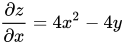

1)

| Solution: |
|---|
This page were made by Tri Phan