Find the following limit: 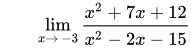 .
.
| Foundations:
|
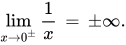
| When evaluating limits of rational functions, the first idea to try is to simply plug in the limit. In addition to this, we must consider that as a limit,
|

|
| and
|
|
| In the latter case, the sign matters. Unfortunately, most (but not all) exam questions require more work. Many of them will evaluate to an indeterminate form, or something of the form
|
 or or 
|
In this case, there are several approaches to try:
|
- We can multiply the numerator and denominator by the conjugate of the denominator. This frequently results in a term that cancels, allowing us to then just plug in our limit value.
- We can factor a term creatively. For example,
 can be factored as can be factored as  , or as , or as ![{\displaystyle \left({\sqrt[{3}]{x}}-1\right)\left(\left({\sqrt[{3}]{x}}\right)^{2}+{\sqrt[{3}]{x}}+1\right)}](https://wikimedia.org/api/rest_v1/media/math/render/svg/e0afb547cc668e424337a1effff0c87319c32d75) , both of which could result in a factor that cancels in our fraction. , both of which could result in a factor that cancels in our fraction.
- We can apply l'Hôpital's Rule: Suppose
 is contained in some interval is contained in some interval  . If . If  and and  exists, and exists, and  for all for all  in , then in , then 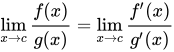 . .
|
Note that the first requirement in l'Hôpital's Rule is that the fraction must be an indeterminate form. This should be shown in your answer for any exam question.
|
Solution:
| Step 1:
|
We take the limit and find that

|
| This is an indeterminate form, and we need to apply l'Hôpital's Rule.
|
| Step 2:
|
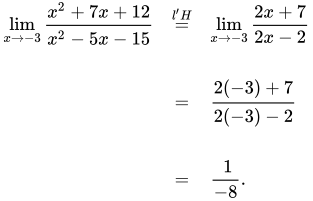
| Applying l'Hôpital's Rule (by taking the derivative of the numerator and denominator separately), we find:
|
|
| Final Answer:
|

|
Return to Sample Exam