009B Sample Final 2, Problem 4

From Math Wiki
Jump to navigation Jump to search

A city bordered on one side by a lake can be approximated by a semicircle of radius 7 miles, whose city center is on the shoreline. As we move away from the center along a radius the population density of the city can be approximated by:

Failed to parse (MathML with SVG or PNG fallback (recommended for modern browsers and accessibility tools): Invalid response ("Math extension cannot connect to Restbase.") from server "https://wikimedia.org/api/rest_v1/":): {\displaystyle \rho(x)=25000e^{-0.15x}}

people per square mile. What is the population of the city?

Foundations:  
Many word problems can be confusing, and this is a good example.
We know that we are going to integrate over a half-disk of radius 7, but how do we construct the integral?
One key could be the expression of our density,
        Failed to parse (MathML with SVG or PNG fallback (recommended for modern browsers and accessibility tools): Invalid response ("Math extension cannot connect to Restbase.") from server "https://wikimedia.org/api/rest_v1/":): {\displaystyle \rho(x)=25,000e^{-0.15x}}
where  Failed to parse (MathML with SVG or PNG fallback (recommended for modern browsers and accessibility tools): Invalid response ("Math extension cannot connect to Restbase.") from server "https://wikimedia.org/api/rest_v1/":): {\displaystyle x}   is the distance from the center.
Any slice along a radius gives us a cross section.
If we were revolving ALL the way around the center, this would be typical solid of revolution,
and we could find the volume of revolving the center by the usual shell formula
       Failed to parse (MathML with SVG or PNG fallback (recommended for modern browsers and accessibility tools): Invalid response ("Math extension cannot connect to Restbase.") from server "https://wikimedia.org/api/rest_v1/":): {\displaystyle V\ =\ \int_{x_{1}}^{x_{2}}2\pi R\cdot h\,dx.}
What changes, since we are only doing half of a disk?
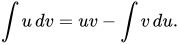
Also, this particular problem will require integration by parts:
       Failed to parse (MathML with SVG or PNG fallback (recommended for modern browsers and accessibility tools): Invalid response ("Math extension cannot connect to Restbase.") from server "https://wikimedia.org/api/rest_v1/":): {\displaystyle \int u\,dv=uv-\int v\,du.}


Solution:

Step 1:  
We can treat this as a solid of revolution, and use the shell method.
We are working on a half disk of radius 7, so we can integrate a cross-section where  Failed to parse (MathML with SVG or PNG fallback (recommended for modern browsers and accessibility tools): Invalid response ("Math extension cannot connect to Restbase.") from server "https://wikimedia.org/api/rest_v1/":): {\displaystyle x}   goes from 0 to 7
and the height at each  Failed to parse (MathML with SVG or PNG fallback (recommended for modern browsers and accessibility tools): Invalid response ("Math extension cannot connect to Restbase.") from server "https://wikimedia.org/api/rest_v1/":): {\displaystyle x}   is our density function,  Failed to parse (MathML with SVG or PNG fallback (recommended for modern browsers and accessibility tools): Invalid response ("Math extension cannot connect to Restbase.") from server "https://wikimedia.org/api/rest_v1/":): {\displaystyle \rho(x).}  
Normally  Failed to parse (MathML with SVG or PNG fallback (recommended for modern browsers and accessibility tools): Invalid response ("Math extension cannot connect to Restbase.") from server "https://wikimedia.org/api/rest_v1/":): {\displaystyle 2\pi R}   represents once around a circle of radius  Failed to parse (MathML with SVG or PNG fallback (recommended for modern browsers and accessibility tools): Invalid response ("Math extension cannot connect to Restbase.") from server "https://wikimedia.org/api/rest_v1/":): {\displaystyle R,}  
but in this case we only go half way around.
Therefore, we adjust our usual shell method formula to find the population as

        Failed to parse (MathML with SVG or PNG fallback (recommended for modern browsers and accessibility tools): Invalid response ("Math extension cannot connect to Restbase.") from server "https://wikimedia.org/api/rest_v1/":): {\displaystyle \begin{array}{rcl} \displaystyle{P} & = & \displaystyle{\int_{x_{1}}^{x_{2}}\pi R\cdot h\,dx}\\ &&\\ & = & \displaystyle{\int_{0}^{7}\pi x\cdot\rho(x)\,dx.} \end{array}}

Step 2:  
Let's plug in the actual formula for density and solve. We have

        Failed to parse (MathML with SVG or PNG fallback (recommended for modern browsers and accessibility tools): Invalid response ("Math extension cannot connect to Restbase.") from server "https://wikimedia.org/api/rest_v1/":): {\displaystyle \begin{array}{rcl} \displaystyle{P} & = & \displaystyle{\int_{0}^{7}\pi x\cdot25,000e^{-0.15x}\,dx}\\ &&\\ & = & \displaystyle{25,000\pi\int_{0}^{7}xe^{-0.15x}\,dx.} \end{array}}

To solve this, we need to use integration by parts.
Let  Failed to parse (MathML with SVG or PNG fallback (recommended for modern browsers and accessibility tools): Invalid response ("Math extension cannot connect to Restbase.") from server "https://wikimedia.org/api/rest_v1/":): {\displaystyle u=x}   and  Failed to parse (MathML with SVG or PNG fallback (recommended for modern browsers and accessibility tools): Invalid response ("Math extension cannot connect to Restbase.") from server "https://wikimedia.org/api/rest_v1/":): {\displaystyle dv=e^{-0.15x}dx.}  
Then,  Failed to parse (MathML with SVG or PNG fallback (recommended for modern browsers and accessibility tools): Invalid response ("Math extension cannot connect to Restbase.") from server "https://wikimedia.org/api/rest_v1/":): {\displaystyle du=dx}   and  Failed to parse (MathML with SVG or PNG fallback (recommended for modern browsers and accessibility tools): Invalid response ("Math extension cannot connect to Restbase.") from server "https://wikimedia.org/api/rest_v1/":): {\displaystyle v=-{\displaystyle \frac{e^{-0.15x}}{0.15}.}}  
Thus,

        Failed to parse (MathML with SVG or PNG fallback (recommended for modern browsers and accessibility tools): Invalid response ("Math extension cannot connect to Restbase.") from server "https://wikimedia.org/api/rest_v1/":): {\displaystyle \begin{array}{rcl} \displaystyle{P} & = & \displaystyle{25,000\pi\int_{0}^{7}xe^{-0.15x}\,dx}\\ &&\\ & = & \displaystyle{25,000\pi\left[\left.-\frac{xe^{-0.15x}}{0.15}\right|_{0}^{7}+\int_{0}^{7}\frac{e^{-0.15x}}{0.15}\,dx\right]}\\ &&\\ & = & \displaystyle{25,000\pi\left[-\frac{xe^{-0.15x}}{0.15}-\frac{e^{-0.15x}}{(0.15)^{2}}\right]_{0}^{7}}\\ &&\\ & = & \displaystyle{25,000\pi\left[\left(-\frac{7e^{-1.05}}{0.15}-\frac{e^{-1.05}}{(0.15)^{2}}\right)+\frac{1}{(0.15)^{2}}\right]}\\ &&\\ & \approx & 986,556. \end{array}}

Note that in a calculator-prohibited test, no one would expect the actual numerical answer.
However, you would likely need the line above it to receive full credit.


Final Answer:  
       Failed to parse (MathML with SVG or PNG fallback (recommended for modern browsers and accessibility tools): Invalid response ("Math extension cannot connect to Restbase.") from server "https://wikimedia.org/api/rest_v1/":): {\displaystyle {\displaystyle 25,000\pi\left[\left(-\frac{7e^{-1.05}}{0.15}-\frac{e^{-1.05}}{(0.15)^{2}}\right)+\frac{1}{(0.15)^{2}}\right]\ \approx\ 986,556}}

Return to Sample Exam