Given the function Failed to parse (Conversion error. Server ("https://wikimedia.org/api/rest_") reported: "Cannot get mml. Server problem."): {\displaystyle f(x)=x^{3}-6x^{2}+5}
,
(a) Find the intervals in which the function increases or decreases.
(b) Find the local maximum and local minimum values.
(c) Find the intervals in which the function concaves upward or concaves downward.
(d) Find the inflection point(s).
(e) Use the above information (a) to (d) to sketch the graph of  .
.
| Foundations:
|
| Recall:
|
1.  is increasing when Failed to parse (Conversion error. Server ("https://wikimedia.org/api/rest_") reported: "Cannot get mml. Server problem."): {\displaystyle f'(x)>0}
and is decreasing when Failed to parse (Conversion error. Server ("https://wikimedia.org/api/rest_") reported: "Cannot get mml. Server problem."): {\displaystyle f'(x)<0.} is increasing when Failed to parse (Conversion error. Server ("https://wikimedia.org/api/rest_") reported: "Cannot get mml. Server problem."): {\displaystyle f'(x)>0}
and is decreasing when Failed to parse (Conversion error. Server ("https://wikimedia.org/api/rest_") reported: "Cannot get mml. Server problem."): {\displaystyle f'(x)<0.}
|
| 2. The First Derivative Test tells us when we have a local maximum or local minimum.
|
3. is concave up when Failed to parse (Conversion error. Server ("https://wikimedia.org/api/rest_") reported: "Cannot get mml. Server problem."): {\displaystyle f''(x)>0}
and is concave down when 
|
| 4. Inflection points occur when Failed to parse (Conversion error. Server ("https://wikimedia.org/api/rest_") reported: "Cannot get mml. Server problem."): {\displaystyle f''(x)=0.}
|
Solution:
(a)
| Step 1:
|
We start by taking the derivative of 
|
We have 
|
Now, we set  So, we have So, we have
|

|
Hence, we have  and and 
|
So, these values of  break up the number line into 3 intervals: break up the number line into 3 intervals:
|
| Failed to parse (Conversion error. Server ("https://wikimedia.org/api/rest_") reported: "Cannot get mml. Server problem."): {\displaystyle (-\infty ,0),(0,4),(4,\infty ).}
|
| Step 2:
|
| To check whether the function is increasing or decreasing in these intervals, we use testpoints.
|
For 
|
For 
|
For 
|
Thus, is increasing on  and decreasing on Failed to parse (Conversion error. Server ("https://wikimedia.org/api/rest_") reported: "Cannot get mml. Server problem."): {\displaystyle (0,4).} and decreasing on Failed to parse (Conversion error. Server ("https://wikimedia.org/api/rest_") reported: "Cannot get mml. Server problem."): {\displaystyle (0,4).}
|
(b)
| Step 1:
|
| By the First Derivative Test, the local maximum occurs at and the local minimum occurs at
|
| Step 2:
|
| So, the local maximum value is Failed to parse (Conversion error. Server ("https://wikimedia.org/api/rest_") reported: "Cannot get mml. Server problem."): {\displaystyle f(0)=5}
and the local minimum value is Failed to parse (Conversion error. Server ("https://wikimedia.org/api/rest_") reported: "Cannot get mml. Server problem."): {\displaystyle f(4)=-27.}
|
(c)
| Step 1:
|
To find the intervals when the function is concave up or concave down, we need to find 
|
| We have Failed to parse (Conversion error. Server ("https://wikimedia.org/api/rest_") reported: "Cannot get mml. Server problem."): {\displaystyle f''(x)=6x-12.}
|
| We set Failed to parse (Conversion error. Server ("https://wikimedia.org/api/rest_") reported: "Cannot get mml. Server problem."): {\displaystyle f''(x)=0.}
|
| So, we have
|
 Hence, Hence, 
|
| This value breaks up the number line into two intervals:
|
| Failed to parse (Conversion error. Server ("https://wikimedia.org/api/rest_") reported: "Cannot get mml. Server problem."): {\displaystyle (-\infty ,2),(2,\infty ).}
|
| Step 2:
|
| Again, we use test points in these two intervals.
|
For  we have we have 
|
For  we have we have 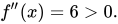
|
Thus, is concave up on the interval  and concave down on the interval and concave down on the interval 
|
| (d)
|
| Using the information from part (c), there is one inflection point that occurs at
|
| Now, we have Failed to parse (Conversion error. Server ("https://wikimedia.org/api/rest_") reported: "Cannot get mml. Server problem."): {\displaystyle f(2)=8-24+5=-11.}
|
| So, the inflection point is Failed to parse (Conversion error. Server ("https://wikimedia.org/api/rest_") reported: "Cannot get mml. Server problem."): {\displaystyle (2,-11).}
|
| Final Answer:
|
| (a) is increasing on Failed to parse (Conversion error. Server ("https://wikimedia.org/api/rest_") reported: "Cannot get mml. Server problem."): {\displaystyle (-\infty ,0),(4,\infty ),}
and decreasing on Failed to parse (MathML with SVG or PNG fallback (recommended for modern browsers and accessibility tools): Invalid response ("Math extension cannot connect to Restbase.") from server "https://wikimedia.org/api/rest_v1/":): {\displaystyle (0,4).}
|
| (b) The local maximum value is Failed to parse (MathML with SVG or PNG fallback (recommended for modern browsers and accessibility tools): Invalid response ("Math extension cannot connect to Restbase.") from server "https://wikimedia.org/api/rest_v1/":): {\displaystyle f(0)=5,}
and the local minimum value is Failed to parse (MathML with SVG or PNG fallback (recommended for modern browsers and accessibility tools): Invalid response ("Math extension cannot connect to Restbase.") from server "https://wikimedia.org/api/rest_v1/":): {\displaystyle f(4)=-27.}
|
| (c) Failed to parse (MathML with SVG or PNG fallback (recommended for modern browsers and accessibility tools): Invalid response ("Math extension cannot connect to Restbase.") from server "https://wikimedia.org/api/rest_v1/":): {\displaystyle f(x)}
is concave up on the interval Failed to parse (MathML with SVG or PNG fallback (recommended for modern browsers and accessibility tools): Invalid response ("Math extension cannot connect to Restbase.") from server "https://wikimedia.org/api/rest_v1/":): {\displaystyle (2,\infty),}
and concave down on the interval Failed to parse (MathML with SVG or PNG fallback (recommended for modern browsers and accessibility tools): Invalid response ("Math extension cannot connect to Restbase.") from server "https://wikimedia.org/api/rest_v1/":): {\displaystyle (-\infty,2).}
|
| (d) Failed to parse (MathML with SVG or PNG fallback (recommended for modern browsers and accessibility tools): Invalid response ("Math extension cannot connect to Restbase.") from server "https://wikimedia.org/api/rest_v1/":): {\displaystyle (2,-11)}
|
| (e) See graph above.
|
Return to Sample Exam
