Limit of a Function(Definition): Introduction to ε-δ Arguments
Formal Definition
We say is the limit of at if, for any , there exists a such that whenever ,




An Explanation
When most students initially confront the definition above, they are really confused. It helps to ``unravel the absolute values a bit. For example, is really the same thing as
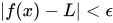

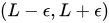
If we then add to each term, we arrive at

In other words, we are trying to restrict to the -neighborhood centered at Failed to parse (Conversion error. Server ("https://wikimedia.org/api/rest_") reported: "Cannot get mml. Server problem."): {\displaystyle {\boldsymbol {L}}} , which is the interval . Similarly, we can rewrite to become



- Failed to parse (Conversion error. Server ("https://wikimedia.org/api/rest_") reported: "Cannot get mml. Server problem."): {\displaystyle c-\delta \,<\,x\,<\,c+\delta .}
On its own, this would mean lies in the -neighborhood centered at , which is the interval . But what about the other requirement, that Failed to parse (Conversion error. Server ("https://wikimedia.org/api/rest_") reported: "Cannot get mml. Server problem."): {\displaystyle 0<|x-c|} ? This means we ignore what happens at .


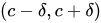
This neighborhood - the interval , minus the point - is known as a punctured neighborhood.
This definition can possibly be better understood through a short video.
< Video coming soon! >
Proof Approach
The goal in these proofs is always the same: we need to find a , which will usually be expressed in terms of an arbitrary . For example, we might have to choose a , or a Failed to parse (Conversion error. Server ("https://wikimedia.org/api/rest_") reported: "Cannot get mml. Server problem."): {\displaystyle \delta <\epsilon /3} , or even a . But in each case, we usually build our proof ``backwards in what we can refer to as scratchwork.



Scratchwork begins by assuming our desired result, that

From here, we do whatever it takes (usually factoring) to change into . Once we have a statement of the form


- Failed to parse (Conversion error. Server ("https://wikimedia.org/api/rest_") reported: "Cannot get mml. Server problem."): {\displaystyle |x-c|\,<\,{\textrm {something}},}
this allows us to pick a that will work. We then just ``reverse the chain of equalities in our scratchwork to construct the proof. It's easier to see in a few examples.
Examples with Linear Functions
Problem 1. Using the definition of a limit, show that Failed to parse (Conversion error. Server ("https://wikimedia.org/api/rest_") reported: "Cannot get mml. Server problem."): {\displaystyle {\displaystyle \lim _{x\rightarrow 1}10=10}} .
Solution. Looking at the statement we need to prove, we have and . Since for any , we have , we know that for any



- Failed to parse (Conversion error. Server ("https://wikimedia.org/api/rest_") reported: "Cannot get mml. Server problem."): {\displaystyle |f(x)-L|\,=\,|10-10|\,=\,0\,<\epsilon }
as must be strictly positive. This means any will work. To write it out, you would proceed as follows:
Proof. Let be given. Choose . Then, whenever , we have


- Failed to parse (Conversion error. Server ("https://wikimedia.org/api/rest_") reported: "Cannot get mml. Server problem."): {\displaystyle |f(x)-L|\ =\ |10-10|\ =\ 0\ <\ \epsilon .}
</math>\square</math>
A few quick notes about these.
Every one will begin with ``let be given. That's because most of the time, our will be tied to the .
We conclude the proof with a box/square, indicating we're done.
Problem 2. Using the definition of a limit, show that Failed to parse (Conversion error. Server ("https://wikimedia.org/api/rest_") reported: "Cannot get mml. Server problem."): {\displaystyle {\displaystyle \lim _{x\rightarrow 3}2x-4=2}} .
Solution. In this case, we have and . We again begin with scratchwork, and assume our goal. If we knew that , then we would work to get an expression that has . It goes like this:



- Failed to parse (Conversion error. Server ("https://wikimedia.org/api/rest_") reported: "Cannot get mml. Server problem."): {\displaystyle {\begin{array}{ccccrcl}&&&&\left|(2x-4)-2\right|&<&\epsilon \\\\\Rightarrow &&&&|2x-6|&<&\epsilon \\\\\Rightarrow &&&&|2(x-3)|&<&\epsilon \\\\\Rightarrow &&&&2|x-3|&<&\epsilon \\\\\Rightarrow &&&&|x-3|&<&{\displaystyle {\frac {\epsilon }{2}}.}\end{array}}}
This gives us our . We will choose a Failed to parse (Conversion error. Server ("https://wikimedia.org/api/rest_") reported: "Cannot get mml. Server problem."): {\displaystyle \delta <\epsilon /2} .
But that was all scratchwork, and the formal writeup looks like a bit different:
Proof. Let be given. Choose . Then, whenever , we have



as required.
</math>\square</math>
It should be mentioned that in cases where Failed to parse (Conversion error. Server ("https://wikimedia.org/api/rest_") reported: "Cannot get mml. Server problem."): {\displaystyle f(x)=mx+b} , and Failed to parse (Conversion error. Server ("https://wikimedia.org/api/rest_") reported: "Cannot get mml. Server problem."): {\displaystyle m\neq 0} , we will get that every time.

Examples with Quadratic Functions
Problem 3. Using the definition of a limit, show that .

Solution. Here, we have and . We again begin with scratchwork. Suppose . We then solve for to find


- Failed to parse (Conversion error. Server ("https://wikimedia.org/api/rest_") reported: "Cannot get mml. Server problem."): {\displaystyle {\begin{array}{ccccrcl}&&&&\left|x^{2}-1\right|&<&\epsilon \\\\\Rightarrow &&&&|(x-1)(x+1)|&<&\epsilon \\\\\Rightarrow &&&&|x+1|\cdot |x-1|&<&\epsilon \\\\\Rightarrow &&&&|x-1|&<&{\displaystyle {\frac {\epsilon }{|x+1|}}.}\end{array}}}
This certainly describes in terms of , but there's also an on the right hand side! This requires us to pick an ``initial </math>\delta</math>. Let's choose . Then, whenever , we have


- Failed to parse (Conversion error. Server ("https://wikimedia.org/api/rest_") reported: "Cannot get mml. Server problem."): {\displaystyle -\delta \,=\,-1\,<\,x-1\,<\,1\,=\,\delta ,}
in the manner explained in An Explanation'. More importantly, by adding two to the inequality we have

Dividing Failed to parse (MathML with SVG or PNG fallback (recommended for modern browsers and accessibility tools): Invalid response ("Math extension cannot connect to Restbase.") from server "https://wikimedia.org/api/rest_v1/":): {\displaystyle \epsilon} by this inequality (which reverses its direction), we have
- Failed to parse (MathML with SVG or PNG fallback (recommended for modern browsers and accessibility tools): Invalid response ("Math extension cannot connect to Restbase.") from server "https://wikimedia.org/api/rest_v1/":): {\displaystyle \frac{\epsilon}{3}\,<\,\frac{\epsilon}{x+1}\,=\,\frac{\epsilon}{|x+1|}\,<\,\frac{\epsilon}{1}\,=\,\epsilon.}
This means that for any Failed to parse (MathML with SVG or PNG fallback (recommended for modern browsers and accessibility tools): Invalid response ("Math extension cannot connect to Restbase.") from server "https://wikimedia.org/api/rest_v1/":): {\displaystyle x} satisfying Failed to parse (MathML with SVG or PNG fallback (recommended for modern browsers and accessibility tools): Invalid response ("Math extension cannot connect to Restbase.") from server "https://wikimedia.org/api/rest_v1/":): {\displaystyle |x-1|<1} , we know that Failed to parse (MathML with SVG or PNG fallback (recommended for modern browsers and accessibility tools): Invalid response ("Math extension cannot connect to Restbase.") from server "https://wikimedia.org/api/rest_v1/":): {\displaystyle \epsilon/3<\epsilon/|x+1|} . Thus, we can choose a Failed to parse (MathML with SVG or PNG fallback (recommended for modern browsers and accessibility tools): Invalid response ("Math extension cannot connect to Restbase.") from server "https://wikimedia.org/api/rest_v1/":): {\displaystyle \delta<\epsilon/3} , and the proof should work. There's a small problem, though - we already chose a Failed to parse (MathML with SVG or PNG fallback (recommended for modern browsers and accessibility tools): Invalid response ("Math extension cannot connect to Restbase.") from server "https://wikimedia.org/api/rest_v1/":): {\displaystyle \delta=1} . The way around this is to use the minimum function.
- When we write Failed to parse (MathML with SVG or PNG fallback (recommended for modern browsers and accessibility tools): Invalid response ("Math extension cannot connect to Restbase.") from server "https://wikimedia.org/api/rest_v1/":): {\displaystyle \min\{a,b\}} , it means to take whichever is the
least of both Failed to parse (MathML with SVG or PNG fallback (recommended for modern browsers and accessibility tools): Invalid response ("Math extension cannot connect to Restbase.") from server "https://wikimedia.org/api/rest_v1/":): {\displaystyle a} and Failed to parse (MathML with SVG or PNG fallback (recommended for modern browsers and accessibility tools): Invalid response ("Math extension cannot connect to Restbase.") from server "https://wikimedia.org/api/rest_v1/":): {\displaystyle b} .
Now, our proof can be written.
Proof. Let Failed to parse (MathML with SVG or PNG fallback (recommended for modern browsers and accessibility tools): Invalid response ("Math extension cannot connect to Restbase.") from server "https://wikimedia.org/api/rest_v1/":): {\displaystyle \epsilon>0} be given. Choose Failed to parse (MathML with SVG or PNG fallback (recommended for modern browsers and accessibility tools): Invalid response ("Math extension cannot connect to Restbase.") from server "https://wikimedia.org/api/rest_v1/":): {\displaystyle \delta=\min\{1,\epsilon/3\}} . Then, whenever Failed to parse (MathML with SVG or PNG fallback (recommended for modern browsers and accessibility tools): Invalid response ("Math extension cannot connect to Restbase.") from server "https://wikimedia.org/api/rest_v1/":): {\displaystyle |x-c|=|x-1|<\delta} ,
- Failed to parse (MathML with SVG or PNG fallback (recommended for modern browsers and accessibility tools): Invalid response ("Math extension cannot connect to Restbase.") from server "https://wikimedia.org/api/rest_v1/":): {\displaystyle \begin{array}{ccrcrclccccc} & & & & |x-1| & < & {\displaystyle \frac{\epsilon}{3}}\\ \\ \Rightarrow & & & & 3|x-1| & < & \epsilon\\ \\ \Rightarrow & & |x+1||x-1| & < & 3|x-1| & < & \epsilon & & & & & \textrm{(using }\dagger)\\ \\ \Rightarrow & & & & |x^{2}-1| & < & \epsilon\\ \\ \Rightarrow & & & & |f(x)-L| & < & \epsilon, \end{array}}
as required.
</math>\square</math>
Problem 4. Using the definition of a limit, show that Failed to parse (MathML with SVG or PNG fallback (recommended for modern browsers and accessibility tools): Invalid response ("Math extension cannot connect to Restbase.") from server "https://wikimedia.org/api/rest_v1/":): {\displaystyle {\displaystyle \lim_{x\rightarrow2}3x^{2}=12}} .
Solution. This time, Failed to parse (MathML with SVG or PNG fallback (recommended for modern browsers and accessibility tools): Invalid response ("Math extension cannot connect to Restbase.") from server "https://wikimedia.org/api/rest_v1/":): {\displaystyle f(x)=3x^{2},\ L=12} and Failed to parse (MathML with SVG or PNG fallback (recommended for modern browsers and accessibility tools): Invalid response ("Math extension cannot connect to Restbase.") from server "https://wikimedia.org/api/rest_v1/":): {\displaystyle c=2} . We follow the same pattern, doing the scratchwork first. Assume Failed to parse (MathML with SVG or PNG fallback (recommended for modern browsers and accessibility tools): Invalid response ("Math extension cannot connect to Restbase.") from server "https://wikimedia.org/api/rest_v1/":): {\displaystyle |f(x)-L|<\epsilon} . Then
- Failed to parse (MathML with SVG or PNG fallback (recommended for modern browsers and accessibility tools): Invalid response ("Math extension cannot connect to Restbase.") from server "https://wikimedia.org/api/rest_v1/":): {\displaystyle \begin{array}{ccccrcl} & & & & \left|3x^{2}-12\right| & < & \epsilon\\ \\ \Rightarrow & & & & 3|x^{2}-4| & < & \epsilon\\ \\ \Rightarrow & & & & 3|(x+2|\cdot|x-2)| & < & \epsilon\\ \\ \Rightarrow & & & & |x-2| & < & {\displaystyle \frac{\epsilon}{3|x+2|}.} \end{array}}
Based on the previous problem, let's choose an initial Failed to parse (MathML with SVG or PNG fallback (recommended for modern browsers and accessibility tools): Invalid response ("Math extension cannot connect to Restbase.") from server "https://wikimedia.org/api/rest_v1/":): {\displaystyle \delta=1} . Then we have
- Failed to parse (MathML with SVG or PNG fallback (recommended for modern browsers and accessibility tools): Invalid response ("Math extension cannot connect to Restbase.") from server "https://wikimedia.org/api/rest_v1/":): {\displaystyle -\delta\,=\,-1\,<\, x-2\,<\,1\,=\,\delta.}
Now adding 4 to the inequality, we have
- Failed to parse (MathML with SVG or PNG fallback (recommended for modern browsers and accessibility tools): Invalid response ("Math extension cannot connect to Restbase.") from server "https://wikimedia.org/api/rest_v1/":): {\displaystyle 3\,<\, x+2\,<\,5.\qquad\qquad\qquad(\dagger\dagger)}
Dividing Failed to parse (MathML with SVG or PNG fallback (recommended for modern browsers and accessibility tools): Invalid response ("Math extension cannot connect to Restbase.") from server "https://wikimedia.org/api/rest_v1/":): {\displaystyle \epsilon} by this inequality, we have
- Failed to parse (MathML with SVG or PNG fallback (recommended for modern browsers and accessibility tools): Invalid response ("Math extension cannot connect to Restbase.") from server "https://wikimedia.org/api/rest_v1/":): {\displaystyle \frac{\epsilon}{5}\,<\,\frac{\epsilon}{|x+2|}\,<\,\frac{\epsilon}{3}.}
So we can choose Failed to parse (MathML with SVG or PNG fallback (recommended for modern browsers and accessibility tools): Invalid response ("Math extension cannot connect to Restbase.") from server "https://wikimedia.org/api/rest_v1/":): {\displaystyle \delta=\min\left\{ 1,\frac{1}{3}\cdot\frac{\epsilon}{3}\right\} =\min\left\{ 1,\frac{\epsilon}{9}\right\}.} Then the proof works.
Proof. Let Failed to parse (MathML with SVG or PNG fallback (recommended for modern browsers and accessibility tools): Invalid response ("Math extension cannot connect to Restbase.") from server "https://wikimedia.org/api/rest_v1/":): {\displaystyle \epsilon>0} be given. Choose Failed to parse (MathML with SVG or PNG fallback (recommended for modern browsers and accessibility tools): Invalid response ("Math extension cannot connect to Restbase.") from server "https://wikimedia.org/api/rest_v1/":): {\displaystyle \delta=\min\left\{ 1,\frac{\epsilon}{9}\right\}} . Then, whenever Failed to parse (MathML with SVG or PNG fallback (recommended for modern browsers and accessibility tools): Invalid response ("Math extension cannot connect to Restbase.") from server "https://wikimedia.org/api/rest_v1/":): {\displaystyle |x-c|=|x-2|<\delta} ,
- Failed to parse (MathML with SVG or PNG fallback (recommended for modern browsers and accessibility tools): Invalid response ("Math extension cannot connect to Restbase.") from server "https://wikimedia.org/api/rest_v1/":): {\displaystyle \begin{array}{ccrcrclccccc} & & & & |x-2| & < & {\displaystyle \frac{\epsilon}{9}}\\ \\ \Rightarrow & & & & 9|x-2| & < & \epsilon\\ \\ \Rightarrow & & 3|x+2||x-2| & < & 9|x-2| & < & \epsilon & & & & & \textrm{(using }\dagger\dagger)\\ \\ \Rightarrow & & & & |3x^{2}-12| & < & \epsilon\\ \\ \Rightarrow & & & & |f(x)-L| & < & \epsilon, \end{array}}
as required.
</math>\square</math>
Problem 5.Using the definition of a limit, show that Failed to parse (MathML with SVG or PNG fallback (recommended for modern browsers and accessibility tools): Invalid response ("Math extension cannot connect to Restbase.") from server "https://wikimedia.org/api/rest_v1/":): {\displaystyle {\displaystyle \lim_{x\rightarrow2}x^{2}+3x+1=11}} .
Solution. Here, we have Failed to parse (MathML with SVG or PNG fallback (recommended for modern browsers and accessibility tools): Invalid response ("Math extension cannot connect to Restbase.") from server "https://wikimedia.org/api/rest_v1/":): {\displaystyle f(x)=x^{2}+3x+1,\ L=11} and Failed to parse (MathML with SVG or PNG fallback (recommended for modern browsers and accessibility tools): Invalid response ("Math extension cannot connect to Restbase.") from server "https://wikimedia.org/api/rest_v1/":): {\displaystyle c=2} . We again begin with scratchwork, assuming Failed to parse (MathML with SVG or PNG fallback (recommended for modern browsers and accessibility tools): Invalid response ("Math extension cannot connect to Restbase.") from server "https://wikimedia.org/api/rest_v1/":): {\displaystyle |f(x)-L|<\epsilon} . Then
- Failed to parse (MathML with SVG or PNG fallback (recommended for modern browsers and accessibility tools): Invalid response ("Math extension cannot connect to Restbase.") from server "https://wikimedia.org/api/rest_v1/":): {\displaystyle \begin{array}{ccccrcl} & & & & \left|x^{2}+3x+1-11\right| & < & \epsilon\\ \\ \Rightarrow & & & & |x^{2}+3x-10| & < & \epsilon\\ \\ \Rightarrow & & & & |(x+5)(x-2)| & < & \epsilon\\ \\ \Rightarrow & & & & |(x+5|\cdot|x-2)| & < & \epsilon\\ \\ \Rightarrow & & & & |x-2| & < & {\displaystyle \frac{\epsilon}{|x+5|}.} \end{array}}
Now, we again assume Failed to parse (MathML with SVG or PNG fallback (recommended for modern browsers and accessibility tools): Invalid response ("Math extension cannot connect to Restbase.") from server "https://wikimedia.org/api/rest_v1/":): {\displaystyle \delta=1} , so
- Failed to parse (MathML with SVG or PNG fallback (recommended for modern browsers and accessibility tools): Invalid response ("Math extension cannot connect to Restbase.") from server "https://wikimedia.org/api/rest_v1/":): {\displaystyle -\delta\,=\,-1\,<\, x-2\,<\,1\,=\,\delta,\qquad\qquad\qquad(\natural)}
and adding 7 to the inequality,
- Failed to parse (MathML with SVG or PNG fallback (recommended for modern browsers and accessibility tools): Invalid response ("Math extension cannot connect to Restbase.") from server "https://wikimedia.org/api/rest_v1/":): {\displaystyle -\delta\,=\,6\,<\, x+5\,<\,1\,=\,7.}
Again, dividing Failed to parse (MathML with SVG or PNG fallback (recommended for modern browsers and accessibility tools): Invalid response ("Math extension cannot connect to Restbase.") from server "https://wikimedia.org/api/rest_v1/":): {\displaystyle \epsilon} by we have
- Failed to parse (MathML with SVG or PNG fallback (recommended for modern browsers and accessibility tools): Invalid response ("Math extension cannot connect to Restbase.") from server "https://wikimedia.org/api/rest_v1/":): {\displaystyle \frac{\epsilon}{7}\,<\,\frac{\epsilon}{|x+5|}\,<\,\frac{\epsilon}{5}}
for all Failed to parse (MathML with SVG or PNG fallback (recommended for modern browsers and accessibility tools): Invalid response ("Math extension cannot connect to Restbase.") from server "https://wikimedia.org/api/rest_v1/":): {\displaystyle x} satisfying Failed to parse (MathML with SVG or PNG fallback (recommended for modern browsers and accessibility tools): Invalid response ("Math extension cannot connect to Restbase.") from server "https://wikimedia.org/api/rest_v1/":): {\displaystyle |x-2|<1.} We can now write the proof.
Proof. Let Failed to parse (MathML with SVG or PNG fallback (recommended for modern browsers and accessibility tools): Invalid response ("Math extension cannot connect to Restbase.") from server "https://wikimedia.org/api/rest_v1/":): {\displaystyle \epsilon>0} be given. Choose Failed to parse (MathML with SVG or PNG fallback (recommended for modern browsers and accessibility tools): Invalid response ("Math extension cannot connect to Restbase.") from server "https://wikimedia.org/api/rest_v1/":): {\displaystyle \delta=\min\left\{ 1,\frac{\epsilon}{7}\right\}} . Then, whenever Failed to parse (MathML with SVG or PNG fallback (recommended for modern browsers and accessibility tools): Invalid response ("Math extension cannot connect to Restbase.") from server "https://wikimedia.org/api/rest_v1/":): {\displaystyle |x-c|=|x-2|<\delta,}
- Failed to parse (MathML with SVG or PNG fallback (recommended for modern browsers and accessibility tools): Invalid response ("Math extension cannot connect to Restbase.") from server "https://wikimedia.org/api/rest_v1/":): {\displaystyle \begin{array}{ccrcrclccccl} & & & & |x-2| & < & {\displaystyle \frac{\epsilon}{7}}\\ \\ \Rightarrow & & & & 7|x-2| & < & \epsilon\\ \\ \Rightarrow & & |x+5||x-2| & < & 7|x-2| & < & \epsilon & & & & & \textrm{(using }\natural)\\ \\ \Rightarrow & & & & |x^{2}+3x-10| & < & \epsilon\\ \\ \Rightarrow & & & & |x^{2}+3x+1-11 & < & \epsilon\\ \\ \Rightarrow & & & & |f(x)-L| & < & \epsilon, \end{array}}
as required.
</math>\square</math>
Other Examples
Problem 6. Using the definition of a limit, show that Failed to parse (MathML with SVG or PNG fallback (recommended for modern browsers and accessibility tools): Invalid response ("Math extension cannot connect to Restbase.") from server "https://wikimedia.org/api/rest_v1/":): {\displaystyle {\displaystyle \lim_{x\rightarrow1}\sqrt{x}=1}} .
Solution. We have Failed to parse (MathML with SVG or PNG fallback (recommended for modern browsers and accessibility tools): Invalid response ("Math extension cannot connect to Restbase.") from server "https://wikimedia.org/api/rest_v1/":): {\displaystyle f(x)=\sqrt{x},\ L=1} and Failed to parse (MathML with SVG or PNG fallback (recommended for modern browsers and accessibility tools): Invalid response ("Math extension cannot connect to Restbase.") from server "https://wikimedia.org/api/rest_v1/":): {\displaystyle c=1} . We start our scratchwork as usual, assuming Failed to parse (MathML with SVG or PNG fallback (recommended for modern browsers and accessibility tools): Invalid response ("Math extension cannot connect to Restbase.") from server "https://wikimedia.org/api/rest_v1/":): {\displaystyle |f(x)-L|<\epsilon} . Then we have
- Failed to parse (MathML with SVG or PNG fallback (recommended for modern browsers and accessibility tools): Invalid response ("Math extension cannot connect to Restbase.") from server "https://wikimedia.org/api/rest_v1/":): {\displaystyle \begin{array}{cccrcl} & & & |\sqrt{x}-1| & < & {\displaystyle \epsilon}\\ \\ \Rightarrow & & & |\sqrt{x}+1|\cdot|\sqrt{x}-1 & < & |\sqrt{x}+1|\cdot\epsilon\\ \\ \Rightarrow & & & |x-1| & < & |\sqrt{x}+1|\cdot\epsilon. \end{array}}
Similar to the quadratic examples, we can set an initial Failed to parse (MathML with SVG or PNG fallback (recommended for modern browsers and accessibility tools): Invalid response ("Math extension cannot connect to Restbase.") from server "https://wikimedia.org/api/rest_v1/":): {\displaystyle \delta=1.} Then
- Failed to parse (MathML with SVG or PNG fallback (recommended for modern browsers and accessibility tools): Invalid response ("Math extension cannot connect to Restbase.") from server "https://wikimedia.org/api/rest_v1/":): {\displaystyle -\delta\,=\,-1\,<\, x-1\,<\,1\,=\,\delta,}
and adding one to each term we find
- Failed to parse (MathML with SVG or PNG fallback (recommended for modern browsers and accessibility tools): Invalid response ("Math extension cannot connect to Restbase.") from server "https://wikimedia.org/api/rest_v1/":): {\displaystyle 0\,<\, x\,<\,2.}
This, in turn, means that
- Failed to parse (MathML with SVG or PNG fallback (recommended for modern browsers and accessibility tools): Invalid response ("Math extension cannot connect to Restbase.") from server "https://wikimedia.org/api/rest_v1/":): {\displaystyle 1\,<\,\sqrt{x}+1\,<\,\sqrt{2}+1.}
Multiplying the inequality by Failed to parse (MathML with SVG or PNG fallback (recommended for modern browsers and accessibility tools): Invalid response ("Math extension cannot connect to Restbase.") from server "https://wikimedia.org/api/rest_v1/":): {\displaystyle \epsilon} , we have
- Failed to parse (MathML with SVG or PNG fallback (recommended for modern browsers and accessibility tools): Invalid response ("Math extension cannot connect to Restbase.") from server "https://wikimedia.org/api/rest_v1/":): {\displaystyle \epsilon\,<\,|\sqrt{x}+1|\,<\,\left(\sqrt{2}+1\right)\epsilon\qquad\mbox{while}\qquad\frac{\epsilon}{\sqrt{2}+1}\,<\,\frac{\epsilon}{|\sqrt{x}+1|}\,<\,\frac{\epsilon}{1}.}
for all Failed to parse (MathML with SVG or PNG fallback (recommended for modern browsers and accessibility tools): Invalid response ("Math extension cannot connect to Restbase.") from server "https://wikimedia.org/api/rest_v1/":): {\displaystyle x} satisfying Failed to parse (MathML with SVG or PNG fallback (recommended for modern browsers and accessibility tools): Invalid response ("Math extension cannot connect to Restbase.") from server "https://wikimedia.org/api/rest_v1/":): {\displaystyle |x-1|<1=\delta} . This gives us our Failed to parse (MathML with SVG or PNG fallback (recommended for modern browsers and accessibility tools): Invalid response ("Math extension cannot connect to Restbase.") from server "https://wikimedia.org/api/rest_v1/":): {\displaystyle \delta} , and we can write the proof.
Proof. Let Failed to parse (MathML with SVG or PNG fallback (recommended for modern browsers and accessibility tools): Invalid response ("Math extension cannot connect to Restbase.") from server "https://wikimedia.org/api/rest_v1/":): {\displaystyle \epsilon>0} be given. Choose Failed to parse (MathML with SVG or PNG fallback (recommended for modern browsers and accessibility tools): Invalid response ("Math extension cannot connect to Restbase.") from server "https://wikimedia.org/api/rest_v1/":): {\displaystyle \delta=\min\left\{ 1,\epsilon\right\}} . Then, whenever Failed to parse (MathML with SVG or PNG fallback (recommended for modern browsers and accessibility tools): Invalid response ("Math extension cannot connect to Restbase.") from server "https://wikimedia.org/api/rest_v1/":): {\displaystyle |x-c|=|x-1|<\delta} ,
- Failed to parse (MathML with SVG or PNG fallback (recommended for modern browsers and accessibility tools): Invalid response ("Math extension cannot connect to Restbase.") from server "https://wikimedia.org/api/rest_v1/":): {\displaystyle \begin{array}{cccrclcc} & & & |x-1| & < & {\displaystyle \epsilon}\\ \\ \Rightarrow & & & |(\sqrt{x}+1)(\sqrt{x}-1)| & < & \epsilon\\ \\ \Rightarrow & & & \left|\sqrt{x}+1\right|\cdot\left|\sqrt{x}-1\right| & < & \epsilon\\ \\ \Rightarrow & & & \left|\sqrt{x}-1\right| & < & \frac{\epsilon}{\left|\sqrt{x}+1\right|} & < & \epsilon, \end{array}}
as required. Notice that we used both of the inequalities involving </math>\epsilon</math> and Failed to parse (MathML with SVG or PNG fallback (recommended for modern browsers and accessibility tools): Invalid response ("Math extension cannot connect to Restbase.") from server "https://wikimedia.org/api/rest_v1/":): {\displaystyle \left|\sqrt{x}+1\right|} to complete the proof.
</math>\square</math>
There are many more difficult examples, but these are meant as an introduction. \end{document}