022 Sample Final A, Problem 1
Jump to navigation
Jump to search
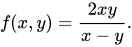
Find all first and second partial derivatives of the following function, and demostrate that the mixed second partials are equal for the function
| Foundations: |
|---|
| 1)Which derivative rules do you have to use for this problem? |
| 2)What is the partial derivative of xy, with respect to x? |
| 1)You have to use the quotient rule, and product rule. The quotient rule says that Failed to parse (MathML with SVG or PNG fallback (recommended for modern browsers and accessibility tools): Invalid response ("Math extension cannot connect to Restbase.") from server "https://wikimedia.org/api/rest_v1/":): {\displaystyle \frac{\partial}{\partial x} \left(\frac{f(x)}{g(x)}\right) = \frac{f'(x)g(x) - g'(x)f(x)}{g(x)^2}} , so Failed to parse (MathML with SVG or PNG fallback (recommended for modern browsers and accessibility tools): Invalid response ("Math extension cannot connect to Restbase.") from server "https://wikimedia.org/api/rest_v1/":): {\displaystyle \frac{\partial}{\partial x} \left(\frac{x^2}{x + 1}\right) = \frac{2x(x + 1) - x^2}{(x + 1)^2}} . The product rule says Failed to parse (MathML with SVG or PNG fallback (recommended for modern browsers and accessibility tools): Invalid response ("Math extension cannot connect to Restbase.") from server "https://wikimedia.org/api/rest_v1/":): {\displaystyle \frac{\partial}{\partial x} f(x)g(x) = f'(x)g(x) + g'(x)f(x) } . This means Failed to parse (MathML with SVG or PNG fallback (recommended for modern browsers and accessibility tools): Invalid response ("Math extension cannot connect to Restbase.") from server "https://wikimedia.org/api/rest_v1/":): {\displaystyle \frac{\partial}{\partial x} x(x + 1) = (x + 1) + x } |
| 2) The partial derivative is y, since we treat anything not involving x as a constant and take the derivative with respect to x. So Failed to parse (MathML with SVG or PNG fallback (recommended for modern browsers and accessibility tools): Invalid response ("Math extension cannot connect to Restbase.") from server "https://wikimedia.org/api/rest_v1/":): {\displaystyle \frac{\partial}{\partial y} xy = x\frac{\partial}{\partial y} y = x.} |
Solution:
| Foundations: |
|---|
| The word 'marginal' should make you immediately think of a derivative. In this case, the marginal is just the partial derivative with respect to a particular variable. |
| The teacher has also added the additional restriction that you should not leave your answer with negative exponents. |