Question Graph the following,

| Foundations:
|
| 1) What type of function is this?
|
| 2) What can you say about the orientation of the graph?
|
| Answer:
|
1) Since both x and y are squared it must be a hyperbola or an ellipse. We can conclude that the graph is a hyperbola since  and Failed to parse (MathML with SVG or PNG fallback (recommended for modern browsers and accessibility tools): Invalid response ("Math extension cannot connect to Restbase.") from server "https://wikimedia.org/api/rest_v1/":): {\displaystyle y^2}
have the different signs, one negative and one positive. and Failed to parse (MathML with SVG or PNG fallback (recommended for modern browsers and accessibility tools): Invalid response ("Math extension cannot connect to Restbase.") from server "https://wikimedia.org/api/rest_v1/":): {\displaystyle y^2}
have the different signs, one negative and one positive.
|
| 2) Since the Failed to parse (MathML with SVG or PNG fallback (recommended for modern browsers and accessibility tools): Invalid response ("Math extension cannot connect to Restbase.") from server "https://wikimedia.org/api/rest_v1/":): {\displaystyle y^2}
is positive, the hyperbola opens up and down.
|
Solution:
| Step 1:
|
| We start by completing the square twice, once for x and once for y. After completing the squares we end up with Failed to parse (MathML with SVG or PNG fallback (recommended for modern browsers and accessibility tools): Invalid response ("Math extension cannot connect to Restbase.") from server "https://wikimedia.org/api/rest_v1/":): {\displaystyle -(x + 1)^2 +4(y - 2)^2 = 4}
|
| Common Mistake: When completing the square we will end up adding numbers inside of parenthesis. So make sure you add the correct value to this other side. In this case we add -1, and 16 for completing the square with respect to x and y, respectively.
|
| Step 2:
|
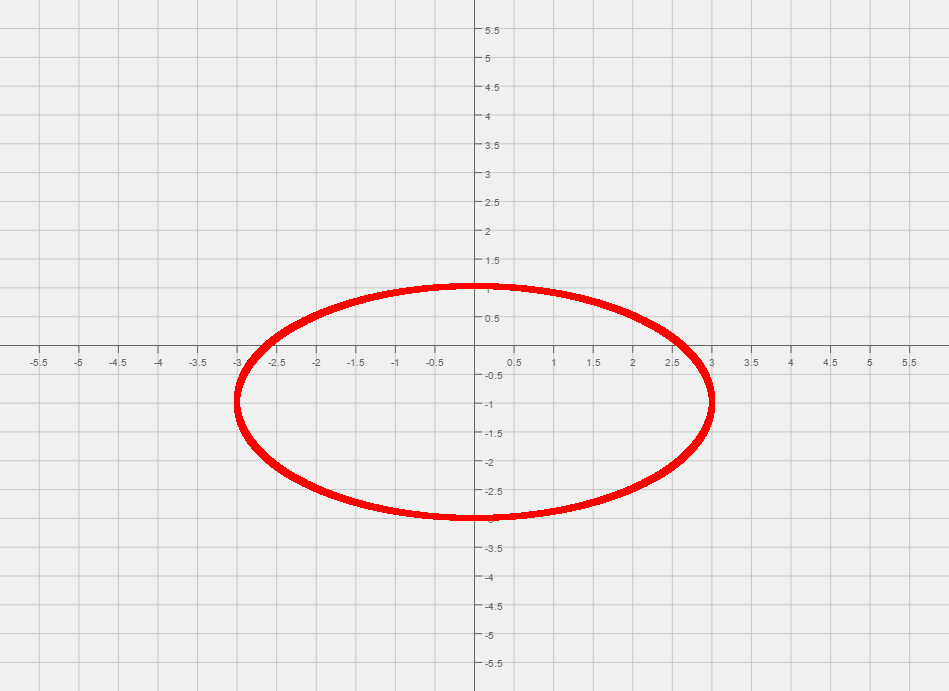
| Now that we have the equation that looks like an ellipse, we can read off the center of the ellipse, (0, -1).
|
| From the center mark the two points that are 3 units left, and three units right of the center.
|
| Then mark the two points that are 2 units up, and two units down from the center.
|
| Final Answer:
|
| The four vertices are: Failed to parse (MathML with SVG or PNG fallback (recommended for modern browsers and accessibility tools): Invalid response ("Math extension cannot connect to Restbase.") from server "https://wikimedia.org/api/rest_v1/":): {\displaystyle (-3, -1), (3, -1), (0, 1) \text{ and } (0, -3)}
|
|
Return to Sample Exam
