a) Find the vertex, standard graphing form, and x-intercepts for 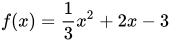
b) Sketch the graph. Provide the y-intercept.
| Foundations
|
| 1) What is the standard graphing form of a parabola?
|
| 2) What is the vertex of a parabola?
|
3) What is the  -intercept? -intercept?
|
| Answer:
|
1) Standard graphing form is  . .
|
| 2) Using the standard graphing form, the vertex is Failed to parse (Conversion error. Server ("https://wikimedia.org/api/rest_") reported: "Cannot get mml. Server problem."): {\displaystyle (h,k)}
.
|
3) The -intercept is the point  where Failed to parse (Conversion error. Server ("https://wikimedia.org/api/rest_") reported: "Cannot get mml. Server problem."): {\displaystyle f(0)=y}
. where Failed to parse (Conversion error. Server ("https://wikimedia.org/api/rest_") reported: "Cannot get mml. Server problem."): {\displaystyle f(0)=y}
.
|
Solution:
| Step 1:
|
| First, we put the equation into standard graphing form. Multiplying the equation Failed to parse (Conversion error. Server ("https://wikimedia.org/api/rest_") reported: "Cannot get mml. Server problem."): {\displaystyle y={\frac {1}{3}}x^{2}+2x-3}
by 3, we get
|
| Failed to parse (Conversion error. Server ("https://wikimedia.org/api/rest_") reported: "Cannot get mml. Server problem."): {\displaystyle 3y=x^{2}+6x-9}
.
|
| Step 2:
|
| Completing the square, we get Failed to parse (Conversion error. Server ("https://wikimedia.org/api/rest_") reported: "Cannot get mml. Server problem."): {\displaystyle 3y=(x+3)^{2}-18}
. Dividing by 3 and subtracting 6 on both sides, we have
|
| Failed to parse (Conversion error. Server ("https://wikimedia.org/api/rest_") reported: "Cannot get mml. Server problem."): {\displaystyle y+6={\frac {1}{3}}(x+3)^{2}}
.
|
| Step 3:
|
From standard graphing form, we see that the vertex is (-3,-6). Also, to find the  intercept, we let intercept, we let  . So, . So,
|
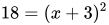 . Solving, we get Failed to parse (Conversion error. Server ("https://wikimedia.org/api/rest_") reported: "Cannot get mml. Server problem."): {\displaystyle x=-3\pm 3{\sqrt {2}}}
. . Solving, we get Failed to parse (Conversion error. Server ("https://wikimedia.org/api/rest_") reported: "Cannot get mml. Server problem."): {\displaystyle x=-3\pm 3{\sqrt {2}}}
.
|
| Thus, the two intercepts occur at Failed to parse (Conversion error. Server ("https://wikimedia.org/api/rest_") reported: "Cannot get mml. Server problem."): {\displaystyle (-3+3{\sqrt {2}},0)}
and Failed to parse (Conversion error. Server ("https://wikimedia.org/api/rest_") reported: "Cannot get mml. Server problem."): {\displaystyle (-3-3{\sqrt {2}},0)}
.
|
|
|
| Step 4:
|
To find the intercept, we let  . So, we get Failed to parse (Conversion error. Server ("https://wikimedia.org/api/rest_") reported: "Cannot get mml. Server problem."): {\displaystyle y=-3}
. . So, we get Failed to parse (Conversion error. Server ("https://wikimedia.org/api/rest_") reported: "Cannot get mml. Server problem."): {\displaystyle y=-3}
.
|
| Thus, the intercept is (0,-3).
|
|
|
| Final Answer:
|
| The vertex is (-3,-6). The equation in standard graphing form is Failed to parse (Conversion error. Server ("https://wikimedia.org/api/rest_") reported: "Cannot get mml. Server problem."): {\displaystyle y+6={\frac {1}{3}}(x+3)^{2}}
.
|
| The two intercepts are Failed to parse (Conversion error. Server ("https://wikimedia.org/api/rest_") reported: "Cannot get mml. Server problem."): {\displaystyle (-3+3{\sqrt {2}},0)}
and Failed to parse (Conversion error. Server ("https://wikimedia.org/api/rest_") reported: "Cannot get mml. Server problem."): {\displaystyle (-3-3{\sqrt {2}},0)}
.
|
| The intercept is (0,-3)
|
Return to Sample Exam