Find all relative extrema and points of inflection for the function 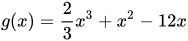 . Be sure to give coordinate pairs for each point. You do not need to draw the graph.
| Foundations:
|
| Since our function is a polynomial, the relative extrema occur when the first derivative is zero. We then have two choices for finding if it is a local maximum or minimum:
|
Second Derivative Test: If the first derivative at a point  is is  , and the second derivative is negative (indicating it is concave-down, like an upside-down parabola), then the point , and the second derivative is negative (indicating it is concave-down, like an upside-down parabola), then the point  is a local maximum. is a local maximum.
|
| On the other hand, if the second derivative is positive, the point is a local minimum. You can also use the first derivative test, but it is usually a bit more work! For inflection points, we need to find when the second derivative is zero, as well as check that the second derivative "splits" on both sides.
|
Solution:
| Step 1:
|
| Find the first and second derivatives: Based on our function, we have
|

|
| Similarly, from the first derivative we find
|

|
| Step 2:
|
| Find the roots of the derivatives: We can rewrite the first derivative as
|

|
from which it should be clear we have roots  and and  . .
|
| On the other hand, for the second derivative, we have
|

|
This has a single root:  . .
|
| Step 3:
|
Test the potential extrema: We know that  are the candidates. We check the second derivative, finding are the candidates. We check the second derivative, finding
|

|
| while
|

|
| Note that
|

|
| while
|

|
By the second derivative test, the point 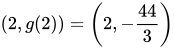 is a relative maximum, while the point is a relative maximum, while the point  is a relative maximum. is a relative maximum.
|
| Step 4:
|
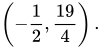
Test the potential inflection point: We know that 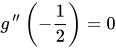 . On the other hand, it should be clear that if . On the other hand, it should be clear that if  , then , then  . Similarly, if . Similarly, if  , then , then  . Thus, the second derivative "splits" around (i.e., changes sign), so the point . Thus, the second derivative "splits" around (i.e., changes sign), so the point 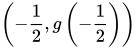 is an inflection point. is an inflection point.
|
| Since
|

|
| our inflection point is
|
|
| Final Answer:
|
| The area is maximized when both the length and width are 12 meters.
|
Return to Sample Exam