Find the radius of convergence and the interval of convergence
of the series.
- (a) (6 points)

- (b) (6 points)

When we do, the interval will be
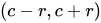
. However, the boundary values for

,

and

must be tested individually for convergence. Many times, one boundary value will produce an alternating, convergent series while the other will produce a divergent, non-alternating series. As a result, intervals of convergence may not be strictly open.
| Foundations:
|
| When we are asked to find the radius of convergence, we are given a series where
|

|
where  and and  are functions of and are functions of and  respectively, and respectively, and  is a constant (frequently zero). We need to find a bound (radius) on is a constant (frequently zero). We need to find a bound (radius) on  such that whenever such that whenever  , the ratio test , the ratio test
|

|
Solution:
Return to Sample Exam