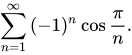
009C Sample Midterm 3, Problem 4

From Math Wiki
Revision as of 14:21, 26 April 2015 by MathAdmin (talk | contribs)
Jump to navigation Jump to search

Test the series for convergence or divergence.

(a) (6 points)     
(b) (6 points)     
Foundations:  
For Failed to parse (Conversion error. Server ("https://wikimedia.org/api/rest_") reported: "Cannot get mml. Server problem."): {\displaystyle n\geq 2} , both sine and cosine of Failed to parse (Conversion error. Server ("https://wikimedia.org/api/rest_") reported: "Cannot get mml. Server problem."): {\displaystyle {\frac {\pi }{n}}} are strictly nonnegative. Thus, these series are alternating, and we can apply the
Alternating Series Test: If a series Failed to parse (MathML with SVG or PNG fallback (recommended for modern browsers and accessibility tools): Invalid response ("Math extension cannot connect to Restbase.") from server "https://wikimedia.org/api/rest_v1/":): {\displaystyle \sum_{k=1}^{\infty} a_{k}} is
  • Alternating in sign, and
  • Failed to parse (MathML with SVG or PNG fallback (recommended for modern browsers and accessibility tools): Invalid response ("Math extension cannot connect to Restbase.") from server "https://wikimedia.org/api/rest_v1/":): {\displaystyle \lim_{k\rightarrow 0}|a_{k}|=0,}
then the series is convergent.
Note that if the series does not converge to zero, we must claim it diverges by the

Divergence Test: If Failed to parse (MathML with SVG or PNG fallback (recommended for modern browsers and accessibility tools): Invalid response ("Math extension cannot connect to Restbase.") from server "https://wikimedia.org/api/rest_v1/":): {\displaystyle {\displaystyle \lim_{k\rightarrow\infty}a_{k}\neq0,}} then the series/sum Failed to parse (MathML with SVG or PNG fallback (recommended for modern browsers and accessibility tools): Invalid response ("Math extension cannot connect to Restbase.") from server "https://wikimedia.org/api/rest_v1/":): {\displaystyle \sum_{k=0}^{\infty}a_{k}} diverges.

In the case of an alternating series, such as the two listed for this problem, we can choose to show it does not converge to zero absolutely.

 Solution:

(a):  
Here, we have
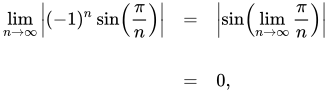
Failed to parse (MathML with SVG or PNG fallback (recommended for modern browsers and accessibility tools): Invalid response ("Math extension cannot connect to Restbase.") from server "https://wikimedia.org/api/rest_v1/":): {\displaystyle \begin{array}{rcl} {\displaystyle \lim_{n\rightarrow\infty}\left|(-1)^{n}\sin\left(\frac{\pi}{n}\right)\right|} & = & \left|\sin\left({\displaystyle \lim_{n\rightarrow\infty}\frac{\pi}{n}}\right)\right|\\ \\ & = & 0, \end{array} }

as we can pass the limit through absolute value and sine because both are continuous functions. Since the series alternates for Failed to parse (MathML with SVG or PNG fallback (recommended for modern browsers and accessibility tools): Invalid response ("Math extension cannot connect to Restbase.") from server "https://wikimedia.org/api/rest_v1/":): {\displaystyle n\geq 2} , the series is convergent by the alternating series test.
(b):  
In this case, we find
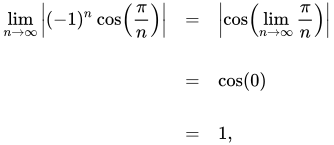
Failed to parse (MathML with SVG or PNG fallback (recommended for modern browsers and accessibility tools): Invalid response ("Math extension cannot connect to Restbase.") from server "https://wikimedia.org/api/rest_v1/":): {\displaystyle \begin{array}{rcl} {\displaystyle \lim_{n\rightarrow\infty}\left|(-1)^{n}\cos\left(\frac{\pi}{n}\right)\right|} & = & \left|\cos\left({\displaystyle \lim_{n\rightarrow\infty}\frac{\pi}{n}}\right)\right|\\ \\ & = & \cos(0)\\ \\ & = & 1, \end{array}}
where we can again pass the limit through absolute value and cosine because both are continuous. Since the terms do not converge to zero absolutely, they do not converge to zero. Thus, by the divergence test, the series is divergent.
Final Answer:  
The series for (a) is convergent, while the series (b) is divergent.

Return to Sample Exam