8. (a) Find the linear approximation  to the function
  at the point
  .
.
(b) Use to estimate the value of  .
.
| Foundations:
|
Recall that the linear approximation is the equation of the tangent line to a function at a given point. If we are given the point  , then we will have the approximation , then we will have the approximation  . Note that such an approximation is usually only good "fairly close" to your original point . . Note that such an approximation is usually only good "fairly close" to your original point .
|
Solution:
| Part (a):
|
Note that  . Since . Since  and and  , we have , we have
|

|
Similarly,  Together, this means that Together, this means that
|
|
|

|
| Part (b):
|
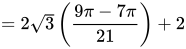
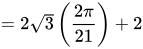
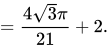
| This is simply an exercise in plugging in values. We have
|

|
|
|
|
Return to Sample Exam