Math 22 The Derivative and the Slope of a Graph
Slope of a Graph
We can estimate the slope at the given point to be
Slope =
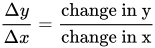
Difference Quotient
The slope of the graph of Failed to parse (MathML with SVG or PNG fallback (recommended for modern browsers and accessibility tools): Invalid response ("Math extension cannot connect to Restbase.") from server "https://wikimedia.org/api/rest_v1/":): {\displaystyle f}
at the point Failed to parse (MathML with SVG or PNG fallback (recommended for modern browsers and accessibility tools): Invalid response ("Math extension cannot connect to Restbase.") from server "https://wikimedia.org/api/rest_v1/":): {\displaystyle (x,f(x))}
can be
written as :
Failed to parse (MathML with SVG or PNG fallback (recommended for modern browsers and accessibility tools): Invalid response ("Math extension cannot connect to Restbase.") from server "https://wikimedia.org/api/rest_v1/":): {\displaystyle m=\lim_{h\to 0}\frac {f(x+h)-f(x)}{h}}
The right side of this equation Failed to parse (MathML with SVG or PNG fallback (recommended for modern browsers and accessibility tools): Invalid response ("Math extension cannot connect to Restbase.") from server "https://wikimedia.org/api/rest_v1/":): {\displaystyle \frac {f(x+h)-f(x)}{h}}
is called Difference Quotient

Example: Find the Different Quotient of
1) Failed to parse (MathML with SVG or PNG fallback (recommended for modern browsers and accessibility tools): Invalid response ("Math extension cannot connect to Restbase.") from server "https://wikimedia.org/api/rest_v1/":): {\displaystyle f(x)=x^2-1}
Solution: Consider Failed to parse (MathML with SVG or PNG fallback (recommended for modern browsers and accessibility tools): Invalid response ("Math extension cannot connect to Restbase.") from server "https://wikimedia.org/api/rest_v1/":): {\displaystyle \frac {f(x+h)-f(x)}{h}=\frac{(x+h)^2-1-(x^2-1)}{h}}
Failed to parse (MathML with SVG or PNG fallback (recommended for modern browsers and accessibility tools): Invalid response ("Math extension cannot connect to Restbase.") from server "https://wikimedia.org/api/rest_v1/":): {\displaystyle =\frac{x^2+2xh+h^2-1-x^2+1}{h}=\frac{2xh+h^2}{h}=\frac{h(2x+h)}{h}=2xh}
2) Failed to parse (MathML with SVG or PNG fallback (recommended for modern browsers and accessibility tools): Invalid response ("Math extension cannot connect to Restbase.") from server "https://wikimedia.org/api/rest_v1/":): {\displaystyle f(x)=4x-1}
| Solution: |
|---|
| Consider Failed to parse (MathML with SVG or PNG fallback (recommended for modern browsers and accessibility tools): Invalid response ("Math extension cannot connect to Restbase.") from server "https://wikimedia.org/api/rest_v1/":): {\displaystyle \frac {f(x+h)-f(x)}{h}=\frac {4(x+h)-1 -(4x-1)}{h}=\frac {4x+4h-1+4x+1}{h}=\frac {4h}{h}=4} |
Definition of the Derivattive
 The derivative of Failed to parse (MathML with SVG or PNG fallback (recommended for modern browsers and accessibility tools): Invalid response ("Math extension cannot connect to Restbase.") from server "https://wikimedia.org/api/rest_v1/":): {\displaystyle f}
 at Failed to parse (MathML with SVG or PNG fallback (recommended for modern browsers and accessibility tools): Invalid response ("Math extension cannot connect to Restbase.") from server "https://wikimedia.org/api/rest_v1/":): {\displaystyle x}
 is given by

 Failed to parse (MathML with SVG or PNG fallback (recommended for modern browsers and accessibility tools): Invalid response ("Math extension cannot connect to Restbase.") from server "https://wikimedia.org/api/rest_v1/":): {\displaystyle f'(x)=\lim_{h\to 0} \frac{f(x+h)-f(x)}{h}}


 provided this limit exists. A function is differentiable at Failed to parse (MathML with SVG or PNG fallback (recommended for modern browsers and accessibility tools): Invalid response ("Math extension cannot connect to Restbase.") from server "https://wikimedia.org/api/rest_v1/":): {\displaystyle x}
 when its
 derivative exists at . The process of finding derivatives is called differentiation.
Example: Use limit definition to find the derivative of
1) Failed to parse (MathML with SVG or PNG fallback (recommended for modern browsers and accessibility tools): Invalid response ("Math extension cannot connect to Restbase.") from server "https://wikimedia.org/api/rest_v1/":): {\displaystyle f(x)=x^2+2x}
Solution: Consider: Failed to parse (MathML with SVG or PNG fallback (recommended for modern browsers and accessibility tools): Invalid response ("Math extension cannot connect to Restbase.") from server "https://wikimedia.org/api/rest_v1/":): {\displaystyle f'(x)=\lim_{h\to 0} \frac{f(x+h)-f(x)}{h}=\lim_{h\to 0} \frac {(x+h)^2+2(x+h)-(x^2+2x)}{h}}
Failed to parse (MathML with SVG or PNG fallback (recommended for modern browsers and accessibility tools): Invalid response ("Math extension cannot connect to Restbase.") from server "https://wikimedia.org/api/rest_v1/":): {\displaystyle =\lim_{h\to 0} \frac {x^2+2xh+h^2 +2x+2h-x^2-2x}{h}=\lim_{h\to 0} \frac {2xh+h^2+2h}{h}}
Failed to parse (MathML with SVG or PNG fallback (recommended for modern browsers and accessibility tools): Invalid response ("Math extension cannot connect to Restbase.") from server "https://wikimedia.org/api/rest_v1/":): {\displaystyle \lim_{h\to 0} \frac{h(2x+h+2)}{h}=\lim_{h\to 0} (2x+h+2)=2x+(0)+2=2x+2}
2) Failed to parse (MathML with SVG or PNG fallback (recommended for modern browsers and accessibility tools): Invalid response ("Math extension cannot connect to Restbase.") from server "https://wikimedia.org/api/rest_v1/":): {\displaystyle f(x)=2x^2-3x+1}
| Solution: |
|---|
| Consider: Failed to parse (MathML with SVG or PNG fallback (recommended for modern browsers and accessibility tools): Invalid response ("Math extension cannot connect to Restbase.") from server "https://wikimedia.org/api/rest_v1/":): {\displaystyle f'(x)=\lim_{h\to 0} \frac{f(x+h)-f(x)}{h}=\lim_{h\to 0} \frac {2(x+h)^2-3(x+h)+1-(x^2-3x+1)}{h}} |
| Failed to parse (MathML with SVG or PNG fallback (recommended for modern browsers and accessibility tools): Invalid response ("Math extension cannot connect to Restbase.") from server "https://wikimedia.org/api/rest_v1/":): {\displaystyle =\lim_{h\to 0} \frac {2x^2+4xh+2h^2 -3x-3h+1-2x^2+3x-1}{h}=\lim_{h\to 0} \frac {4xh+2h^2-3h}{h}} |
| Failed to parse (MathML with SVG or PNG fallback (recommended for modern browsers and accessibility tools): Invalid response ("Math extension cannot connect to Restbase.") from server "https://wikimedia.org/api/rest_v1/":): {\displaystyle \lim_{h\to 0} \frac{h(4x+2h-3)}{h}=\lim_{h\to 0} (4x+2h-3)=4x+2(0)-3=4x-2} |
This page were made by Tri Phan