Sketch the graph of 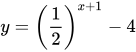 .
.
| Foundations:
|
| This is a problem about graphing through transformations. It requires you to find the basic or prototype graph, and then understand how to apple the transformations. In particular, if our basic graph is
|

|
| and we have a transformed graph
|
- Failed to parse (Conversion error. Server ("https://wikimedia.org/api/rest_") reported: "Cannot get mml. Server problem."): {\displaystyle y=A\,f(x-B)+C,}
|
we would have to consider a shift/mirroring of the basic graph from  , a horizontal shift from , a horizontal shift from  , and a vertical shift from , and a vertical shift from  . .
|
Solution:
| Step 1:
|
| Identify the Basic Graph: The basic graph is
|

|
| If you do not know exactly what this looks like, plot the basic points:
|

|
| I would always recommend plotting the basic graph, in order to show that you properly applied the transformations. Note that since our base is less than one, the basic graph will be decreasing.
|
| Step 2:
|
| Verify the Transformations: Here, we need to shift the basic graph down by four, while moving it to the right one (as the argument Failed to parse (MathML with SVG or PNG fallback (recommended for modern browsers and accessibility tools): Invalid response ("Math extension cannot connect to Restbase.") from server "https://wikimedia.org/api/rest_v1/":): {\displaystyle x+1}
is zero when Failed to parse (MathML with SVG or PNG fallback (recommended for modern browsers and accessibility tools): Invalid response ("Math extension cannot connect to Restbase.") from server "https://wikimedia.org/api/rest_v1/":): {\displaystyle x}
is one). Note that since the basic graph has an asymptote at the Failed to parse (MathML with SVG or PNG fallback (recommended for modern browsers and accessibility tools): Invalid response ("Math extension cannot connect to Restbase.") from server "https://wikimedia.org/api/rest_v1/":): {\displaystyle x}
-axis, we will shift the asymptote to the line Failed to parse (MathML with SVG or PNG fallback (recommended for modern browsers and accessibility tools): Invalid response ("Math extension cannot connect to Restbase.") from server "https://wikimedia.org/api/rest_v1/":): {\displaystyle y=-4.}
|
| Final Answer:
|
| Not done yet!
|
Return to Sample Exam