009C Sample Midterm 3, Problem 3

From Math Wiki
Revision as of 12:59, 26 April 2015 by MathAdmin (talk | contribs)
Jump to navigation Jump to search

Test if each the following series converges or diverges. Give reasons and clearly state if you are using any standard test.

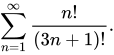
(a) (6 points)     


(b) (6 points)     
Foundations:  
Most of the time, if there are factorials in the terms of a series, you would use the
Ratio Test. Let Failed to parse (MathML with SVG or PNG fallback (recommended for modern browsers and accessibility tools): Invalid response ("Math extension cannot connect to Restbase.") from server "https://wikimedia.org/api/rest_v1/":): {\displaystyle \sum_{k=1}^{\infty} a_{k}} be a series. Then:
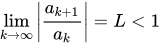
  • If Failed to parse (MathML with SVG or PNG fallback (recommended for modern browsers and accessibility tools): Invalid response ("Math extension cannot connect to Restbase.") from server "https://wikimedia.org/api/rest_v1/":): {\displaystyle \lim_{k\rightarrow\infty}\left|\frac{a_{k+1}}{a_{k}}\right|=L<1} , the series is absolutely convergent (and therefore convergent).
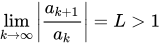
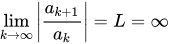
  • If Failed to parse (MathML with SVG or PNG fallback (recommended for modern browsers and accessibility tools): Invalid response ("Math extension cannot connect to Restbase.") from server "https://wikimedia.org/api/rest_v1/":): {\displaystyle \lim_{k\rightarrow\infty}\left|\frac{a_{k+1}}{a_{k}}\right|=L>1} or Failed to parse (MathML with SVG or PNG fallback (recommended for modern browsers and accessibility tools): Invalid response ("Math extension cannot connect to Restbase.") from server "https://wikimedia.org/api/rest_v1/":): {\displaystyle \lim_{k\rightarrow\infty}\left|\frac{a_{k+1}}{a_{k}}\right|=L=\infty} , the series is divergent.
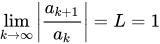
  • If Failed to parse (MathML with SVG or PNG fallback (recommended for modern browsers and accessibility tools): Invalid response ("Math extension cannot connect to Restbase.") from server "https://wikimedia.org/api/rest_v1/":): {\displaystyle \lim_{k\rightarrow\infty}\left|\frac{a_{k+1}}{a_{k}}\right|=L=1} , the Ratio Test is inconclusive.
This works well, as factorials cancel out many terms. For example,
Failed to parse (MathML with SVG or PNG fallback (recommended for modern browsers and accessibility tools): Invalid response ("Math extension cannot connect to Restbase.") from server "https://wikimedia.org/api/rest_v1/":): {\displaystyle \frac{(n+1)!}{n!}\,=\,n+1.}
On the other hand, something built mainly out of powers of Failed to parse (MathML with SVG or PNG fallback (recommended for modern browsers and accessibility tools): Invalid response ("Math extension cannot connect to Restbase.") from server "https://wikimedia.org/api/rest_v1/":): {\displaystyle n} may work well with the
Limit Comparison Test. Suppose Failed to parse (MathML with SVG or PNG fallback (recommended for modern browsers and accessibility tools): Invalid response ("Math extension cannot connect to Restbase.") from server "https://wikimedia.org/api/rest_v1/":): {\displaystyle \sum_{k=1}^{\infty} a_{k}} and Failed to parse (MathML with SVG or PNG fallback (recommended for modern browsers and accessibility tools): Invalid response ("Math extension cannot connect to Restbase.") from server "https://wikimedia.org/api/rest_v1/":): {\displaystyle \sum_{k=1}^{\infty} b_{k}} are series with positive terms. If Failed to parse (MathML with SVG or PNG fallback (recommended for modern browsers and accessibility tools): Invalid response ("Math extension cannot connect to Restbase.") from server "https://wikimedia.org/api/rest_v1/":): {\displaystyle \lim_{k\rightarrow\infty}\frac{a_{k}}{b_{k}}=c} where Failed to parse (MathML with SVG or PNG fallback (recommended for modern browsers and accessibility tools): Invalid response ("Math extension cannot connect to Restbase.") from server "https://wikimedia.org/api/rest_v1/":): {\displaystyle 0<c<\infty} , then either both series converge, or both series diverge.
In the case of a series built mainly out of powers, you would choose to compare it to a p-series.

 Solution:

(a):  
As mentioned in Foundations, we should use the ratio test. Note that
Failed to parse (MathML with SVG or PNG fallback (recommended for modern browsers and accessibility tools): Invalid response ("Math extension cannot connect to Restbase.") from server "https://wikimedia.org/api/rest_v1/":): {\displaystyle \begin{array}{rcl} \displaystyle {\left|\frac{a_{n+1}}{a_{n}}\right|} & = & \left|\frac{\frac{(n+1)!}{(3(n+1)+1)!}}{\frac{n!}{(3n+1)!}}\right|\\ \\ & = & \displaystyle {\frac{(n+1)!}{n!}\cdot\frac{(3n+1)!}{(3n+4)!}}\\ \\ & = & \displaystyle {\frac{n+1}{(3n+2)(3n+3)(3n+4)}}. \end{array}}
Thus,
Failed to parse (MathML with SVG or PNG fallback (recommended for modern browsers and accessibility tools): Invalid response ("Math extension cannot connect to Restbase.") from server "https://wikimedia.org/api/rest_v1/":): {\displaystyle \lim_{n\rightarrow\infty}\left|\frac{a_{n+1}}{a_{n}}\right|\ =\ 0\ <\ 1,}
so by the ratio test the series converges.
(b):  
Here, we can use the limit comparison test. Let Failed to parse (MathML with SVG or PNG fallback (recommended for modern browsers and accessibility tools): Invalid response ("Math extension cannot connect to Restbase.") from server "https://wikimedia.org/api/rest_v1/":): {\displaystyle a_{n}=\frac{\sqrt{n}}{n^{2}-3}} , and let Failed to parse (MathML with SVG or PNG fallback (recommended for modern browsers and accessibility tools): Invalid response ("Math extension cannot connect to Restbase.") from server "https://wikimedia.org/api/rest_v1/":): {\displaystyle b_{n}=\frac{1}{n^{3/2}}.} Notice that the terms of Failed to parse (MathML with SVG or PNG fallback (recommended for modern browsers and accessibility tools): Invalid response ("Math extension cannot connect to Restbase.") from server "https://wikimedia.org/api/rest_v1/":): {\displaystyle a_{n}} are all positive, and
Failed to parse (MathML with SVG or PNG fallback (recommended for modern browsers and accessibility tools): Invalid response ("Math extension cannot connect to Restbase.") from server "https://wikimedia.org/api/rest_v1/":): {\displaystyle \begin{array}{rcl} \displaystyle {\lim_{n\rightarrow\infty}\frac{a_{n}}{b_{n}}} & = & \displaystyle {\lim_{n\rightarrow\infty}\frac{\frac{\sqrt{n}}{n^{2}-3}}{\frac{1}{n^{3/2}}}}\\ \\ & = & \displaystyle {\lim_{n\rightarrow\infty}\frac{n^{2}}{n^{2}-3}}\\ \\ & = & 1\,\,<\,\, \infty. \end{array}}

Since Failed to parse (MathML with SVG or PNG fallback (recommended for modern browsers and accessibility tools): Invalid response ("Math extension cannot connect to Restbase.") from server "https://wikimedia.org/api/rest_v1/":): {\displaystyle \sum_{n=2}^{\infty}\frac{1}{n^{3/2}}}  is a p-series with Failed to parse (MathML with SVG or PNG fallback (recommended for modern browsers and accessibility tools): Invalid response ("Math extension cannot connect to Restbase.") from server "https://wikimedia.org/api/rest_v1/":): {\displaystyle p>1,} it is convergent. By the limit comparison test, Failed to parse (MathML with SVG or PNG fallback (recommended for modern browsers and accessibility tools): Invalid response ("Math extension cannot connect to Restbase.") from server "https://wikimedia.org/api/rest_v1/":): {\displaystyle \sum_{n=2}^{\infty}\frac{\sqrt{n}}{n^{2}-3}}  is convergent.

Final Answer:  
Both series are convergent.

Return to Sample Exam