009C Sample Midterm 3, Problem 1

From Math Wiki
Revision as of 16:39, 3 November 2015 by MathAdmin (talk | contribs)
Jump to navigation Jump to search

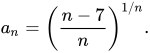
Test if the following sequence converges or diverges. If it converges, also find the limit of the sequence.

Foundations:  
This a common question, and is related to the fact that
In such a limit, the argument Failed to parse (MathML with SVG or PNG fallback (recommended for modern browsers and accessibility tools): Invalid response ("Math extension cannot connect to Restbase.") from server "https://wikimedia.org/api/rest_v1/":): {\displaystyle 1+\alpha /x} tends to one as Failed to parse (MathML with SVG or PNG fallback (recommended for modern browsers and accessibility tools): Invalid response ("Math extension cannot connect to Restbase.") from server "https://wikimedia.org/api/rest_v1/":): {\displaystyle x} gets large, while we are raising that argument to an increasing power. Neither one really "wins", so we end up with a finite limit that is neither zero nor infinity.
On the other hand, in the exam problem the argument Failed to parse (MathML with SVG or PNG fallback (recommended for modern browsers and accessibility tools): Invalid response ("Math extension cannot connect to Restbase.") from server "https://wikimedia.org/api/rest_v1/":): {\displaystyle (n-7)/n} is always smaller than one, but tends to one as Failed to parse (MathML with SVG or PNG fallback (recommended for modern browsers and accessibility tools): Invalid response ("Math extension cannot connect to Restbase.") from server "https://wikimedia.org/api/rest_v1/":): {\displaystyle n} gets large, while the exponent Failed to parse (MathML with SVG or PNG fallback (recommended for modern browsers and accessibility tools): Invalid response ("Math extension cannot connect to Restbase.") from server "https://wikimedia.org/api/rest_v1/":): {\displaystyle 1/n} tends to zero. These do not disagree, so the limit should be one, but we need to prove it.
Any time you have a function raised to a function, we need to use natural log and take advantage of the log rule:
Failed to parse (MathML with SVG or PNG fallback (recommended for modern browsers and accessibility tools): Invalid response ("Math extension cannot connect to Restbase.") from server "https://wikimedia.org/api/rest_v1/":): {\displaystyle \ln\left(a^{b}\right)=b\ln(a).}
For example, to find Failed to parse (MathML with SVG or PNG fallback (recommended for modern browsers and accessibility tools): Invalid response ("Math extension cannot connect to Restbase.") from server "https://wikimedia.org/api/rest_v1/":): {\displaystyle \lim_{x\rightarrow\infty}\left(1-\frac{1}{x}\right)^{x}} , you could begin by saying: Let Failed to parse (MathML with SVG or PNG fallback (recommended for modern browsers and accessibility tools): Invalid response ("Math extension cannot connect to Restbase.") from server "https://wikimedia.org/api/rest_v1/":): {\displaystyle L=\lim_{x\rightarrow\infty}\left(1-\frac{1}{x}\right)^{x}.}

Then

Failed to parse (MathML with SVG or PNG fallback (recommended for modern browsers and accessibility tools): Invalid response ("Math extension cannot connect to Restbase.") from server "https://wikimedia.org/api/rest_v1/":): {\displaystyle \ln L=\ln\left[\lim_{x\rightarrow\infty}\left(1-\frac{1}{x}\right)^{x}\right]=\lim_{x\rightarrow\infty}\ln\left[\left(1-\frac{1}{x}\right)^{x}\right],}

where we are allowed to pass the log through the limit because natural log is continuous. But by log rules,

Failed to parse (MathML with SVG or PNG fallback (recommended for modern browsers and accessibility tools): Invalid response ("Math extension cannot connect to Restbase.") from server "https://wikimedia.org/api/rest_v1/":): {\displaystyle \ln\left[\left(1-\frac{1}{x}\right)^{x}\right]=x\ln\left(1-\frac{1}{x}\right).}
Thus
Failed to parse (MathML with SVG or PNG fallback (recommended for modern browsers and accessibility tools): Invalid response ("Math extension cannot connect to Restbase.") from server "https://wikimedia.org/api/rest_v1/":): {\displaystyle \begin{array}{rcl} \lim_{x\rightarrow\infty}\ln\left[\left(1-\frac{1}{x}\right)^{x}\right] & = & \lim_{x\rightarrow\infty}x\ln\left(1-\frac{1}{x}\right),\\ & = & \lim_{x\rightarrow\infty}\frac{\ln\left(1-\frac{1}{x}\right)}{\frac{1}{x}}\\ & \overset{l'H}{=} & \lim_{x\rightarrow\infty}\frac{\frac{x}{x-1}\cdot\left(-\frac{1}{x}\right)'}{\left(\frac{1}{x}\right)'}\\ & = & -1. \end{array}}

Note that Failed to parse (MathML with SVG or PNG fallback (recommended for modern browsers and accessibility tools): Invalid response ("Math extension cannot connect to Restbase.") from server "https://wikimedia.org/api/rest_v1/":): {\displaystyle \lim_{x\rightarrow\infty}\frac{\ln\left(1-\frac{1}{x}\right)}{\frac{1}{x}}=\frac{0}{0},}  so we can apply l'Hôpital's rule. Finally, since Failed to parse (MathML with SVG or PNG fallback (recommended for modern browsers and accessibility tools): Invalid response ("Math extension cannot connect to Restbase.") from server "https://wikimedia.org/api/rest_v1/":): {\displaystyle \ln L=-1,\,\,L=\frac{1}{e}.}

Again, such a technique is not required for this particular problem, as the exponent tends to zero. But the technique is common enough on exams to justify providing an example.
Solution: 
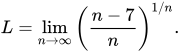
Following the procedure outlined in Foundations, let Failed to parse (MathML with SVG or PNG fallback (recommended for modern browsers and accessibility tools): Invalid response ("Math extension cannot connect to Restbase.") from server "https://wikimedia.org/api/rest_v1/":): {\displaystyle L=\lim_{n\rightarrow\infty}\left(\frac{n-7}{n}\right)^{1/n}.} Then
Failed to parse (MathML with SVG or PNG fallback (recommended for modern browsers and accessibility tools): Invalid response ("Math extension cannot connect to Restbase.") from server "https://wikimedia.org/api/rest_v1/":): {\displaystyle \begin{array}{rcl} \ln L & = & \displaystyle{ \ln\left(\lim_{n\rightarrow\infty}\left[\left(\frac{n-7}{n}\right)^{1/n}\right]\right)}\\ \\ & = &\displaystyle{ \lim_{n\rightarrow\infty}\ln\left[\left(\frac{n-7}{n}\right)^{1/n}\right]}\\ \\ & & \displaystyle{ \lim_{n\rightarrow\infty}\left[\frac{1}{n}\cdot\ln\left(\frac{n-7}{n}\right)\right]}\\ \\ & = & 0\cdot\ln(1)\\ \\ & = & 0. \end{array}}

Thus, Failed to parse (MathML with SVG or PNG fallback (recommended for modern browsers and accessibility tools): Invalid response ("Math extension cannot connect to Restbase.") from server "https://wikimedia.org/api/rest_v1/":): {\displaystyle L=e^{0}=1.} Also, most teachers would require you to mention that natural log is continuous as justification for passing the limit through it.
Final Answer:  
The limit of the sequence is Failed to parse (MathML with SVG or PNG fallback (recommended for modern browsers and accessibility tools): Invalid response ("Math extension cannot connect to Restbase.") from server "https://wikimedia.org/api/rest_v1/":): {\displaystyle e^{0}=1.}

Return to Sample Exam