009A Sample Final A, Problem 2
Jump to navigation
Jump to search
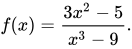
2. Find the derivatives of the following functions:
(a)
(b) Failed to parse (MathML with SVG or PNG fallback (recommended for modern browsers and accessibility tools): Invalid response ("Math extension cannot connect to Restbase.") from server "https://wikimedia.org/api/rest_v1/":): {\displaystyle g(x)=\pi+2\cos(\sqrt{x-2}).}
(c) Failed to parse (MathML with SVG or PNG fallback (recommended for modern browsers and accessibility tools): Invalid response ("Math extension cannot connect to Restbase.") from server "https://wikimedia.org/api/rest_v1/":): {\displaystyle h(x)=4x\sin(x)+e(x^{2}+2)^{2}.}
| Foundations: |
|---|
| These are problems involving some more advanced rules of differentiation. In particular, they use |
| The Chain Rule: If f and g are differentiable functions, then |
Failed to parse (MathML with SVG or PNG fallback (recommended for modern browsers and accessibility tools): Invalid response ("Math extension cannot connect to Restbase.") from server "https://wikimedia.org/api/rest_v1/":): {\displaystyle (f\circ g)'(x) = f'(g(x))\cdot g'(x).} |
The Product Rule: If f and g are differentiable functions, then |
Failed to parse (MathML with SVG or PNG fallback (recommended for modern browsers and accessibility tools): Invalid response ("Math extension cannot connect to Restbase.") from server "https://wikimedia.org/api/rest_v1/":): {\displaystyle (fg)'(x) = f'(x)\cdot g(x)+f(x)\cdot g'(x).} |
The Quotient Rule: If f and g are differentiable functions and g(x) ≠ 0, then |
Failed to parse (MathML with SVG or PNG fallback (recommended for modern browsers and accessibility tools): Invalid response ("Math extension cannot connect to Restbase.") from server "https://wikimedia.org/api/rest_v1/":): {\displaystyle \left(\frac{f}{g}\right)'(x) = \frac{f'(x)\cdot g(x)-f(x)\cdot g'(x)}{\left(g(x)\right)^2}. } |
Solution:
| Part (a): |
|---|
| We need to use the quotient rule: |
| Failed to parse (MathML with SVG or PNG fallback (recommended for modern browsers and accessibility tools): Invalid response ("Math extension cannot connect to Restbase.") from server "https://wikimedia.org/api/rest_v1/":): {\displaystyle f'(x) = \frac {\left(3x^{2}-5\right)' \cdot \left(x^{3}-9 \right)- \left( 3x^{2}-5 \right) \cdot \left( x^{3}-9\right)'}{\left(x^{3}-9\right)^2} } |
| Failed to parse (MathML with SVG or PNG fallback (recommended for modern browsers and accessibility tools): Invalid response ("Math extension cannot connect to Restbase.") from server "https://wikimedia.org/api/rest_v1/":): {\displaystyle = \frac{6x(x^{3}-9)-(3x^{2}-5)(3x^{2})}{(x^{3}-9)^{2}}} |
| Failed to parse (MathML with SVG or PNG fallback (recommended for modern browsers and accessibility tools): Invalid response ("Math extension cannot connect to Restbase.") from server "https://wikimedia.org/api/rest_v1/":): {\displaystyle = \frac{6x^{4}-54x-9x^{4}+15x^{2}}{(x^{3}-9)^{2}}} |
| Failed to parse (MathML with SVG or PNG fallback (recommended for modern browsers and accessibility tools): Invalid response ("Math extension cannot connect to Restbase.") from server "https://wikimedia.org/api/rest_v1/":): {\displaystyle = \frac{-3x^{4}+15x^{2}-54x}{(x^{3}-9)^{2}}.} |
| Part (b): |
|---|
| Both parts (b) and (c) attempt to confuse you by including the familiar constants e and π. Remember - they are just constants, like 10 or 1/2. With that in mind, we really just need to apply the chain rule to find |
| Failed to parse (MathML with SVG or PNG fallback (recommended for modern browsers and accessibility tools): Invalid response ("Math extension cannot connect to Restbase.") from server "https://wikimedia.org/api/rest_v1/":): {\displaystyle g'(x)=0-2\sin\left(\sqrt{x-2}\right)\cdot\frac{1}{2}\cdot(x-2)^{-1/2}\cdot1=\,-\frac{\sin\left(\sqrt{x-2}\right)}{\sqrt{x-2}}.} |
| Part (c): |
|---|
| We can choose to expand the second term, finding |
| Failed to parse (MathML with SVG or PNG fallback (recommended for modern browsers and accessibility tools): Invalid response ("Math extension cannot connect to Restbase.") from server "https://wikimedia.org/api/rest_v1/":): {\displaystyle e(x^{2}+2)^{2}=ex^{4}+4ex^{2}+4e.} |
| We then only require the product rule on the first term, so |
| Failed to parse (MathML with SVG or PNG fallback (recommended for modern browsers and accessibility tools): Invalid response ("Math extension cannot connect to Restbase.") from server "https://wikimedia.org/api/rest_v1/":): {\displaystyle h'(x)=(4x)'\cdot\sin(x)+4x\cdot(\sin(x))'+\left(ex^{4}+4ex^{2}+4e\right)'=4\sin(x)+4x\cos(x)+4ex^{3}+8ex.} |