009B Sample Final 1, Problem 7

From Math Wiki
Revision as of 15:12, 18 April 2016 by MathAdmin (talk | contribs)
Jump to navigation Jump to search
a) Find the length of the curve
Failed to parse (Conversion error. Server ("https://wikimedia.org/api/rest_") reported: "Cannot get mml. Server problem."): {\displaystyle y=\ln(\cos x),~~~0\leq x\leq {\frac {\pi }{3}}.}
b) The curve
is rotated about the -axis. Find the area of the resulting surface.
Foundations:  
Recall:
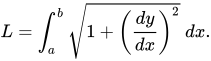
1. The formula for the length of a curve where Failed to parse (Conversion error. Server ("https://wikimedia.org/api/rest_") reported: "Cannot get mml. Server problem."): {\displaystyle a\leq x\leq b} is
Failed to parse (Conversion error. Server ("https://wikimedia.org/api/rest_") reported: "Cannot get mml. Server problem."): {\displaystyle L=\int _{a}^{b}{\sqrt {1+{\bigg (}{\frac {dy}{dx}}{\bigg )}^{2}}}~dx.}
2.
3. The surface area of a function rotated about the -axis is given by
Failed to parse (Conversion error. Server ("https://wikimedia.org/api/rest_") reported: "Cannot get mml. Server problem."): {\displaystyle S=\int 2\pi x\,ds} , where Failed to parse (Conversion error. Server ("https://wikimedia.org/api/rest_") reported: "Cannot get mml. Server problem."): {\displaystyle ds={\sqrt {1+{\bigg (}{\frac {dy}{dx}}{\bigg )}^{2}}}.}

Solution:

(a)

Step 1:  
First, we calculate 
Since Failed to parse (Conversion error. Server ("https://wikimedia.org/api/rest_") reported: "Cannot get mml. Server problem."): {\displaystyle y=\ln(\cos x),}
Using the formula given in the Foundations section, we have
Step 2:  
Now, we have:
Step 3:  
Finally,

(b)

Step 1:  
We start by calculating 
Since Failed to parse (Conversion error. Server ("https://wikimedia.org/api/rest_") reported: "Cannot get mml. Server problem."): {\displaystyle y=1-x^{2},~{\frac {dy}{dx}}=-2x.}
Using the formula given in the Foundations section, we have
Step 2:  
Now, we have
We proceed by using trig substitution. Let Then,
So, we have
Step 3:  
Now, we use -substitution. Let Then,
So, the integral becomes
Step 4:  
We started with a definite integral. So, using Step 2 and 3, we have
Final Answer:  
   (a)  
   (b)  

Return to Sample Exam