We would like to evaluate
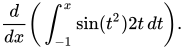
- a) Compute

- b) Find

- c) State the Fundamental Theorem of Calculus.
- d) Use the Fundamental Theorem of Calculus to compute
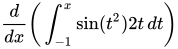 without first computing the integral.
- d) Use the Fundamental Theorem of Calculus to compute
 without first computing the integral.
| Foundations:
|
How would you integrate 
|
- You could use
 -substitution. Let -substitution. Let  Then, Then, 
|
- So, we get

|
Solution:
(a)
| Step 1:
|
We proceed using -substitution. Let  Then, Then, 
|
| Since this is a definite integral, we need to change the bounds of integration.
|
Plugging our values into the equation  we get we get  and and 
|
| Step 2:
|
| So, we have
|

|
(b)
| Step 1:
|
From part (a), we have 
|
| Step 2:
|
If we take the derivative, we get  since since  is just a constant. is just a constant.
|
(c)
| Step 1:
|
| The Fundamental Theorem of Calculus has two parts.
|
| The Fundamental Theorem of Calculus, Part 1
|
- Let
 be continuous on be continuous on ![{\displaystyle [a,b]}](https://wikimedia.org/api/rest_v1/media/math/render/svg/9c4b788fc5c637e26ee98b45f89a5c08c85f7935) and let and let 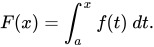
|
- Then,
 is a differentiable function on is a differentiable function on  and and 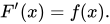
|
| Step 2:
|
| The Fundamental Theorem of Calculus, Part 2
|
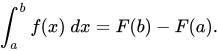
- Let be continuous on and let be any antiderivative of

|
- Then,
|
| (d)
|
| By the Fundamental Theorem of Calculus, Part 1,
|

|
| Final Answer:
|
(a) 
|
(b) 
|
| (c) The Fundamental Theorem of Calculus, Part 1
|
Let be continuous on and let 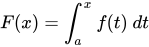 . .
|
Then, is a differentiable function on and  . .
|
| The Fundamental Theorem of Calculus, Part 2
|
| Let be continuous on and let be any antiderivative of .
|
Then, 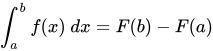 . .
|
(d) 
|
Return to Sample Exam