Find the antiderivative: 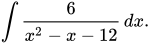
| Foundations:
|
| 1) What does the denominator factor into? What will be the form of the decomposition?
|
| 2) How do you solve for the numerators?
|
| 3) What special integral do we have to use?
|
| Answer:
|
| 1) Since Failed to parse (MathML with SVG or PNG fallback (recommended for modern browsers and accessibility tools): Invalid response ("Math extension cannot connect to Restbase.") from server "https://wikimedia.org/api/rest_v1/":): {\displaystyle x^2 - x - 12 = (x - 4)(x +3)}
, and each term has multiplicity one, the decomposition will be of the form: Failed to parse (MathML with SVG or PNG fallback (recommended for modern browsers and accessibility tools): Invalid response ("Math extension cannot connect to Restbase.") from server "https://wikimedia.org/api/rest_v1/":): {\displaystyle \frac{A}{x - 4} + \frac{B}{x + 3}}
|
| 2) After writing the equality, Failed to parse (MathML with SVG or PNG fallback (recommended for modern browsers and accessibility tools): Invalid response ("Math extension cannot connect to Restbase.") from server "https://wikimedia.org/api/rest_v1/":): {\displaystyle \frac{6}{x^2 -x - 12} = \frac{A}{x - 4} + \frac{B}{x + 3}}
, clear the denominators, and evaluate both sides at x = 4, -3, Each evaluation will yield the value of one of the unknowns.
|
| 3) We have to remember that Failed to parse (MathML with SVG or PNG fallback (recommended for modern browsers and accessibility tools): Invalid response ("Math extension cannot connect to Restbase.") from server "https://wikimedia.org/api/rest_v1/":): {\displaystyle \int \frac{c}{x - a} dx = c\ln(x - a)}
, for any numbers c, a.
|
Solution:
| Step 1:
|
| First, we factor Failed to parse (MathML with SVG or PNG fallback (recommended for modern browsers and accessibility tools): Invalid response ("Math extension cannot connect to Restbase.") from server "https://wikimedia.org/api/rest_v1/":): {\displaystyle x^2 - x - 12 = (x - 4)(x + 3)}
|
| Step 2:
|
| Now we want to find the partial fraction expansion for Failed to parse (MathML with SVG or PNG fallback (recommended for modern browsers and accessibility tools): Invalid response ("Math extension cannot connect to Restbase.") from server "https://wikimedia.org/api/rest_v1/":): {\displaystyle \frac{6}{(x - 4)(x + 3)}}
, which will have the form Failed to parse (MathML with SVG or PNG fallback (recommended for modern browsers and accessibility tools): Invalid response ("Math extension cannot connect to Restbase.") from server "https://wikimedia.org/api/rest_v1/":): {\displaystyle \frac{A}{x - 4} + {B}{x + 3}}
|
| To do this we need to solve the equation Failed to parse (MathML with SVG or PNG fallback (recommended for modern browsers and accessibility tools): Invalid response ("Math extension cannot connect to Restbase.") from server "https://wikimedia.org/api/rest_v1/":): {\displaystyle 6 = A( x + 3) + B(x - 4)}
|
| Plugging in -3 for x to both sides we find that Failed to parse (MathML with SVG or PNG fallback (recommended for modern browsers and accessibility tools): Invalid response ("Math extension cannot connect to Restbase.") from server "https://wikimedia.org/api/rest_v1/":): {\displaystyle 6 = -7B}
and Failed to parse (MathML with SVG or PNG fallback (recommended for modern browsers and accessibility tools): Invalid response ("Math extension cannot connect to Restbase.") from server "https://wikimedia.org/api/rest_v1/":): {\displaystyle B = -\frac{6}{7}}
.
|
| Now we can find A by plugging in 4 for x to both sides. This yields Failed to parse (MathML with SVG or PNG fallback (recommended for modern browsers and accessibility tools): Invalid response ("Math extension cannot connect to Restbase.") from server "https://wikimedia.org/api/rest_v1/":): {\displaystyle 6 = 7A}
, so Failed to parse (MathML with SVG or PNG fallback (recommended for modern browsers and accessibility tools): Invalid response ("Math extension cannot connect to Restbase.") from server "https://wikimedia.org/api/rest_v1/":): {\displaystyle A = \frac{6}{7}}
|
| Finally we have the partial fraction expansion: Failed to parse (MathML with SVG or PNG fallback (recommended for modern browsers and accessibility tools): Invalid response ("Math extension cannot connect to Restbase.") from server "https://wikimedia.org/api/rest_v1/":): {\displaystyle \frac{6}{x^2 -x - 12} = \frac{6}{7(x - 4)} - \frac{6}{7(x + 3)}}
|
| Step 3:
|
| Now to finish the problem we integrate each fraction to get: Failed to parse (MathML with SVG or PNG fallback (recommended for modern browsers and accessibility tools): Invalid response ("Math extension cannot connect to Restbase.") from server "https://wikimedia.org/api/rest_v1/":): {\displaystyle \int \frac{6}{x^2 -x -12} dx = \int \frac{6}{7(x - 4)}dx - \int \frac{6}{7(x + 3)}dx }
to get Failed to parse (MathML with SVG or PNG fallback (recommended for modern browsers and accessibility tools): Invalid response ("Math extension cannot connect to Restbase.") from server "https://wikimedia.org/api/rest_v1/":): {\displaystyle \frac{6}{7}\ln(x - 4) - \frac{6}{7}\ln(x + 3)}
|
| Step 4:
|
| Now make sure you remember to add the Failed to parse (MathML with SVG or PNG fallback (recommended for modern browsers and accessibility tools): Invalid response ("Math extension cannot connect to Restbase.") from server "https://wikimedia.org/api/rest_v1/":): {\displaystyle + C}
to the integral at the end.
|
| Final Answer:
|
| Failed to parse (MathML with SVG or PNG fallback (recommended for modern browsers and accessibility tools): Invalid response ("Math extension cannot connect to Restbase.") from server "https://wikimedia.org/api/rest_v1/":): {\displaystyle \frac{6}{7}\ln(x - 4) - \frac{6}{7}\ln(x + 3) + C}
|
Return to Sample Final