009C Sample Midterm 2, Problem 3
Determine convergence or divergence:
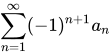
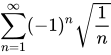
(a)
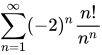
(b) Failed to parse (Conversion error. Server ("https://wikimedia.org/api/rest_") reported: "Cannot get mml. Server problem."): {\displaystyle \sum _{n=1}^{\infty }(-2)^{n}{\frac {n!}{n^{n}}}}
| Foundations: |
|---|
| 1. Alternating Series Test |
| Let be a positive, decreasing sequence where |
| Then, and |
| converge. |
| 2. Ratio Test |
| Let be a series and |
| Then, |
|
If the series is absolutely convergent. |
|
If the series is divergent. |
|
If the test is inconclusive. |
| 3. If a series absolutely converges, then it also converges. |
Solution:
(a)
| Step 1: |
|---|
| First, we have |
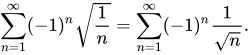
| Failed to parse (Conversion error. Server ("https://wikimedia.org/api/rest_") reported: "Cannot get mml. Server problem."): {\displaystyle \sum _{n=1}^{\infty }(-1)^{n}{\sqrt {\frac {1}{n}}}=\sum _{n=1}^{\infty }(-1)^{n}{\frac {1}{\sqrt {n}}}.} |
| Step 2: |
|---|
| We notice that the series is alternating. |
| Let |
| First, we have |
| for all |
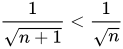
| The sequence is decreasing since |
| for all |
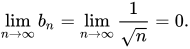
| Also, |
| Therefore, the series Failed to parse (Conversion error. Server ("https://wikimedia.org/api/rest_") reported: "Cannot get mml. Server problem."): {\displaystyle \sum _{n=1}^{\infty }{\frac {(-1)^{n}}{\sqrt {n}}}} converges by the Alternating Series Test. |
(b)
| Step 1: |
|---|
| We begin by using the Ratio Test. |
| We have |
|
Failed to parse (Conversion error. Server ("https://wikimedia.org/api/rest_") reported: "Cannot get mml. Server problem."): {\displaystyle {\begin{array}{rcl}\displaystyle {\lim _{n\rightarrow \infty }{\bigg |}{\frac {a_{n+1}}{a_{n}}}{\bigg |}}&=&\displaystyle {\lim _{n\rightarrow \infty }{\bigg |}{\frac {(-2)^{n+1}(n+1)!}{(n+1)^{n+1}}}{\frac {n^{n}}{(-2)^{n}n!}}{\bigg |}}\\&&\\&=&\displaystyle {\lim _{n\rightarrow \infty }{\bigg |}(-2)(n+1){\frac {n^{n}}{(n+1)^{n+1}}}{\bigg |}}\\&&\\&=&\displaystyle {\lim _{n\rightarrow \infty }2{\frac {n^{n}}{(n+1)^{n}}}}\\&&\\&=&\displaystyle {2\lim _{n\rightarrow \infty }{\bigg (}{\frac {n}{n+1}}{\bigg )}^{n}.}\end{array}}} |
| Step 2: |
|---|
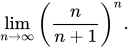
| Now, we need to calculate |
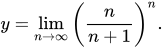
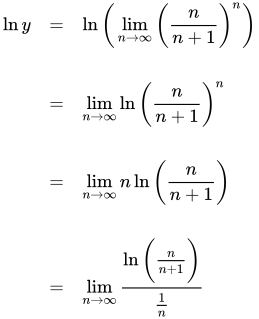
| Let Failed to parse (Conversion error. Server ("https://wikimedia.org/api/rest_") reported: "Cannot get mml. Server problem."): {\displaystyle y=\lim _{n\rightarrow \infty }{\bigg (}{\frac {n}{n+1}}{\bigg )}^{n}.} |
| Then, taking the natural log of both sides, we get |
|
|
| since we can interchange limits and continuous functions. |
| Now, this limit has the form |
| Hence, we can use L'Hopital's Rule to calculate this limit. |
| Step 3: |
|---|
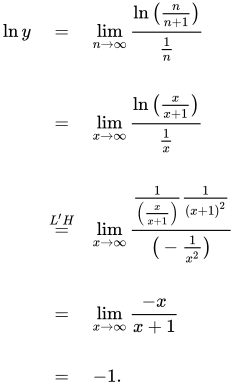
| Now, we have |
|
Failed to parse (Conversion error. Server ("https://wikimedia.org/api/rest_") reported: "Cannot get mml. Server problem."): {\displaystyle {\begin{array}{rcl}\displaystyle {\ln y}&=&\displaystyle {\lim _{n\rightarrow \infty }{\frac {\ln {\big (}{\frac {n}{n+1}}{\big )}}{\frac {1}{n}}}}\\&&\\&=&\displaystyle {\lim _{x\rightarrow \infty }{\frac {\ln {\big (}{\frac {x}{x+1}}{\big )}}{\frac {1}{x}}}}\\&&\\&{\overset {L'H}{=}}&\displaystyle {\lim _{x\rightarrow \infty }{\frac {{\frac {1}{{\big (}{\frac {x}{x+1}}{\big )}}}{\frac {1}{(x+1)^{2}}}}{{\big (}-{\frac {1}{x^{2}}}{\big )}}}}\\&&\\&=&\displaystyle {\lim _{x\rightarrow \infty }{\frac {-x}{x+1}}}\\&&\\&=&\displaystyle {-1.}\end{array}}} |
| Step 4: |
|---|
| Since we know |
| Failed to parse (Conversion error. Server ("https://wikimedia.org/api/rest_") reported: "Cannot get mml. Server problem."): {\displaystyle y=e^{-1}.} |
| Now, we have |
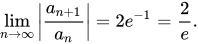
| Failed to parse (Conversion error. Server ("https://wikimedia.org/api/rest_") reported: "Cannot get mml. Server problem."): {\displaystyle \lim _{n\rightarrow \infty }{\bigg |}{\frac {a_{n+1}}{a_{n}}}{\bigg |}=2e^{-1}={\frac {2}{e}}.} |
| Since Failed to parse (Conversion error. Server ("https://wikimedia.org/api/rest_") reported: "Cannot get mml. Server problem."): {\displaystyle {\frac {2}{e}}<1,} the series is absolutely convergent by the Ratio Test. |
| Therefore, the series converges. |
| Final Answer: |
|---|
| (a) converges (by the Alternating Series Test) |
| (b) converges (by the Ratio Test) |