|
|
| Line 40: |
Line 40: |
| | | Now we need to substitute back into our original variables using our original substitution <math style="vertical-align: -8%">u = e^{2x} + 1</math> | | | Now we need to substitute back into our original variables using our original substitution <math style="vertical-align: -8%">u = e^{2x} + 1</math> |
| | |- | | |- |
| − | | to find <math style="vertical-align: -21%">\ln(u) = \ln(e^{2x} + 1).</math> | + | | to find <math style="vertical-align: -25%">\ln(u) = \ln(e^{2x} + 1).</math> |
| | |} | | |} |
| | | | |
Revision as of 12:09, 18 May 2015
Find the antiderivative of 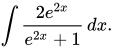
| Foundations:
|
| This problem requires two rules of integration. In particular, you need
|
Integration by substitution (u - sub): If  is a differentiable functions whose range is in the domain of is a differentiable functions whose range is in the domain of  , then , then
|

|
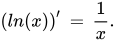
| We also need the derivative of the natural log since we will recover natural log from integration:
|
|
Solution:
| Step 1:
|
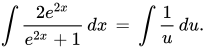
Use a u-substitution with  This means This means 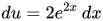 . After substitution we have . After substitution we have
|
| Step 2:
|
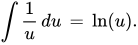
| We can now take the integral remembering the special rule:
|
|
| Step 3:
|
Now we need to substitute back into our original variables using our original substitution 
|
to find 
|
| Step 4:
|
Since this integral is an indefinite integral we have to remember to add a constant  at the end. at the end.
|
| Final Answer:
|

|
Return to Sample Exam