Difference between revisions of "022 Exam 2 Sample B, Problem 7"
Jump to navigation
Jump to search
| Line 36: | Line 36: | ||
!(a) Step 2: | !(a) Step 2: | ||
|- | |- | ||
| − | |Now, we need to substitute back into our original | + | |Now, we need to substitute back into our original variable using our original substitution <math style="vertical-align: -5%">u = 3x^2 + 1</math> |
|- | |- | ||
| to find <math style="vertical-align: -60%">\frac{1}{6}e^u = \frac{e^{3x^2 + 1}}{6}.</math> | | to find <math style="vertical-align: -60%">\frac{1}{6}e^u = \frac{e^{3x^2 + 1}}{6}.</math> | ||
Revision as of 11:04, 17 May 2015
Find the antiderivatives:
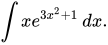
- (a)
- (b)
| Foundations: |
|---|
| This problem requires Integration by substitution (u - sub): If Failed to parse (MathML with SVG or PNG fallback (recommended for modern browsers and accessibility tools): Invalid response ("Math extension cannot connect to Restbase.") from server "https://wikimedia.org/api/rest_v1/":): {\displaystyle u = g(x)} is a differentiable functions whose range is in the domain of Failed to parse (MathML with SVG or PNG fallback (recommended for modern browsers and accessibility tools): Invalid response ("Math extension cannot connect to Restbase.") from server "https://wikimedia.org/api/rest_v1/":): {\displaystyle f} , then |
|
| We also need our power rule for integration: |
|
| as well as the convenient antiderivative: |
|
Solution:
| (a) Step 1: |
|---|
(a) Use a u-substitution with Failed to parse (MathML with SVG or PNG fallback (recommended for modern browsers and accessibility tools): Invalid response ("Math extension cannot connect to Restbase.") from server "https://wikimedia.org/api/rest_v1/":): {\displaystyle u = 3x^2 + 1.}
This means Failed to parse (MathML with SVG or PNG fallback (recommended for modern browsers and accessibility tools): Invalid response ("Math extension cannot connect to Restbase.") from server "https://wikimedia.org/api/rest_v1/":): {\displaystyle du = 6x\,dx}
, or Failed to parse (MathML with SVG or PNG fallback (recommended for modern browsers and accessibility tools): Invalid response ("Math extension cannot connect to Restbase.") from server "https://wikimedia.org/api/rest_v1/":): {\displaystyle dx=du/6}
. Substituting, we have
|
| (a) Step 2: |
|---|
| Now, we need to substitute back into our original variable using our original substitution Failed to parse (MathML with SVG or PNG fallback (recommended for modern browsers and accessibility tools): Invalid response ("Math extension cannot connect to Restbase.") from server "https://wikimedia.org/api/rest_v1/":): {\displaystyle u = 3x^2 + 1} |
| to find Failed to parse (MathML with SVG or PNG fallback (recommended for modern browsers and accessibility tools): Invalid response ("Math extension cannot connect to Restbase.") from server "https://wikimedia.org/api/rest_v1/":): {\displaystyle \frac{1}{6}e^u = \frac{e^{3x^2 + 1}}{6}.} |
| (a) Step 3: |
|---|
| Since this integral is an indefinite integral, we have to remember to add a constant Failed to parse (MathML with SVG or PNG fallback (recommended for modern browsers and accessibility tools): Invalid response ("Math extension cannot connect to Restbase.") from server "https://wikimedia.org/api/rest_v1/":): {\displaystyle C} at the end. |
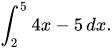
| (b): |
|---|
| Unlike part (a), this requires no substitution. We can integrate term-by-term to find |
|
| Then, we evaluate: |
|
| Final Answer: |
|---|
(a)
|
| (b) |
|