Difference between revisions of "022 Exam 2 Sample A, Problem 9"

From Math Wiki
Jump to navigation Jump to search
Line 80: Line 80:
 
|-
 
|-
 
|
 
|
::<math>g\left(-\frac{1}{2}\right)\,=\,\frac{2}{3}\cdot-\frac{1}{8}+\frac{1}{4}-12\left(-\frac{1}{2}\right)\,=\,\frac{19}{4},</math>
+
::<math>g\left(-\frac{1}{2}\right)\,=\,\frac{2}{3}\left(-\frac{1}{8}\right)+\frac{1}{4}-12\left(-\frac{1}{2}\right)\,=\,\frac{37}{6},</math>
 
|-
 
|-
 
|our inflection point is  
 
|our inflection point is  
 
|-
 
|-
 
|
 
|
::<math>\left(-\frac{1}{2},\frac{19}{4}\right).</math>
+
::<math>\left(-\frac{1}{2},\frac{37}{6}\right).</math>
 
|}
 
|}
  
Line 91: Line 91:
 
!Final Answer: &nbsp;
 
!Final Answer: &nbsp;
 
|-
 
|-
|There is a local minimum at <math style="vertical-align: -70%">\left(2,-\frac{44}{3}\right)</math>, a local maximum at <math style="vertical-align: -22%">(-3,27)</math> and an inflection point at <math style="vertical-align: -70%">\left(-\frac{1}{2},\frac{19}{4}\right).</math>
+
|There is a local minimum at <math style="vertical-align: -70%">\left(2,-\frac{44}{3}\right)</math>, a local maximum at <math style="vertical-align: -22%">(-3,27)</math> and an inflection point at <math style="vertical-align: -70%">\left(-\frac{1}{2},\frac{37}{6}\right).</math>
 
|}
 
|}
  
 
[[022_Exam_2_Sample_A|'''<u>Return to Sample Exam</u>''']]
 
[[022_Exam_2_Sample_A|'''<u>Return to Sample Exam</u>''']]

Revision as of 21:41, 15 May 2015

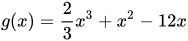
Find all relative extrema and points of inflection for the function Failed to parse (MathML with SVG or PNG fallback (recommended for modern browsers and accessibility tools): Invalid response ("Math extension cannot connect to Restbase.") from server "https://wikimedia.org/api/rest_v1/":): {\displaystyle g(x) = \frac{2}{3}x^3 + x^2 - 12x} . Be sure to give coordinate pairs for each point. You do not need to draw the graph.
Foundations:  
Since our function is a polynomial, the relative extrema occur when the first derivative is zero. We then have two choices for finding if it is a local maximum or minimum:
Second Derivative Test: If the first derivative at a point Failed to parse (MathML with SVG or PNG fallback (recommended for modern browsers and accessibility tools): Invalid response ("Math extension cannot connect to Restbase.") from server "https://wikimedia.org/api/rest_v1/":): {\displaystyle x_0} is Failed to parse (MathML with SVG or PNG fallback (recommended for modern browsers and accessibility tools): Invalid response ("Math extension cannot connect to Restbase.") from server "https://wikimedia.org/api/rest_v1/":): {\displaystyle 0} , and the second derivative is negative (indicating it is concave-down, like an upside-down parabola), then the point Failed to parse (MathML with SVG or PNG fallback (recommended for modern browsers and accessibility tools): Invalid response ("Math extension cannot connect to Restbase.") from server "https://wikimedia.org/api/rest_v1/":): {\displaystyle \left(x_0,f(x_0)\right)} is a local maximum.
On the other hand, if the second derivative is positive, the point Failed to parse (MathML with SVG or PNG fallback (recommended for modern browsers and accessibility tools): Invalid response ("Math extension cannot connect to Restbase.") from server "https://wikimedia.org/api/rest_v1/":): {\displaystyle \left(x_0,f(x_0)\right)} is a local minimum. You can also use the first derivative test, but it is usually a bit more work! For inflection points, we need to find when the second derivative is zero, as well as check that the second derivative "splits" on both sides.

 Solution:

Step 1:  
Find the first and second derivatives: Based on our function, we have
Failed to parse (MathML with SVG or PNG fallback (recommended for modern browsers and accessibility tools): Invalid response ("Math extension cannot connect to Restbase.") from server "https://wikimedia.org/api/rest_v1/":): {\displaystyle g\,'(x)\,=\,\frac{2}{3}\cdot 3x^2+2x-12\,=\,2x^2+2x-12.}
Similarly, from the first derivative we find
Failed to parse (MathML with SVG or PNG fallback (recommended for modern browsers and accessibility tools): Invalid response ("Math extension cannot connect to Restbase.") from server "https://wikimedia.org/api/rest_v1/":): {\displaystyle g\,''(x)\,=\,4x+2.}
Step 2:  
Find the roots of the derivatives: We can rewrite the first derivative as
Failed to parse (MathML with SVG or PNG fallback (recommended for modern browsers and accessibility tools): Invalid response ("Math extension cannot connect to Restbase.") from server "https://wikimedia.org/api/rest_v1/":): {\displaystyle g\,'(x)\,=\,2x^2+2x-12\,=\,2(x^2+x-6)\,=\,2(x+3)(x-2),}
from which it should be clear we have roots Failed to parse (MathML with SVG or PNG fallback (recommended for modern browsers and accessibility tools): Invalid response ("Math extension cannot connect to Restbase.") from server "https://wikimedia.org/api/rest_v1/":): {\displaystyle 2} and Failed to parse (MathML with SVG or PNG fallback (recommended for modern browsers and accessibility tools): Invalid response ("Math extension cannot connect to Restbase.") from server "https://wikimedia.org/api/rest_v1/":): {\displaystyle -3} .
On the other hand, for the second derivative, we have
Failed to parse (MathML with SVG or PNG fallback (recommended for modern browsers and accessibility tools): Invalid response ("Math extension cannot connect to Restbase.") from server "https://wikimedia.org/api/rest_v1/":): {\displaystyle g\,''(x)\,=\,4x+2\,=\,2\left(x+\frac{1}{2}\right).}
This has a single root: Failed to parse (MathML with SVG or PNG fallback (recommended for modern browsers and accessibility tools): Invalid response ("Math extension cannot connect to Restbase.") from server "https://wikimedia.org/api/rest_v1/":): {\displaystyle x=-\frac{1}{2}} .
Step 3:  
Test the potential extrema: We know that Failed to parse (MathML with SVG or PNG fallback (recommended for modern browsers and accessibility tools): Invalid response ("Math extension cannot connect to Restbase.") from server "https://wikimedia.org/api/rest_v1/":): {\displaystyle x=2,-3} are the candidates. We check the second derivative, finding
Failed to parse (MathML with SVG or PNG fallback (recommended for modern browsers and accessibility tools): Invalid response ("Math extension cannot connect to Restbase.") from server "https://wikimedia.org/api/rest_v1/":): {\displaystyle g\,''(2)\,=\,4\cdot 2+2\,>\,0,}
while
Failed to parse (MathML with SVG or PNG fallback (recommended for modern browsers and accessibility tools): Invalid response ("Math extension cannot connect to Restbase.") from server "https://wikimedia.org/api/rest_v1/":): {\displaystyle g\,''(-3)\,=\,2(-3)+2\,<\,0.}
Note that
Failed to parse (MathML with SVG or PNG fallback (recommended for modern browsers and accessibility tools): Invalid response ("Math extension cannot connect to Restbase.") from server "https://wikimedia.org/api/rest_v1/":): {\displaystyle g(2)\,=\,\frac{2}{3}(8)+4-24\,=\,-\frac{44}{3},}
while
Failed to parse (MathML with SVG or PNG fallback (recommended for modern browsers and accessibility tools): Invalid response ("Math extension cannot connect to Restbase.") from server "https://wikimedia.org/api/rest_v1/":): {\displaystyle g(-3)\,=\,\frac{2}{3}(-27)+9-12(-3)\,=\,27.}
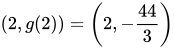
By the second derivative test, the point Failed to parse (MathML with SVG or PNG fallback (recommended for modern browsers and accessibility tools): Invalid response ("Math extension cannot connect to Restbase.") from server "https://wikimedia.org/api/rest_v1/":): {\displaystyle (2,g(2))=\left(2,-\frac{44}{3}\right)} is a relative minimum, while the point Failed to parse (MathML with SVG or PNG fallback (recommended for modern browsers and accessibility tools): Invalid response ("Math extension cannot connect to Restbase.") from server "https://wikimedia.org/api/rest_v1/":): {\displaystyle (-3,g(-3))=(-3,27)} is a relative maximum.
Step 4:  
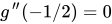
Test the potential inflection point: We know that Failed to parse (MathML with SVG or PNG fallback (recommended for modern browsers and accessibility tools): Invalid response ("Math extension cannot connect to Restbase.") from server "https://wikimedia.org/api/rest_v1/":): {\displaystyle g\,''(-1/2)=0} . On the other hand, it should be clear that if Failed to parse (MathML with SVG or PNG fallback (recommended for modern browsers and accessibility tools): Invalid response ("Math extension cannot connect to Restbase.") from server "https://wikimedia.org/api/rest_v1/":): {\displaystyle x<-1/2} , then Failed to parse (MathML with SVG or PNG fallback (recommended for modern browsers and accessibility tools): Invalid response ("Math extension cannot connect to Restbase.") from server "https://wikimedia.org/api/rest_v1/":): {\displaystyle g\,''(x)<0} . Similarly, if Failed to parse (MathML with SVG or PNG fallback (recommended for modern browsers and accessibility tools): Invalid response ("Math extension cannot connect to Restbase.") from server "https://wikimedia.org/api/rest_v1/":): {\displaystyle x>-1/2} , then Failed to parse (MathML with SVG or PNG fallback (recommended for modern browsers and accessibility tools): Invalid response ("Math extension cannot connect to Restbase.") from server "https://wikimedia.org/api/rest_v1/":): {\displaystyle g\,''(x)>0} . Thus, the second derivative "splits" around Failed to parse (MathML with SVG or PNG fallback (recommended for modern browsers and accessibility tools): Invalid response ("Math extension cannot connect to Restbase.") from server "https://wikimedia.org/api/rest_v1/":): {\displaystyle x=-1/2}   (i.e., changes sign), so the point Failed to parse (MathML with SVG or PNG fallback (recommended for modern browsers and accessibility tools): Invalid response ("Math extension cannot connect to Restbase.") from server "https://wikimedia.org/api/rest_v1/":): {\displaystyle \left(-1/2,g(-1/2)\right)}   is an inflection point.
Since
Failed to parse (MathML with SVG or PNG fallback (recommended for modern browsers and accessibility tools): Invalid response ("Math extension cannot connect to Restbase.") from server "https://wikimedia.org/api/rest_v1/":): {\displaystyle g\left(-\frac{1}{2}\right)\,=\,\frac{2}{3}\left(-\frac{1}{8}\right)+\frac{1}{4}-12\left(-\frac{1}{2}\right)\,=\,\frac{37}{6},}
our inflection point is
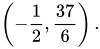
Failed to parse (MathML with SVG or PNG fallback (recommended for modern browsers and accessibility tools): Invalid response ("Math extension cannot connect to Restbase.") from server "https://wikimedia.org/api/rest_v1/":): {\displaystyle \left(-\frac{1}{2},\frac{37}{6}\right).}
Final Answer:  
There is a local minimum at Failed to parse (MathML with SVG or PNG fallback (recommended for modern browsers and accessibility tools): Invalid response ("Math extension cannot connect to Restbase.") from server "https://wikimedia.org/api/rest_v1/":): {\displaystyle \left(2,-\frac{44}{3}\right)} , a local maximum at Failed to parse (MathML with SVG or PNG fallback (recommended for modern browsers and accessibility tools): Invalid response ("Math extension cannot connect to Restbase.") from server "https://wikimedia.org/api/rest_v1/":): {\displaystyle (-3,27)} and an inflection point at Failed to parse (MathML with SVG or PNG fallback (recommended for modern browsers and accessibility tools): Invalid response ("Math extension cannot connect to Restbase.") from server "https://wikimedia.org/api/rest_v1/":): {\displaystyle \left(-\frac{1}{2},\frac{37}{6}\right).}

Return to Sample Exam