Difference between revisions of "022 Exam 2 Sample A, Problem 8"

From Math Wiki
Jump to navigation Jump to search
(Created page with "Use differentials to approximate the change in profit given <math style="vertical-align: -5%">x = 10</math>  units and <math style="vertical-align: 0%">dx = 0.2</math>&...")
 
Line 1: Line 1:
Use differentials to approximate the change in profit given <math style="vertical-align: -5%">x = 10</math>&thinsp; units and <math style="vertical-align: 0%">dx = 0.2</math>&thinsp; units, where profit is given by  <math style="vertical-align: -23%">P(x) = -4x^2 + 90x - 128</math>.
+
<span class="exam">Use differentials to approximate the change in profit given <math style="vertical-align: -5%">x = 10</math>&thinsp; units and <math style="vertical-align: 0%">dx = 0.2</math>&thinsp; units, where profit is given by  <math style="vertical-align: -23%">P(x) = -4x^2 + 90x - 128</math>.
  
 
{| class="mw-collapsible mw-collapsed" style = "text-align:left;"
 
{| class="mw-collapsible mw-collapsed" style = "text-align:left;"
 
!Foundations: &nbsp;  
 
!Foundations: &nbsp;  
 
|-
 
|-
|A differential is a method of approximating a change,  
+
|A differential is a method of linearly approximating the change of a function.  We use the derivative of the function at an initial point <math style="vertical-align: 0%">x_0</math> as the slope of a line, and use the standard relation
 
|-
 
|-
 
|
 
|
::<math>\int x^n dn = \frac{x^{n+1}}{n+1} + C</math>
+
::<math>m\,=\,\frac{\Delta y}{\Delta x},</math>
 
|-
 
|-
|For setup of the problem we need to integrate the region between the x - axis, the curve, x = 1, and x = 4.
+
|where <math style="vertical-align: -20%">\Delta y</math> represents the change in <math style="vertical-align: -20%">y</math> values, and <math style="vertical-align: 0%">\Delta x</math> represents the change in <math style="vertical-align: 0%">x</math> values. Due to the use of the derivative <math style="vertical-align: -22%">f'\left(x_0\right)</math> as the slope, we usually rewrite this using <math>dy</math> and <math style="vertical-align: 0%">dx</math> to indicate the relative changes. Thus,
 +
|-
 +
|
 +
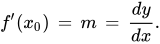
::<math>f'(x_0)\,=\,m\,=\,\frac{dy}{dx}.</math>
 +
|-
 +
|We can then rearrange this to find <math>dy=f'(x_0)\cdot dx.</math>
 +
|-
 +
 
 
|}
 
|}
  

Revision as of 20:12, 15 May 2015

Use differentials to approximate the change in profit given   units and   units, where profit is given by Failed to parse (MathML with SVG or PNG fallback (recommended for modern browsers and accessibility tools): Invalid response ("Math extension cannot connect to Restbase.") from server "https://wikimedia.org/api/rest_v1/":): {\displaystyle P(x) = -4x^2 + 90x - 128} .

Foundations:  
A differential is a method of linearly approximating the change of a function. We use the derivative of the function at an initial point Failed to parse (MathML with SVG or PNG fallback (recommended for modern browsers and accessibility tools): Invalid response ("Math extension cannot connect to Restbase.") from server "https://wikimedia.org/api/rest_v1/":): {\displaystyle x_0} as the slope of a line, and use the standard relation
Failed to parse (MathML with SVG or PNG fallback (recommended for modern browsers and accessibility tools): Invalid response ("Math extension cannot connect to Restbase.") from server "https://wikimedia.org/api/rest_v1/":): {\displaystyle m\,=\,\frac{\Delta y}{\Delta x},}
where Failed to parse (MathML with SVG or PNG fallback (recommended for modern browsers and accessibility tools): Invalid response ("Math extension cannot connect to Restbase.") from server "https://wikimedia.org/api/rest_v1/":): {\displaystyle \Delta y} represents the change in Failed to parse (MathML with SVG or PNG fallback (recommended for modern browsers and accessibility tools): Invalid response ("Math extension cannot connect to Restbase.") from server "https://wikimedia.org/api/rest_v1/":): {\displaystyle y} values, and Failed to parse (MathML with SVG or PNG fallback (recommended for modern browsers and accessibility tools): Invalid response ("Math extension cannot connect to Restbase.") from server "https://wikimedia.org/api/rest_v1/":): {\displaystyle \Delta x} represents the change in Failed to parse (MathML with SVG or PNG fallback (recommended for modern browsers and accessibility tools): Invalid response ("Math extension cannot connect to Restbase.") from server "https://wikimedia.org/api/rest_v1/":): {\displaystyle x} values. Due to the use of the derivative Failed to parse (MathML with SVG or PNG fallback (recommended for modern browsers and accessibility tools): Invalid response ("Math extension cannot connect to Restbase.") from server "https://wikimedia.org/api/rest_v1/":): {\displaystyle f'\left(x_0\right)} as the slope, we usually rewrite this using Failed to parse (MathML with SVG or PNG fallback (recommended for modern browsers and accessibility tools): Invalid response ("Math extension cannot connect to Restbase.") from server "https://wikimedia.org/api/rest_v1/":): {\displaystyle dy} and Failed to parse (MathML with SVG or PNG fallback (recommended for modern browsers and accessibility tools): Invalid response ("Math extension cannot connect to Restbase.") from server "https://wikimedia.org/api/rest_v1/":): {\displaystyle dx} to indicate the relative changes. Thus,
Failed to parse (MathML with SVG or PNG fallback (recommended for modern browsers and accessibility tools): Invalid response ("Math extension cannot connect to Restbase.") from server "https://wikimedia.org/api/rest_v1/":): {\displaystyle f'(x_0)\,=\,m\,=\,\frac{dy}{dx}.}
We can then rearrange this to find Failed to parse (MathML with SVG or PNG fallback (recommended for modern browsers and accessibility tools): Invalid response ("Math extension cannot connect to Restbase.") from server "https://wikimedia.org/api/rest_v1/":): {\displaystyle dy=f'(x_0)\cdot dx.}

 Solution:

Step 1:  
Step 2:  

Return to Sample Exam