Difference between revisions of "022 Exam 1 Sample A, Problem 5"
Jump to navigation
Jump to search
m |
|||
| Line 13: | Line 13: | ||
! Foundations: | ! Foundations: | ||
|- | |- | ||
| − | |Recall that the demand function, <math style="vertical-align: -25%">p(x)</math>, relates the price per unit <math style="vertical-align: -17%">p</math> to the number of units sold, <math style="vertical-align: 0%">x</math>. | + | |Recall that the '''demand function''', <math style="vertical-align: -25%">p(x)</math>, relates the price per unit <math style="vertical-align: -17%">p</math> to the number of units sold, <math style="vertical-align: 0%">x</math>. |
Moreover, we have several important important functions: | Moreover, we have several important important functions: | ||
|- | |- | ||
| | | | ||
| − | *<math style="vertical-align: -20%">C(x)</math>, the total cost to produce <math style="vertical-align: 0%">x</math> units;<br> | + | *<math style="vertical-align: -20%">C(x)</math>, the '''total cost''' to produce <math style="vertical-align: 0%">x</math> units;<br> |
| − | *<math style="vertical-align: -20%">R(x)</math>, the total revenue (or gross receipts) from producing <math style="vertical-align: 0%">x</math> units;<br> | + | *<math style="vertical-align: -20%">R(x)</math>, the '''total revenue''' (or gross receipts) from producing <math style="vertical-align: 0%">x</math> units;<br> |
| − | *<math style="vertical-align: -20%">P(x)</math>, the total profit from producing <math style="vertical-align: 0%">x</math> units.<br> | + | *<math style="vertical-align: -20%">P(x)</math>, the '''total profit''' from producing <math style="vertical-align: 0%">x</math> units.<br> |
|- | |- | ||
|In particular, we have the relations | |In particular, we have the relations | ||
| Line 31: | Line 31: | ||
::<math>R(x)=x\cdot p(x).</math> | ::<math>R(x)=x\cdot p(x).</math> | ||
|- | |- | ||
| − | |Finally, marginal profit at <math style="vertical-align: -20%">x_0</math> units is defined to be the effective | + | |Finally, the '''marginal profit''' at <math style="vertical-align: -20%">x_0</math> units is defined to be the effective profit of the next unit produced, and is precisely <math style="vertical-align: -22%">P'(x_0)</math>. Similarly, the '''marginal revenue''' or '''marginal cost''' would be <math style="vertical-align: -22%">R'(x_0)</math> or <math style="vertical-align: -22%">C'(x_0)</math>, respectively. |
|} | |} | ||
Revision as of 20:37, 13 April 2015
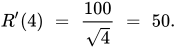
Find the marginal revenue and marginal profit at , given the demand function


and the cost function

Should the firm produce one more item under these conditions? Justify your answer.
| Foundations: |
|---|
| Recall that the demand function, , relates the price per unit to the number of units sold, .
Moreover, we have several important important functions: |
|
| In particular, we have the relations |
|
|
| and |
|
|
| Finally, the marginal profit at units is defined to be the effective profit of the next unit produced, and is precisely . Similarly, the marginal revenue or marginal cost would be or , respectively. |






Solution:
| Step 1: |
|---|
| Find the Important Functions: We have |
|
|
| From this, |
|
|


| Step 2: |
|---|
| Find the Marginal Revenue and Profit: The equation for marginal revenue is |
|
|
| while the equation for marginal profit is |
|
| At , we find |
|
|
| On the other hand, marginal profit is |
|
| Thus, it is not profitable to produce another item. |

| Final Answer: |
|---|
|
| Thus, it is not profitable to produce another item. |