Difference between revisions of "Math 22 Logarithmic Functions"
Jump to navigation
Jump to search
| Line 23: | Line 23: | ||
5.<math>\ln{x^n}=n\ln x</math> | 5.<math>\ln{x^n}=n\ln x</math> | ||
| + | |||
| + | |||
'''Exercises 1''' Use the properties of logarithms to rewrite the expression as the logarithm of a single quantity | '''Exercises 1''' Use the properties of logarithms to rewrite the expression as the logarithm of a single quantity | ||
Latest revision as of 09:44, 11 August 2020
Logarithm Function
The logarithm is defined as if and only if


Definition of the Natural Logarithmic Function
The natural logarithmic function, denoted by , is defined as if and only if


Properties of the Natural Logarithmic Function
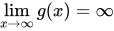
Let 1. The domain of is and the range of is 2. The x-intercept of the graph of is 3. The function is continuous, increasing, and one-to-one. 4. and


Inverse Properties of Logarithms and Exponents
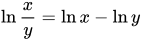
1. 2. 3. 4. 5.



Exercises 1 Use the properties of logarithms to rewrite the expression as the logarithm of a single quantity
a)

| Solution: |
|---|

b)

| Solution: |
|---|
![{\displaystyle 5\ln(x-6)+{\frac {1}{2}}\ln(5x+1)=\ln(x-6)^{5}+\ln[(5x+1)^{\frac {1}{2}}]=\ln[(x-6)^{5}{\sqrt {5x+1}}]}](https://wikimedia.org/api/rest_v1/media/math/render/svg/b548d1076509d504ed47a8fd0003873fa59dff4e)
c)

| Solution: |
|---|

d)

| Solution: |
|---|

Exercises 2 Solve for x.
a)

| Solution: |
|---|
| , so , hence |


b)

| Solution: |
|---|
| , so , so , hence |


![{\displaystyle x={\sqrt[{5}]{e^{3}}}}](https://wikimedia.org/api/rest_v1/media/math/render/svg/48f2e908d0f129ed8b9ee9687ead6c7be08cef4a)
This page were made by Tri Phan