Difference between revisions of "009A Sample Final A, Problem 3"
m |
m |
||
| Line 37: | Line 37: | ||
| <math>f(1)\,=\,1\,=\,4\cdot 1^2+C,</math> | | <math>f(1)\,=\,1\,=\,4\cdot 1^2+C,</math> | ||
|- | |- | ||
| − | |we can set <math style="vertical-align: - | + | |we can set <math style="vertical-align: -1%;">C=-3</math>, and the function will be continuous (the left and right hand limits agree, and equal the function's value at the point <math style="vertical-align: -2%;">x=1</math> ). |
(b) To test differentiability, we note that for <math style="vertical-align: -2%;">x<1</math>, | (b) To test differentiability, we note that for <math style="vertical-align: -2%;">x<1</math>, | ||
| Line 43: | Line 43: | ||
| <math>f'(x)=\frac{1}{2\sqrt{x}},</math> | | <math>f'(x)=\frac{1}{2\sqrt{x}},</math> | ||
|- | |- | ||
| − | |while for <math style="vertical-align: - | + | |while for <math style="vertical-align: -6%;">x> 1</math>, |
|- | |- | ||
| <math>f'(x)=8x.</math> | | <math>f'(x)=8x.</math> | ||
| Line 55: | Line 55: | ||
| <math>\lim_{x\rightarrow 1^+}f'(x)\,=\,8\cdot1\,=\,8.</math> | | <math>\lim_{x\rightarrow 1^+}f'(x)\,=\,8\cdot1\,=\,8.</math> | ||
|- | |- | ||
| − | |Since the left and right hand limit do not agree, the derivative does not exist at the point <math style="vertical-align: | + | |Since the left and right hand limit do not agree, the derivative does not exist at the point <math style="vertical-align: 1%;">x=1</math>.<br> |
|} | |} | ||
Revision as of 14:24, 27 March 2015
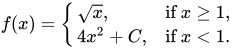
3. (Version I) Consider the following function:
(a) Find a value of Failed to parse (MathML with SVG or PNG fallback (recommended for modern browsers and accessibility tools): Invalid response ("Math extension cannot connect to Restbase.") from server "https://wikimedia.org/api/rest_v1/":): {\displaystyle C}
which makes Failed to parse (MathML with SVG or PNG fallback (recommended for modern browsers and accessibility tools): Invalid response ("Math extension cannot connect to Restbase.") from server "https://wikimedia.org/api/rest_v1/":): {\displaystyle f}
continuous at Failed to parse (MathML with SVG or PNG fallback (recommended for modern browsers and accessibility tools): Invalid response ("Math extension cannot connect to Restbase.") from server "https://wikimedia.org/api/rest_v1/":): {\displaystyle x=1.}
(b) With your choice of Failed to parse (MathML with SVG or PNG fallback (recommended for modern browsers and accessibility tools): Invalid response ("Math extension cannot connect to Restbase.") from server "https://wikimedia.org/api/rest_v1/":): {\displaystyle C}
, is Failed to parse (MathML with SVG or PNG fallback (recommended for modern browsers and accessibility tools): Invalid response ("Math extension cannot connect to Restbase.") from server "https://wikimedia.org/api/rest_v1/":): {\displaystyle f}
differentiable at Failed to parse (MathML with SVG or PNG fallback (recommended for modern browsers and accessibility tools): Invalid response ("Math extension cannot connect to Restbase.") from server "https://wikimedia.org/api/rest_v1/":): {\displaystyle x=1}
? Use the definition of the derivative to motivate your answer.
3. (Version II) Consider the following function:
Failed to parse (MathML with SVG or PNG fallback (recommended for modern browsers and accessibility tools): Invalid response ("Math extension cannot connect to Restbase.") from server "https://wikimedia.org/api/rest_v1/":): {\displaystyle g(x)=\begin{cases} \sqrt{x^{2}+3}, & \quad\mbox{if } x\geq1\\ \frac{1}{4}x^{2}+C, & \quad\mbox{if }x<1. \end{cases}}
(a) Find a value of Failed to parse (MathML with SVG or PNG fallback (recommended for modern browsers and accessibility tools): Invalid response ("Math extension cannot connect to Restbase.") from server "https://wikimedia.org/api/rest_v1/":): {\displaystyle C}
which makes Failed to parse (MathML with SVG or PNG fallback (recommended for modern browsers and accessibility tools): Invalid response ("Math extension cannot connect to Restbase.") from server "https://wikimedia.org/api/rest_v1/":): {\displaystyle f}
continuous at Failed to parse (MathML with SVG or PNG fallback (recommended for modern browsers and accessibility tools): Invalid response ("Math extension cannot connect to Restbase.") from server "https://wikimedia.org/api/rest_v1/":): {\displaystyle x=1.}
(b) With your choice of Failed to parse (MathML with SVG or PNG fallback (recommended for modern browsers and accessibility tools): Invalid response ("Math extension cannot connect to Restbase.") from server "https://wikimedia.org/api/rest_v1/":): {\displaystyle C}
, is Failed to parse (MathML with SVG or PNG fallback (recommended for modern browsers and accessibility tools): Invalid response ("Math extension cannot connect to Restbase.") from server "https://wikimedia.org/api/rest_v1/":): {\displaystyle f}
differentiable at Failed to parse (MathML with SVG or PNG fallback (recommended for modern browsers and accessibility tools): Invalid response ("Math extension cannot connect to Restbase.") from server "https://wikimedia.org/api/rest_v1/":): {\displaystyle x=1}
? Use the definition of the derivative to motivate your answer.
| Foundations: |
|---|
| A function Failed to parse (MathML with SVG or PNG fallback (recommended for modern browsers and accessibility tools): Invalid response ("Math extension cannot connect to Restbase.") from server "https://wikimedia.org/api/rest_v1/":): {\displaystyle f} is continuous at a point Failed to parse (MathML with SVG or PNG fallback (recommended for modern browsers and accessibility tools): Invalid response ("Math extension cannot connect to Restbase.") from server "https://wikimedia.org/api/rest_v1/":): {\displaystyle x_0 } if |
| Failed to parse (MathML with SVG or PNG fallback (recommended for modern browsers and accessibility tools): Invalid response ("Math extension cannot connect to Restbase.") from server "https://wikimedia.org/api/rest_v1/":): {\displaystyle \lim_{x\rightarrow x_0} f(x) = f\left(x_0\right).} |
| This can be viewed as saying the left and right hand limits exist, and are equal. For problems like these, where we are trying to find a particular value for Failed to parse (MathML with SVG or PNG fallback (recommended for modern browsers and accessibility tools): Invalid response ("Math extension cannot connect to Restbase.") from server "https://wikimedia.org/api/rest_v1/":): {\displaystyle C} , we can just set the two descriptions of the function to be equal at the value where the definition of Failed to parse (MathML with SVG or PNG fallback (recommended for modern browsers and accessibility tools): Invalid response ("Math extension cannot connect to Restbase.") from server "https://wikimedia.org/api/rest_v1/":): {\displaystyle f} changes. |
| When we speak of differentiability at such a transition point, being "motivated by the definition of the derivative" really means acknowledge that the derivative is a limit, and for a limit to exist it must agree from the left and the right. This means we must show the derivatives agree for both the descriptions of Failed to parse (MathML with SVG or PNG fallback (recommended for modern browsers and accessibility tools): Invalid response ("Math extension cannot connect to Restbase.") from server "https://wikimedia.org/api/rest_v1/":): {\displaystyle f}
at the transition point. |
Solution:
| Version I: |
|---|
| (a) For continuity, we evaluate both rules for the function at the transition point Failed to parse (MathML with SVG or PNG fallback (recommended for modern browsers and accessibility tools): Invalid response ("Math extension cannot connect to Restbase.") from server "https://wikimedia.org/api/rest_v1/":): {\displaystyle x=1} , set the results equal, and then solve for Failed to parse (MathML with SVG or PNG fallback (recommended for modern browsers and accessibility tools): Invalid response ("Math extension cannot connect to Restbase.") from server "https://wikimedia.org/api/rest_v1/":): {\displaystyle C} . Since we want |
| Failed to parse (MathML with SVG or PNG fallback (recommended for modern browsers and accessibility tools): Invalid response ("Math extension cannot connect to Restbase.") from server "https://wikimedia.org/api/rest_v1/":): {\displaystyle f(1)\,=\,1\,=\,4\cdot 1^2+C,} |
| we can set Failed to parse (MathML with SVG or PNG fallback (recommended for modern browsers and accessibility tools): Invalid response ("Math extension cannot connect to Restbase.") from server "https://wikimedia.org/api/rest_v1/":): {\displaystyle C=-3}
, and the function will be continuous (the left and right hand limits agree, and equal the function's value at the point Failed to parse (MathML with SVG or PNG fallback (recommended for modern browsers and accessibility tools): Invalid response ("Math extension cannot connect to Restbase.") from server "https://wikimedia.org/api/rest_v1/":): {\displaystyle x=1}
).
(b) To test differentiability, we note that for Failed to parse (MathML with SVG or PNG fallback (recommended for modern browsers and accessibility tools): Invalid response ("Math extension cannot connect to Restbase.") from server "https://wikimedia.org/api/rest_v1/":): {\displaystyle x<1} , |
| Failed to parse (MathML with SVG or PNG fallback (recommended for modern browsers and accessibility tools): Invalid response ("Math extension cannot connect to Restbase.") from server "https://wikimedia.org/api/rest_v1/":): {\displaystyle f'(x)=\frac{1}{2\sqrt{x}},} |
| while for Failed to parse (MathML with SVG or PNG fallback (recommended for modern browsers and accessibility tools): Invalid response ("Math extension cannot connect to Restbase.") from server "https://wikimedia.org/api/rest_v1/":): {\displaystyle x> 1} , |
| Failed to parse (MathML with SVG or PNG fallback (recommended for modern browsers and accessibility tools): Invalid response ("Math extension cannot connect to Restbase.") from server "https://wikimedia.org/api/rest_v1/":): {\displaystyle f'(x)=8x.} |
| Thus |
| Failed to parse (MathML with SVG or PNG fallback (recommended for modern browsers and accessibility tools): Invalid response ("Math extension cannot connect to Restbase.") from server "https://wikimedia.org/api/rest_v1/":): {\displaystyle \lim_{x\rightarrow 1^-}f'(x)\,=\,\frac{1}{2\sqrt{1}}\,=\,\frac{1}{2},} |
| but |
| Failed to parse (MathML with SVG or PNG fallback (recommended for modern browsers and accessibility tools): Invalid response ("Math extension cannot connect to Restbase.") from server "https://wikimedia.org/api/rest_v1/":): {\displaystyle \lim_{x\rightarrow 1^+}f'(x)\,=\,8\cdot1\,=\,8.} |
| Since the left and right hand limit do not agree, the derivative does not exist at the point Failed to parse (MathML with SVG or PNG fallback (recommended for modern browsers and accessibility tools): Invalid response ("Math extension cannot connect to Restbase.") from server "https://wikimedia.org/api/rest_v1/":): {\displaystyle x=1}
. |
| Version II: |
|---|