Difference between revisions of "Math 22 Functions"
| Line 55: | Line 55: | ||
|<math>f(-3)=\sqrt{-3+1}=\sqrt{-2}=undefined</math> | |<math>f(-3)=\sqrt{-3+1}=\sqrt{-2}=undefined</math> | ||
|} | |} | ||
| + | ==Combinations of Functions== | ||
| + | Two functions can be combine in varuious way. For example, let <math>f(x)=2x+1</math> and <math>g(x)=x^2+3</math> | ||
==Composite Function== | ==Composite Function== | ||
Revision as of 11:48, 12 July 2020
Basic Definitions
A function is a relationship between two variables such that to each value of the independent variable there corresponds exactly one value of the dependent variable.
The domain of the function is the set of all values of the independent variable for which the function is defined.
The range of the function is the set of all values taken on by the dependent variable.
Function notation: We usually denote a function f of x as . For example, function can be written as in function notation.


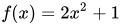
Exercises Find the domain and range of the following functions:
1)

| Solution: |
|---|
| The domain is where the function defines (or all possible values of x). So, the radicand (everything under the square root) need to be non-negative. |
| So, |
| Answer: or |
| The range is all of possible outcomes (values of y). Notice that Failed to parse (Conversion error. Server ("https://wikimedia.org/api/rest_") reported: "Cannot get mml. Server problem."): {\displaystyle {\sqrt {x+1}}} is never negative. So is never negative. |
| Answer: Failed to parse (Conversion error. Server ("https://wikimedia.org/api/rest_") reported: "Cannot get mml. Server problem."): {\displaystyle y\geq 0} or |


Evaluate a Function
To evaluate a function at . We just need to plug in to find .


Example: Find the value of the function at
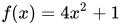

Answer:



Exercises Find the value of the function at the given values:
2) at

| Solution: |
|---|
| isn't in the domain of . So, undefined |
| OR |




Combinations of Functions
Two functions can be combine in varuious way. For example, let Failed to parse (Conversion error. Server ("https://wikimedia.org/api/rest_") reported: "Cannot get mml. Server problem."): {\displaystyle f(x)=2x+1} and
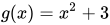
Composite Function
Let and be functions. The function given by is the composite function of and .



Examples: Let Failed to parse (Conversion error. Server ("https://wikimedia.org/api/rest_") reported: "Cannot get mml. Server problem."): {\displaystyle f(x)=2x+1} and
So,

Exercises Given and . Find each composite function below
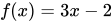
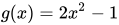
1)

| Solution: |
|---|

2)

| Solution: |
|---|

Inverse Functions
Informally, the inverse function of is another function that “undoes” what has done. We usually denote as Failed to parse (Conversion error. Server ("https://wikimedia.org/api/rest_") reported: "Cannot get mml. Server problem."): {\displaystyle f^{-1}}
Formal definition of inverse function. Let and be functions such that and Under these conditions, the function is the inverse function of , we denote Failed to parse (Conversion error. Server ("https://wikimedia.org/api/rest_") reported: "Cannot get mml. Server problem."): {\displaystyle g=f^{-1}}


Important: The domain of must be equal to the range of Failed to parse (Conversion error. Server ("https://wikimedia.org/api/rest_") reported: "Cannot get mml. Server problem."): {\displaystyle f^{-1}} , and the range of must be equal to the domain of Failed to parse (Conversion error. Server ("https://wikimedia.org/api/rest_") reported: "Cannot get mml. Server problem."): {\displaystyle f^{-1}}
Exercise:
1) Show two functions Failed to parse (Conversion error. Server ("https://wikimedia.org/api/rest_") reported: "Cannot get mml. Server problem."): {\displaystyle f(x)=4x} and Failed to parse (Conversion error. Server ("https://wikimedia.org/api/rest_") reported: "Cannot get mml. Server problem."): {\displaystyle g(x)={\frac {1}{4}}x} are inverses
| Solution: |
|---|
| We want to show that these two functions satisfy and Failed to parse (Conversion error. Server ("https://wikimedia.org/api/rest_") reported: "Cannot get mml. Server problem."): {\displaystyle g(f(x))=x} . So |
| Consider |
| and |
| Hence, Failed to parse (Conversion error. Server ("https://wikimedia.org/api/rest_") reported: "Cannot get mml. Server problem."): {\displaystyle f(x)=4x} and Failed to parse (Conversion error. Server ("https://wikimedia.org/api/rest_") reported: "Cannot get mml. Server problem."): {\displaystyle g(x)={\frac {1}{4}}x} are inverses |



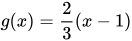
2) Show two functions and Failed to parse (Conversion error. Server ("https://wikimedia.org/api/rest_") reported: "Cannot get mml. Server problem."): {\displaystyle g(x)={\frac {2}{3}}(x-1)} are inverses
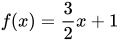
| Solution: |
|---|
| We want to show that these two functions satisfy and Failed to parse (Conversion error. Server ("https://wikimedia.org/api/rest_") reported: "Cannot get mml. Server problem."): {\displaystyle g(f(x))=x} . So |
| Consider Failed to parse (Conversion error. Server ("https://wikimedia.org/api/rest_") reported: "Cannot get mml. Server problem."): {\displaystyle f(g(x))=f({\frac {2}{3}}(x-1))={\frac {3}{2}}[{\frac {2}{3}}(x-1)]+1=(x-1)+1=x} |
| and |
| Hence, and are inverses |

This page were made by Tri Phan