Difference between revisions of "009A Sample Final 3, Problem 1"
Jump to navigation
Jump to search
| Line 112: | Line 112: | ||
|- | |- | ||
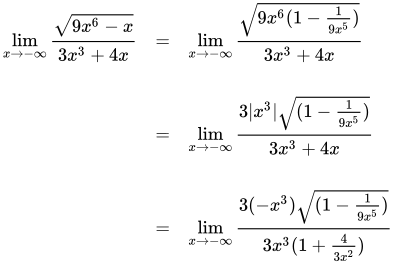
| <math>\begin{array}{rcl} | | <math>\begin{array}{rcl} | ||
| − | \displaystyle{\lim_{x\rightarrow -\infty} \frac{\sqrt{9x^6-x}}{3x^3+4x}} & = & \displaystyle{\lim_{x\rightarrow -\infty} \frac{\sqrt{9x^6- | + | \displaystyle{\lim_{x\rightarrow -\infty} \frac{\sqrt{9x^6-x}}{3x^3+4x}} & = & \displaystyle{\lim_{x\rightarrow -\infty} \frac{\sqrt{9x^6(1-\frac{1}{9x^5})}}{3x^3+4x}}\\ |
&&\\ | &&\\ | ||
| − | & = & \displaystyle{\lim_{x\rightarrow -\infty} \frac{\sqrt{ | + | & = & \displaystyle{\lim_{x\rightarrow -\infty} \frac{3|x^3|\sqrt{(1-\frac{1}{9x^5})}}{3x^3+4x}}\\ |
| + | &&\\ | ||
| + | & = & \displaystyle{\lim_{x\rightarrow -\infty} \frac{3(-x^3)\sqrt{(1-\frac{1}{9x^5})}}{3x^3(1+\frac{4}{3x^2})}} | ||
\end{array}</math> | \end{array}</math> | ||
|} | |} | ||
| Line 124: | Line 126: | ||
|- | |- | ||
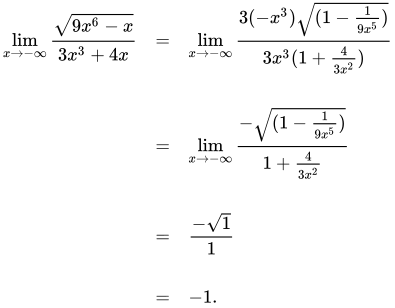
| <math>\begin{array}{rcl} | | <math>\begin{array}{rcl} | ||
| − | \displaystyle{\lim_{x\rightarrow -\infty} \frac{\sqrt{9x^6-x}}{3x^3+4x}} & = & \displaystyle | + | \displaystyle{\lim_{x\rightarrow -\infty} \frac{\sqrt{9x^6-x}}{3x^3+4x}} & = & \displaystyle{\lim_{x\rightarrow -\infty} \frac{3(-x^3)\sqrt{(1-\frac{1}{9x^5})}}{3x^3(1+\frac{4}{3x^2})}}\\ |
| + | &&\\ | ||
| + | & = & \displaystyle{\lim_{x\rightarrow -\infty} \frac{-\sqrt{(1-\frac{1}{9x^5})}}{1+\frac{4}{3x^2}}}\\ | ||
&&\\ | &&\\ | ||
| − | & = & \displaystyle{\frac{\sqrt{ | + | & = & \displaystyle{\frac{-\sqrt{1}}{1}}\\ |
&&\\ | &&\\ | ||
| − | & = & \displaystyle{1.} | + | & = & \displaystyle{-1.}\\ |
\end{array}</math> | \end{array}</math> | ||
|} | |} | ||
| Line 140: | Line 144: | ||
| '''(b)''' <math>-\frac{3}{4}</math> | | '''(b)''' <math>-\frac{3}{4}</math> | ||
|- | |- | ||
| − | | '''(c)''' <math>1</math> | + | | '''(c)''' <math>-1</math> |
|} | |} | ||
[[009A_Sample_Final_3|'''<u>Return to Sample Exam</u>''']] | [[009A_Sample_Final_3|'''<u>Return to Sample Exam</u>''']] | ||
Latest revision as of 09:07, 4 December 2017
Find each of the following limits if it exists. If you think the limit does not exist provide a reason.
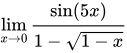
(a)
(b) given that


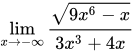
(c)
| Foundations: |
|---|
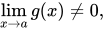
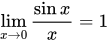
| 1. If we have |
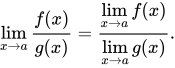
| 2. |
Solution:
(a)
| Step 1: |
|---|
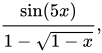
| We begin by noticing that we plug in into |
| we get |


| Step 2: |
|---|
| Now, we multiply the numerator and denominator by the conjugate of the denominator. |
| Hence, we have |

(b)
| Step 1: |
|---|
| Since |
| we have |
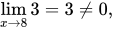
![{\displaystyle {\begin{array}{rcl}\displaystyle {-2}&=&\displaystyle {\lim _{x\rightarrow 8}{\bigg [}{\frac {xf(x)}{3}}{\bigg ]}}\\&&\\&=&\displaystyle {\frac {\displaystyle {\lim _{x\rightarrow 8}xf(x)}}{\displaystyle {\lim _{x\rightarrow 8}3}}}\\&&\\&=&\displaystyle {{\frac {\displaystyle {\lim _{x\rightarrow 8}xf(x)}}{3}}.}\end{array}}}](https://wikimedia.org/api/rest_v1/media/math/render/svg/2127e38d7539b39be8a6a1cb70757242045426a6)
| Step 2: |
|---|
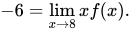
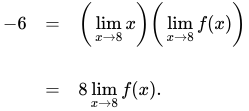
| If we multiply both sides of the last equation by we get |
| Now, using properties of limits, we have |

| Step 3: |
|---|
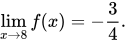
| Solving for in the last equation, |
| we get |
|
|

(c)
| Step 1: |
|---|
| First, we write |
| Step 2: |
|---|
| Now, we have |
| Final Answer: |
|---|
| (a) |
| (b) |
| (c) |


