Difference between revisions of "009A Sample Midterm 2, Problem 5"
Jump to navigation
Jump to search
| Line 85: | Line 85: | ||
|First, we use the Quotient Rule to get | |First, we use the Quotient Rule to get | ||
|- | |- | ||
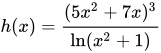
| − | | <math>h'(x)=\frac{\ln(x^2+1)((5x^2+7x)^ | + | | <math>h'(x)=\frac{\ln(x^2+1)((5x^2+7x)^3)'-(5x^2+7x)^3(\ln(x^2+1))'}{(\ln(x^2+1))^2}.</math> |
|} | |} | ||
| Line 94: | Line 94: | ||
|- | |- | ||
| <math>\begin{array}{rcl} | | <math>\begin{array}{rcl} | ||
| − | \displaystyle{h'(x)} & = & \displaystyle{\frac{\ln(x^2+1)((5x^2+7x)^ | + | \displaystyle{h'(x)} & = & \displaystyle{\frac{\ln(x^2+1)((5x^2+7x)^3)'-(5x^2+7x)^3(\ln(x^2+1))'}{(\ln(x^2+1))^2}}\\ |
&&\\ | &&\\ | ||
| − | & = & \displaystyle{\frac{\ln(x^2+1) | + | & = & \displaystyle{\frac{\ln(x^2+1)3(5x^2+7x)^2(5x^2+7x)'-(5x^2+7x)^3\frac{1}{x^2+1}(x^2+1)'}{(\ln(x^2+1))^2}}\\ |
&&\\ | &&\\ | ||
| − | & = & \displaystyle{\frac{\ln(x^2+1) | + | & = & \displaystyle{\frac{\ln(x^2+1)3(5x^2+7x)^2(10x+7)-(5x^2+7x)^3\frac{1}{x^2+1}(2x)}{(\ln(x^2+1))^2}.} |
\end{array}</math> | \end{array}</math> | ||
|} | |} | ||
| Line 110: | Line 110: | ||
| '''(b)''' <math>g'(x)=\cos(\cos(e^x))(-\sin(e^x))(e^x)</math> | | '''(b)''' <math>g'(x)=\cos(\cos(e^x))(-\sin(e^x))(e^x)</math> | ||
|- | |- | ||
| − | | '''(c)''' <math>h'(x)=\frac{\ln(x^2+1) | + | | '''(c)''' <math>h'(x)=\frac{\ln(x^2+1)3(5x^2+7x)^2(10x+7)-(5x^2+7x)^3\frac{1}{x^2+1}(2x)}{(\ln(x^2+1))^2}</math> |
|} | |} | ||
[[009A_Sample_Midterm_2|'''<u>Return to Sample Exam</u>''']] | [[009A_Sample_Midterm_2|'''<u>Return to Sample Exam</u>''']] | ||
Revision as of 12:41, 3 May 2017
Find the derivatives of the following functions. Do not simplify.
(a)

(b)

(c)
| Foundations: |
|---|
| 1. Chain Rule |
| 2. Trig Derivatives |
| 3. Quotient Rule |
| 4. Derivative of natural logarithm |



Solution:
(a)
| Step 1: |
|---|
| First, we use the Chain Rule to get |

| Step 2: |
|---|
| Now, we use the Chain Rule again to get |
|
|

(b)
| Step 1: |
|---|
| First, we use the Chain Rule to get |

| Step 2: |
|---|
| Now, we use the Chain Rule again to get |
|
|

(c)
| Step 1: |
|---|
| First, we use the Quotient Rule to get |

| Step 2: |
|---|
| Now, we use the Chain Rule to get |

| Final Answer: |
|---|
| (a) |
| (b) |
| (c) |


