Difference between revisions of "009B Sample Midterm 2, Problem 4"

From Math Wiki
Jump to navigation Jump to search
Line 7: Line 7:
 
!Foundations:    
 
!Foundations:    
 
|-
 
|-
|'''1.''' Integration by parts tells us <math style="vertical-align: -15px">\int u~dv=uv-\int v~du.</math>
+
|'''1.''' Integration by parts tells us  
 
|-
 
|-
|'''2.''' How would you integrate <math style="vertical-align: -15px">\int e^x\sin x~dx?</math>
+
|&nbsp; &nbsp; &nbsp; &nbsp; <math style="vertical-align: -15px">\int u~dv=uv-\int v~du.</math>
 +
|-
 +
|'''2.''' How would you integrate &nbsp;<math style="vertical-align: -15px">\int e^x\sin x~dx?</math>
 
|-
 
|-
 
|
 
|
::You could use integration by parts.
+
&nbsp; &nbsp; &nbsp; &nbsp; You can use integration by parts.
 
|-
 
|-
 
|
 
|
::Let <math style="vertical-align: -5px">u=\sin(x)</math> and <math style="vertical-align: 0px">dv=e^x~dx.</math> Then, <math style="vertical-align: -5px">du=\cos(x)~dx</math> and <math style="vertical-align: 0px">v=e^x.</math>
+
&nbsp; &nbsp; &nbsp; &nbsp; Let &nbsp;<math style="vertical-align: -5px">u=\sin(x)</math>&nbsp; and &nbsp;<math style="vertical-align: 0px">dv=e^x~dx.</math>  
 +
|-
 +
|&nbsp; &nbsp; &nbsp; &nbsp; Then, &nbsp;<math style="vertical-align: -5px">du=\cos(x)~dx</math>&nbsp; and &nbsp;<math style="vertical-align: 0px">v=e^x.</math>
 
|-
 
|-
 
|
 
|
::Thus, <math style="vertical-align: -15px">\int e^x\sin x~dx\,=\,e^x\sin(x)-\int e^x\cos(x)~dx.</math>
+
&nbsp; &nbsp; &nbsp; &nbsp; Thus, &nbsp;<math style="vertical-align: -15px">\int e^x\sin x~dx=e^x\sin(x)-\int e^x\cos(x)~dx.</math>
 
|-
 
|-
 
|
 
|
::Now, we need to use integration by parts a second time.
+
&nbsp; &nbsp; &nbsp; &nbsp; Now, we need to use integration by parts a second time.
 
|-
 
|-
 
|
 
|
::Let <math style="vertical-align: -5px">u=\cos(x)</math> and <math style="vertical-align: 0px">dv=e^x~dx.</math> Then, <math style="vertical-align: -5px">du=-\sin(x)~dx</math> and <math style="vertical-align: 0px">v=e^x.</math> So,
+
&nbsp; &nbsp; &nbsp; &nbsp; Let &nbsp;<math style="vertical-align: -5px">u=\cos(x)</math>&nbsp; and &nbsp;<math style="vertical-align: 0px">dv=e^x~dx.</math>  
 +
|-
 +
|&nbsp; &nbsp; &nbsp; &nbsp; Then, &nbsp;<math style="vertical-align: -5px">du=-\sin(x)~dx</math>&nbsp; and &nbsp;<math style="vertical-align: 0px">v=e^x.</math>
 +
|-
 +
|&nbsp; &nbsp; &nbsp; &nbsp; Therefore,
 
|-
 
|-
 
|
 
|
::<math>\begin{array}{rcl}
+
&nbsp; &nbsp; &nbsp; &nbsp; <math>\begin{array}{rcl}
 
\displaystyle{\int e^x\sin x~dx} & = & \displaystyle{e^x\sin(x)-(e^x\cos(x)-\int -e^x\sin(x)~dx}\\
 
\displaystyle{\int e^x\sin x~dx} & = & \displaystyle{e^x\sin(x)-(e^x\cos(x)-\int -e^x\sin(x)~dx}\\
 
&&\\
 
&&\\
Line 34: Line 42:
 
|-
 
|-
 
|
 
|
::Notice, we are back where we started.  
+
&nbsp; &nbsp; &nbsp; &nbsp; Notice, we are back where we started.  
 
|-
 
|-
|
+
|&nbsp; &nbsp; &nbsp; &nbsp; Therefore, adding the last term on the right hand side to the opposite side, we get
::So, adding the last term on the right hand side to the opposite side, we get
 
 
|-
 
|-
 
|
 
|
::<math style="vertical-align: -13px">2\int e^x\sin (x)~dx\,=\,e^x(\sin(x)-\cos(x)).</math>
+
&nbsp; &nbsp; &nbsp; &nbsp; <math style="vertical-align: -13px">2\int e^x\sin (x)~dx=e^x(\sin(x)-\cos(x)).</math>
 
|-
 
|-
 
|
 
|
::Hence, <math style="vertical-align: -15px">\int e^x\sin (x)~dx\,=\,\frac{e^x}{2}(\sin(x)-\cos(x))+C.</math>
+
&nbsp; &nbsp; &nbsp; &nbsp; Hence, &nbsp;<math style="vertical-align: -15px">\int e^x\sin (x)~dx=\frac{e^x}{2}(\sin(x)-\cos(x))+C.</math>
 
|}
 
|}
 +
  
 
'''Solution:'''
 
'''Solution:'''
Line 50: Line 58:
 
!Step 1: &nbsp;  
 
!Step 1: &nbsp;  
 
|-
 
|-
|We proceed using integration by parts. Let <math style="vertical-align: -5px">u=\sin(2x)</math> and <math style="vertical-align: 0px">dv=e^{-2x}dx.</math> Then, <math style="vertical-align: -5px">du=2\cos(2x)dx</math> and <math style="vertical-align: -13px">v=\frac{e^{-2x}}{-2}.</math>
+
|We proceed using integration by parts.  
 +
|-
 +
|Let &nbsp;<math style="vertical-align: -5px">u=\sin(2x)</math>&nbsp; and &nbsp;<math style="vertical-align: 0px">dv=e^{-2x}dx.</math>  
 +
|-
 +
|Then, &nbsp;<math style="vertical-align: -5px">du=2\cos(2x)dx</math>&nbsp; and &nbsp;<math style="vertical-align: -13px">v=\frac{e^{-2x}}{-2}.</math>
 
|-
 
|-
|So, we get  
+
|Thus, we get  
 
|-
 
|-
|  
+
|
::<math>\begin{array}{rcl}
+
&nbsp; &nbsp; &nbsp; &nbsp; <math>\begin{array}{rcl}
 
\displaystyle{\int e^{-2x}\sin (2x)~dx} & = & \displaystyle{\frac{\sin(2x)e^{-2x}}{-2}-\int \frac{e^{-2x}2\cos(2x)~dx}{-2}}\\
 
\displaystyle{\int e^{-2x}\sin (2x)~dx} & = & \displaystyle{\frac{\sin(2x)e^{-2x}}{-2}-\int \frac{e^{-2x}2\cos(2x)~dx}{-2}}\\
 
&&\\
 
&&\\
& = & \displaystyle{\frac{\sin(2x)e^{-2x}}{-2}+\int e^{-2x}\cos(2x)~dx.}\\
+
& = & \displaystyle{\frac{\sin(2x)e^{-2x}}{-2}+\int e^{-2x}\cos(2x)~dx.}
 
\end{array}</math>
 
\end{array}</math>
 
|}
 
|}
Line 65: Line 77:
 
!Step 2: &nbsp;
 
!Step 2: &nbsp;
 
|-
 
|-
|Now, we need to use integration by parts again. Let <math style="vertical-align: -5px">u=\cos(2x)</math> and <math style="vertical-align: 0px">dv=e^{-2x}dx.</math> Then, <math style="vertical-align: -5px">du=-2\sin(2x)dx</math> and <math style="vertical-align: -13px">v=\frac{e^{-2x}}{-2}.</math>
+
|Now, we need to use integration by parts again.  
 +
|-
 +
|Let &nbsp;<math style="vertical-align: -5px">u=\cos(2x)</math>&nbsp; and &nbsp;<math style="vertical-align: 0px">dv=e^{-2x}dx.</math>  
 +
|-
 +
|Then, &nbsp;<math style="vertical-align: -5px">du=-2\sin(2x)dx</math>&nbsp; and &nbsp;<math style="vertical-align: -13px">v=\frac{e^{-2x}}{-2}.</math>
 
|-
 
|-
|So, we get  
+
|Therefore, we get  
 
|-
 
|-
 
|
 
|
::<math style="vertical-align: -13px">\int e^{-2x}\sin (2x)~dx=\frac{\sin(2x)e^{-2x}}{-2}+\frac{\cos(2x)e^{-2x}}{-2}-\int e^{-2x}\sin(2x)~dx</math>.
+
&nbsp; &nbsp; &nbsp; &nbsp; <math style="vertical-align: -13px">\int e^{-2x}\sin (2x)~dx=\frac{\sin(2x)e^{-2x}}{-2}+\frac{\cos(2x)e^{-2x}}{-2}-\int e^{-2x}\sin(2x)~dx.</math>
 
|}
 
|}
  
Line 76: Line 92:
 
!Step 3: &nbsp;
 
!Step 3: &nbsp;
 
|-
 
|-
|Notice that the integral on the right of the last equation in Step 2 is the same integral that we had at the beginning of the problem.  
+
|Notice that the integral on the right of the last equation in Step 2
 +
|-
 +
|is the same integral that we had at the beginning of the problem.  
 
|-
 
|-
|So, if we add the integral on the right to the other side of the equation, we get
+
|Thus, if we add the integral on the right to the other side of the equation, we get
 
|-
 
|-
|
+
| &nbsp; &nbsp; &nbsp; &nbsp; <math>2\int e^{-2x}\sin (2x)~dx=\frac{\sin(2x)e^{-2x}}{-2}+\frac{\cos(2x)e^{-2x}}{-2}.</math>
::<math>2\int e^{-2x}\sin (2x)~dx=\frac{\sin(2x)e^{-2x}}{-2}+\frac{\cos(2x)e^{-2x}}{-2}.</math>
 
 
|-
 
|-
 
|Now, we divide both sides by 2 to get  
 
|Now, we divide both sides by 2 to get  
 
|-
 
|-
|
+
| &nbsp; &nbsp; &nbsp; &nbsp; <math>\int e^{-2x}\sin (2x)~dx=\frac{\sin(2x)e^{-2x}}{-4}+\frac{\cos(2x)e^{-2x}}{-4}.</math>
::<math>\int e^{-2x}\sin (2x)~dx=\frac{\sin(2x)e^{-2x}}{-4}+\frac{\cos(2x)e^{-2x}}{-4}.</math>
 
 
|-
 
|-
 
|Thus, the final answer is  
 
|Thus, the final answer is  
 
|-
 
|-
|
+
|&nbsp; &nbsp; &nbsp; &nbsp; <math style="vertical-align: -13px">\int e^{-2x}\sin (2x)~dx=\frac{e^{-2x}}{-4}((\sin(2x)+\cos(2x))+C.</math>
::<math style="vertical-align: -13px">\int e^{-2x}\sin (2x)~dx=\frac{e^{-2x}}{-4}((\sin(2x)+\cos(2x))+C.</math>
 
 
|}
 
|}
 +
  
 
{| class="mw-collapsible mw-collapsed" style = "text-align:left;"
 
{| class="mw-collapsible mw-collapsed" style = "text-align:left;"
 
!Final Answer: &nbsp;  
 
!Final Answer: &nbsp;  
 
|-
 
|-
| &nbsp;&nbsp; <math>\frac{e^{-2x}}{-4}((\sin(2x)+\cos(2x))+C</math>
+
| &nbsp;&nbsp; &nbsp; &nbsp; <math>\frac{e^{-2x}}{-4}((\sin(2x)+\cos(2x))+C</math>
 
|}
 
|}
 
[[009B_Sample_Midterm_2|'''<u>Return to Sample Exam</u>''']]
 
[[009B_Sample_Midterm_2|'''<u>Return to Sample Exam</u>''']]

Revision as of 11:16, 9 April 2017

Evaluate the integral:
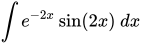
Failed to parse (MathML with SVG or PNG fallback (recommended for modern browsers and accessibility tools): Invalid response ("Math extension cannot connect to Restbase.") from server "https://wikimedia.org/api/rest_v1/":): {\displaystyle \int e^{-2x}\sin (2x)~dx}


Foundations:  
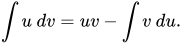
1. Integration by parts tells us
        Failed to parse (MathML with SVG or PNG fallback (recommended for modern browsers and accessibility tools): Invalid response ("Math extension cannot connect to Restbase.") from server "https://wikimedia.org/api/rest_v1/":): {\displaystyle \int u~dv=uv-\int v~du.}
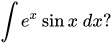
2. How would you integrate  Failed to parse (MathML with SVG or PNG fallback (recommended for modern browsers and accessibility tools): Invalid response ("Math extension cannot connect to Restbase.") from server "https://wikimedia.org/api/rest_v1/":): {\displaystyle \int e^x\sin x~dx?}

        You can use integration by parts.

        Let  Failed to parse (MathML with SVG or PNG fallback (recommended for modern browsers and accessibility tools): Invalid response ("Math extension cannot connect to Restbase.") from server "https://wikimedia.org/api/rest_v1/":): {\displaystyle u=\sin(x)}   and  Failed to parse (MathML with SVG or PNG fallback (recommended for modern browsers and accessibility tools): Invalid response ("Math extension cannot connect to Restbase.") from server "https://wikimedia.org/api/rest_v1/":): {\displaystyle dv=e^x~dx.}

        Then,  Failed to parse (MathML with SVG or PNG fallback (recommended for modern browsers and accessibility tools): Invalid response ("Math extension cannot connect to Restbase.") from server "https://wikimedia.org/api/rest_v1/":): {\displaystyle du=\cos(x)~dx}   and  Failed to parse (MathML with SVG or PNG fallback (recommended for modern browsers and accessibility tools): Invalid response ("Math extension cannot connect to Restbase.") from server "https://wikimedia.org/api/rest_v1/":): {\displaystyle v=e^x.}

        Thus,  Failed to parse (MathML with SVG or PNG fallback (recommended for modern browsers and accessibility tools): Invalid response ("Math extension cannot connect to Restbase.") from server "https://wikimedia.org/api/rest_v1/":): {\displaystyle \int e^x\sin x~dx=e^x\sin(x)-\int e^x\cos(x)~dx.}

        Now, we need to use integration by parts a second time.

        Let  Failed to parse (MathML with SVG or PNG fallback (recommended for modern browsers and accessibility tools): Invalid response ("Math extension cannot connect to Restbase.") from server "https://wikimedia.org/api/rest_v1/":): {\displaystyle u=\cos(x)}   and  Failed to parse (MathML with SVG or PNG fallback (recommended for modern browsers and accessibility tools): Invalid response ("Math extension cannot connect to Restbase.") from server "https://wikimedia.org/api/rest_v1/":): {\displaystyle dv=e^x~dx.}

        Then,  Failed to parse (MathML with SVG or PNG fallback (recommended for modern browsers and accessibility tools): Invalid response ("Math extension cannot connect to Restbase.") from server "https://wikimedia.org/api/rest_v1/":): {\displaystyle du=-\sin(x)~dx}   and  Failed to parse (MathML with SVG or PNG fallback (recommended for modern browsers and accessibility tools): Invalid response ("Math extension cannot connect to Restbase.") from server "https://wikimedia.org/api/rest_v1/":): {\displaystyle v=e^x.}
        Therefore,

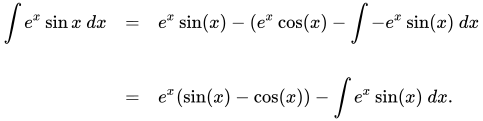
        Failed to parse (MathML with SVG or PNG fallback (recommended for modern browsers and accessibility tools): Invalid response ("Math extension cannot connect to Restbase.") from server "https://wikimedia.org/api/rest_v1/":): {\displaystyle \begin{array}{rcl} \displaystyle{\int e^x\sin x~dx} & = & \displaystyle{e^x\sin(x)-(e^x\cos(x)-\int -e^x\sin(x)~dx}\\ &&\\ & = & \displaystyle{e^x(\sin(x)-\cos(x))-\int e^x\sin(x)~dx.}\\ \end{array}}

        Notice, we are back where we started.

        Therefore, adding the last term on the right hand side to the opposite side, we get

        Failed to parse (MathML with SVG or PNG fallback (recommended for modern browsers and accessibility tools): Invalid response ("Math extension cannot connect to Restbase.") from server "https://wikimedia.org/api/rest_v1/":): {\displaystyle 2\int e^x\sin (x)~dx=e^x(\sin(x)-\cos(x)).}

        Hence,  Failed to parse (MathML with SVG or PNG fallback (recommended for modern browsers and accessibility tools): Invalid response ("Math extension cannot connect to Restbase.") from server "https://wikimedia.org/api/rest_v1/":): {\displaystyle \int e^x\sin (x)~dx=\frac{e^x}{2}(\sin(x)-\cos(x))+C.}


Solution:

Step 1:  
We proceed using integration by parts.
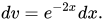
Let  Failed to parse (MathML with SVG or PNG fallback (recommended for modern browsers and accessibility tools): Invalid response ("Math extension cannot connect to Restbase.") from server "https://wikimedia.org/api/rest_v1/":): {\displaystyle u=\sin(2x)}   and  Failed to parse (MathML with SVG or PNG fallback (recommended for modern browsers and accessibility tools): Invalid response ("Math extension cannot connect to Restbase.") from server "https://wikimedia.org/api/rest_v1/":): {\displaystyle dv=e^{-2x}dx.}
Then,  Failed to parse (MathML with SVG or PNG fallback (recommended for modern browsers and accessibility tools): Invalid response ("Math extension cannot connect to Restbase.") from server "https://wikimedia.org/api/rest_v1/":): {\displaystyle du=2\cos(2x)dx}   and  Failed to parse (MathML with SVG or PNG fallback (recommended for modern browsers and accessibility tools): Invalid response ("Math extension cannot connect to Restbase.") from server "https://wikimedia.org/api/rest_v1/":): {\displaystyle v=\frac{e^{-2x}}{-2}.}
Thus, we get

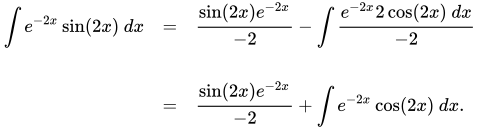
        Failed to parse (MathML with SVG or PNG fallback (recommended for modern browsers and accessibility tools): Invalid response ("Math extension cannot connect to Restbase.") from server "https://wikimedia.org/api/rest_v1/":): {\displaystyle \begin{array}{rcl} \displaystyle{\int e^{-2x}\sin (2x)~dx} & = & \displaystyle{\frac{\sin(2x)e^{-2x}}{-2}-\int \frac{e^{-2x}2\cos(2x)~dx}{-2}}\\ &&\\ & = & \displaystyle{\frac{\sin(2x)e^{-2x}}{-2}+\int e^{-2x}\cos(2x)~dx.} \end{array}}

Step 2:  
Now, we need to use integration by parts again.
Let  Failed to parse (MathML with SVG or PNG fallback (recommended for modern browsers and accessibility tools): Invalid response ("Math extension cannot connect to Restbase.") from server "https://wikimedia.org/api/rest_v1/":): {\displaystyle u=\cos(2x)}   and  Failed to parse (MathML with SVG or PNG fallback (recommended for modern browsers and accessibility tools): Invalid response ("Math extension cannot connect to Restbase.") from server "https://wikimedia.org/api/rest_v1/":): {\displaystyle dv=e^{-2x}dx.}
Then,  Failed to parse (MathML with SVG or PNG fallback (recommended for modern browsers and accessibility tools): Invalid response ("Math extension cannot connect to Restbase.") from server "https://wikimedia.org/api/rest_v1/":): {\displaystyle du=-2\sin(2x)dx}   and  Failed to parse (MathML with SVG or PNG fallback (recommended for modern browsers and accessibility tools): Invalid response ("Math extension cannot connect to Restbase.") from server "https://wikimedia.org/api/rest_v1/":): {\displaystyle v=\frac{e^{-2x}}{-2}.}
Therefore, we get

        Failed to parse (MathML with SVG or PNG fallback (recommended for modern browsers and accessibility tools): Invalid response ("Math extension cannot connect to Restbase.") from server "https://wikimedia.org/api/rest_v1/":): {\displaystyle \int e^{-2x}\sin (2x)~dx=\frac{\sin(2x)e^{-2x}}{-2}+\frac{\cos(2x)e^{-2x}}{-2}-\int e^{-2x}\sin(2x)~dx.}

Step 3:  
Notice that the integral on the right of the last equation in Step 2
is the same integral that we had at the beginning of the problem.
Thus, if we add the integral on the right to the other side of the equation, we get
        Failed to parse (MathML with SVG or PNG fallback (recommended for modern browsers and accessibility tools): Invalid response ("Math extension cannot connect to Restbase.") from server "https://wikimedia.org/api/rest_v1/":): {\displaystyle 2\int e^{-2x}\sin (2x)~dx=\frac{\sin(2x)e^{-2x}}{-2}+\frac{\cos(2x)e^{-2x}}{-2}.}
Now, we divide both sides by 2 to get
        Failed to parse (MathML with SVG or PNG fallback (recommended for modern browsers and accessibility tools): Invalid response ("Math extension cannot connect to Restbase.") from server "https://wikimedia.org/api/rest_v1/":): {\displaystyle \int e^{-2x}\sin (2x)~dx=\frac{\sin(2x)e^{-2x}}{-4}+\frac{\cos(2x)e^{-2x}}{-4}.}
Thus, the final answer is
        Failed to parse (MathML with SVG or PNG fallback (recommended for modern browsers and accessibility tools): Invalid response ("Math extension cannot connect to Restbase.") from server "https://wikimedia.org/api/rest_v1/":): {\displaystyle \int e^{-2x}\sin (2x)~dx=\frac{e^{-2x}}{-4}((\sin(2x)+\cos(2x))+C.}


Final Answer:  
      

Return to Sample Exam