Difference between revisions of "009B Sample Final 1, Problem 7"
Jump to navigation
Jump to search
(Created page with "<span class="exam">a) Find the length of the curve ::::::<math>y=\ln (\cos x),~~~0\leq x \leq \frac{\pi}{3}</math>. <span class="exam">b) The curve ::::::<math>y=1-x^2,~~~0...") |
|||
| Line 1: | Line 1: | ||
| − | <span class="exam">a) Find the length of the curve | + | ::<span class="exam">a) Find the length of the curve |
::::::<math>y=\ln (\cos x),~~~0\leq x \leq \frac{\pi}{3}</math>. | ::::::<math>y=\ln (\cos x),~~~0\leq x \leq \frac{\pi}{3}</math>. | ||
| − | <span class="exam">b) The curve | + | ::<span class="exam">b) The curve |
::::::<math>y=1-x^2,~~~0\leq x \leq 1</math> | ::::::<math>y=1-x^2,~~~0\leq x \leq 1</math> | ||
| − | <span class="exam">is rotated about the <math style="vertical-align: -3px">y</math>-axis. Find the area of the resulting surface. | + | ::<span class="exam">is rotated about the <math style="vertical-align: -3px">y</math>-axis. Find the area of the resulting surface. |
{| class="mw-collapsible mw-collapsed" style = "text-align:left;" | {| class="mw-collapsible mw-collapsed" style = "text-align:left;" | ||
Revision as of 13:20, 18 April 2016
- a) Find the length of the curve
- .

- b) The curve

- is rotated about the -axis. Find the area of the resulting surface.

| Foundations: |
|---|
| Recall: |
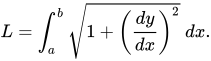
| 1. The formula for the length of a curve where is |
|
|
| 2. |
| 3. The surface area of a function rotated about the -axis is given by |
|




Solution:
(a)
| Step 1: |
|---|
| First, we calculate |
| Since . |
| Using the formula given in the Foundations section, we have |
|


| Step 2: |
|---|
| Now, we have: |
|
|

| Step 3: |
|---|
| Finally, |
|
|

(b)
| Step 1: |
|---|
| We start by calculating . |
| Since . |
| Using the formula given in the Foundations section, we have |
|
|


| Step 2: |
|---|
| Now, we have |
| We proceed by using trig substitution. Let . Then, . |
| So, we have |
|
|


| Step 3: |
|---|
| Now, we use -substitution. Let . Then, . |
| So, the integral becomes |
|
|


| Step 4: |
|---|
| We started with a definite integral. So, using Step 2 and 3, we have |
|
|

| Final Answer: |
|---|
| (a) |
| (b) |

