Difference between revisions of "009B Sample Final 1, Problem 2"
Jump to navigation
Jump to search
(Created page with "<span class="exam"> We would like to evaluate :::::<math>\frac{d}{dx}\bigg(\int_{-1}^{x} \sin(t^2)2t\,dt\bigg).</math> <span class="exam">a) Compute <math style="vertical-ali...") |
|||
| Line 2: | Line 2: | ||
:::::<math>\frac{d}{dx}\bigg(\int_{-1}^{x} \sin(t^2)2t\,dt\bigg).</math> | :::::<math>\frac{d}{dx}\bigg(\int_{-1}^{x} \sin(t^2)2t\,dt\bigg).</math> | ||
| − | <span class="exam">a) Compute <math style="vertical-align: -15px">f(x)=\int_{-1}^{x} \sin(t^2)2t\,dt</math> | + | ::<span class="exam">a) Compute <math style="vertical-align: -15px">f(x)=\int_{-1}^{x} \sin(t^2)2t\,dt.</math> |
| − | <span class="exam">b) Find <math style="vertical-align: -5px">f'(x)</math> | + | ::<span class="exam">b) Find <math style="vertical-align: -5px">f'(x).</math> |
| − | <span class="exam">c) State the Fundamental Theorem of Calculus. | + | ::<span class="exam">c) State the Fundamental Theorem of Calculus. |
| − | <span class="exam">d) Use the Fundamental Theorem of Calculus to compute  <math style="vertical-align: -15px">\frac{d}{dx}\bigg(\int_{-1}^{x} \sin(t^2)2t\,dt\bigg)</math>  without first computing the integral. | + | ::<span class="exam">d) Use the Fundamental Theorem of Calculus to compute  <math style="vertical-align: -15px">\frac{d}{dx}\bigg(\int_{-1}^{x} \sin(t^2)2t\,dt\bigg)</math>  without first computing the integral. |
| − | <span class="exam">d) Use the Fundamental Theorem of Calculus to compute  <math style="vertical-align: -15px">\frac{d}{dx}\bigg(\int_{-1}^{x} \sin(t^2)2tdt\bigg)</math>  without first computing the integral. | + | ::<span class="exam">d) Use the Fundamental Theorem of Calculus to compute  <math style="vertical-align: -15px">\frac{d}{dx}\bigg(\int_{-1}^{x} \sin(t^2)2tdt\bigg)</math>  without first computing the integral. |
{| class="mw-collapsible mw-collapsed" style = "text-align:left;" | {| class="mw-collapsible mw-collapsed" style = "text-align:left;" | ||
!Foundations: | !Foundations: | ||
|- | |- | ||
| − | |How would you integrate <math>\int e^{x^2}2x~dx</math> | + | |How would you integrate <math>\int e^{x^2}2x~dx?</math> |
|- | |- | ||
| | | | ||
| − | ::You could use <math style="vertical-align: -1px">u</math>-substitution. Let <math style="vertical-align: 0px">u=x^2</math> | + | ::You could use <math style="vertical-align: -1px">u</math>-substitution. Let <math style="vertical-align: 0px">u=x^2.</math> Then, <math style="vertical-align: 0px">du=2xdx.</math> |
|- | |- | ||
| | | | ||
| − | ::So, we get <math style="vertical-align: -14px">\int e^u~du=e^u+C=e^{x^2}+C</math> | + | ::So, we get <math style="vertical-align: -14px">\int e^u~du=e^u+C=e^{x^2}+C.</math> |
|} | |} | ||
| Line 31: | Line 31: | ||
!Step 1: | !Step 1: | ||
|- | |- | ||
| − | |We proceed using <math style="vertical-align: 0px">u</math>-substitution. Let <math style="vertical-align: 0px">u=t^2</math> | + | |We proceed using <math style="vertical-align: 0px">u</math>-substitution. Let <math style="vertical-align: 0px">u=t^2.</math> Then, <math style="vertical-align: 0px">du=2t\,dt.</math> |
|- | |- | ||
|Since this is a definite integral, we need to change the bounds of integration. | |Since this is a definite integral, we need to change the bounds of integration. | ||
|- | |- | ||
| − | |Plugging our values into the equation <math style="vertical-align: | + | |Plugging our values into the equation <math style="vertical-align: -4px">u=t^2,</math> we get <math style="vertical-align: -5px">u_1=(-1)^2=1</math> and <math style="vertical-align: -3px">u_2=x^2.</math> |
|} | |} | ||
| Line 61: | Line 61: | ||
!Step 1: | !Step 1: | ||
|- | |- | ||
| − | |From part (a), we have <math style="vertical-align: -5px">f(x)=-\cos(x^2)+\cos(1)</math> | + | |From part (a), we have <math style="vertical-align: -5px">f(x)=-\cos(x^2)+\cos(1).</math> |
|} | |} | ||
| Line 67: | Line 67: | ||
!Step 2: | !Step 2: | ||
|- | |- | ||
| − | |If we take the derivative, we get <math style="vertical-align: -5px">f'(x)=\sin(x^2)2x</math> | + | |If we take the derivative, we get <math style="vertical-align: -5px">f'(x)=\sin(x^2)2x,</math> since <math style="vertical-align: -5px">\cos(1)</math> is just a constant. |
|} | |} | ||
| Line 79: | Line 79: | ||
|'''<u>The Fundamental Theorem of Calculus, Part 1</u>''' | |'''<u>The Fundamental Theorem of Calculus, Part 1</u>''' | ||
|- | |- | ||
| − | | | + | | |
| + | :Let <math>f</math> be continuous on <math style="vertical-align: -5px">[a,b]</math> and let <math style="vertical-align: -14px">F(x)=\int_a^x f(t)~dt.</math> | ||
|- | |- | ||
| − | | | + | | |
| + | :Then, <math style="vertical-align: 0px">F</math> is a differentiable function on <math style="vertical-align: -5px">(a,b)</math> and <math style="vertical-align: -5px">F'(x)=f(x).</math> | ||
|} | |} | ||
| Line 89: | Line 91: | ||
|'''<u>The Fundamental Theorem of Calculus, Part 2</u>''' | |'''<u>The Fundamental Theorem of Calculus, Part 2</u>''' | ||
|- | |- | ||
| − | | | + | | |
| + | :Let <math>f</math> be continuous on <math>[a,b]</math> and let <math style="vertical-align: 0px">F</math> be any antiderivative of <math>f.</math> | ||
|- | |- | ||
| − | | | + | | |
| + | :Then, <math style="vertical-align: -14px">\int_a^b f(x)~dx=F(b)-F(a).</math> | ||
|} | |} | ||
Revision as of 12:51, 18 April 2016
We would like to evaluate
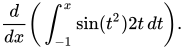
- a) Compute

- b) Find Failed to parse (MathML with SVG or PNG fallback (recommended for modern browsers and accessibility tools): Invalid response ("Math extension cannot connect to Restbase.") from server "https://wikimedia.org/api/rest_v1/":): {\displaystyle f'(x).}
- c) State the Fundamental Theorem of Calculus.
- d) Use the Fundamental Theorem of Calculus to compute Failed to parse (MathML with SVG or PNG fallback (recommended for modern browsers and accessibility tools): Invalid response ("Math extension cannot connect to Restbase.") from server "https://wikimedia.org/api/rest_v1/":): {\displaystyle \frac{d}{dx}\bigg(\int_{-1}^{x} \sin(t^2)2t\,dt\bigg)} without first computing the integral.
- d) Use the Fundamental Theorem of Calculus to compute Failed to parse (MathML with SVG or PNG fallback (recommended for modern browsers and accessibility tools): Invalid response ("Math extension cannot connect to Restbase.") from server "https://wikimedia.org/api/rest_v1/":): {\displaystyle \frac{d}{dx}\bigg(\int_{-1}^{x} \sin(t^2)2tdt\bigg)} without first computing the integral.
| Foundations: |
|---|
| How would you integrate Failed to parse (MathML with SVG or PNG fallback (recommended for modern browsers and accessibility tools): Invalid response ("Math extension cannot connect to Restbase.") from server "https://wikimedia.org/api/rest_v1/":): {\displaystyle \int e^{x^2}2x~dx?} |
|
|
Solution:
(a)
| Step 1: |
|---|
| We proceed using Failed to parse (MathML with SVG or PNG fallback (recommended for modern browsers and accessibility tools): Invalid response ("Math extension cannot connect to Restbase.") from server "https://wikimedia.org/api/rest_v1/":): {\displaystyle u} -substitution. Let Failed to parse (MathML with SVG or PNG fallback (recommended for modern browsers and accessibility tools): Invalid response ("Math extension cannot connect to Restbase.") from server "https://wikimedia.org/api/rest_v1/":): {\displaystyle u=t^2.} Then, Failed to parse (MathML with SVG or PNG fallback (recommended for modern browsers and accessibility tools): Invalid response ("Math extension cannot connect to Restbase.") from server "https://wikimedia.org/api/rest_v1/":): {\displaystyle du=2t\,dt.} |
| Since this is a definite integral, we need to change the bounds of integration. |
| Plugging our values into the equation Failed to parse (MathML with SVG or PNG fallback (recommended for modern browsers and accessibility tools): Invalid response ("Math extension cannot connect to Restbase.") from server "https://wikimedia.org/api/rest_v1/":): {\displaystyle u=t^2,} we get Failed to parse (MathML with SVG or PNG fallback (recommended for modern browsers and accessibility tools): Invalid response ("Math extension cannot connect to Restbase.") from server "https://wikimedia.org/api/rest_v1/":): {\displaystyle u_1=(-1)^2=1} and Failed to parse (MathML with SVG or PNG fallback (recommended for modern browsers and accessibility tools): Invalid response ("Math extension cannot connect to Restbase.") from server "https://wikimedia.org/api/rest_v1/":): {\displaystyle u_2=x^2.} |
| Step 2: |
|---|
| So, we have |
|
(b)
| Step 1: |
|---|
| From part (a), we have Failed to parse (MathML with SVG or PNG fallback (recommended for modern browsers and accessibility tools): Invalid response ("Math extension cannot connect to Restbase.") from server "https://wikimedia.org/api/rest_v1/":): {\displaystyle f(x)=-\cos(x^2)+\cos(1).} |
| Step 2: |
|---|
| If we take the derivative, we get Failed to parse (MathML with SVG or PNG fallback (recommended for modern browsers and accessibility tools): Invalid response ("Math extension cannot connect to Restbase.") from server "https://wikimedia.org/api/rest_v1/":): {\displaystyle f'(x)=\sin(x^2)2x,} since Failed to parse (MathML with SVG or PNG fallback (recommended for modern browsers and accessibility tools): Invalid response ("Math extension cannot connect to Restbase.") from server "https://wikimedia.org/api/rest_v1/":): {\displaystyle \cos(1)} is just a constant. |
(c)
| Step 1: |
|---|
| The Fundamental Theorem of Calculus has two parts. |
| The Fundamental Theorem of Calculus, Part 1 |
|
|
| Step 2: |
|---|
| The Fundamental Theorem of Calculus, Part 2 |
|
|
| (d) |
|---|
| By the Fundamental Theorem of Calculus, Part 1, |
|
| Final Answer: |
|---|
| (a) Failed to parse (MathML with SVG or PNG fallback (recommended for modern browsers and accessibility tools): Invalid response ("Math extension cannot connect to Restbase.") from server "https://wikimedia.org/api/rest_v1/":): {\displaystyle f(x)=-\cos(x^2)+\cos(1)} |
| (b) Failed to parse (MathML with SVG or PNG fallback (recommended for modern browsers and accessibility tools): Invalid response ("Math extension cannot connect to Restbase.") from server "https://wikimedia.org/api/rest_v1/":): {\displaystyle f'(x)=\sin(x^2)2x} |
| (c) The Fundamental Theorem of Calculus, Part 1 |
| Let Failed to parse (MathML with SVG or PNG fallback (recommended for modern browsers and accessibility tools): Invalid response ("Math extension cannot connect to Restbase.") from server "https://wikimedia.org/api/rest_v1/":): {\displaystyle f} be continuous on Failed to parse (MathML with SVG or PNG fallback (recommended for modern browsers and accessibility tools): Invalid response ("Math extension cannot connect to Restbase.") from server "https://wikimedia.org/api/rest_v1/":): {\displaystyle [a,b]} and let Failed to parse (MathML with SVG or PNG fallback (recommended for modern browsers and accessibility tools): Invalid response ("Math extension cannot connect to Restbase.") from server "https://wikimedia.org/api/rest_v1/":): {\displaystyle F(x)=\int_a^x f(t)~dt} . |
| Then, Failed to parse (MathML with SVG or PNG fallback (recommended for modern browsers and accessibility tools): Invalid response ("Math extension cannot connect to Restbase.") from server "https://wikimedia.org/api/rest_v1/":): {\displaystyle F} is a differentiable function on Failed to parse (MathML with SVG or PNG fallback (recommended for modern browsers and accessibility tools): Invalid response ("Math extension cannot connect to Restbase.") from server "https://wikimedia.org/api/rest_v1/":): {\displaystyle (a,b)} and Failed to parse (MathML with SVG or PNG fallback (recommended for modern browsers and accessibility tools): Invalid response ("Math extension cannot connect to Restbase.") from server "https://wikimedia.org/api/rest_v1/":): {\displaystyle F'(x)=f(x)} . |
| The Fundamental Theorem of Calculus, Part 2 |
| Let Failed to parse (MathML with SVG or PNG fallback (recommended for modern browsers and accessibility tools): Invalid response ("Math extension cannot connect to Restbase.") from server "https://wikimedia.org/api/rest_v1/":): {\displaystyle f} be continuous on Failed to parse (MathML with SVG or PNG fallback (recommended for modern browsers and accessibility tools): Invalid response ("Math extension cannot connect to Restbase.") from server "https://wikimedia.org/api/rest_v1/":): {\displaystyle [a,b]} and let Failed to parse (MathML with SVG or PNG fallback (recommended for modern browsers and accessibility tools): Invalid response ("Math extension cannot connect to Restbase.") from server "https://wikimedia.org/api/rest_v1/":): {\displaystyle F} be any antiderivative of Failed to parse (MathML with SVG or PNG fallback (recommended for modern browsers and accessibility tools): Invalid response ("Math extension cannot connect to Restbase.") from server "https://wikimedia.org/api/rest_v1/":): {\displaystyle f} . |
| Then, Failed to parse (MathML with SVG or PNG fallback (recommended for modern browsers and accessibility tools): Invalid response ("Math extension cannot connect to Restbase.") from server "https://wikimedia.org/api/rest_v1/":): {\displaystyle \int_a^b f(x)~dx=F(b)-F(a)} . |
| (d) Failed to parse (MathML with SVG or PNG fallback (recommended for modern browsers and accessibility tools): Invalid response ("Math extension cannot connect to Restbase.") from server "https://wikimedia.org/api/rest_v1/":): {\displaystyle \sin(x^2)2x} |