Difference between revisions of "009C Sample Midterm 3, Problem 1"
m |
|||
| Line 65: | Line 65: | ||
\end{array}</math> | \end{array}</math> | ||
|- | |- | ||
| − | |<br>Thus, <math style="vertical-align: - | + | |<br>Thus, <math style="vertical-align: -1px">L=e^{0}=1.</math> Also, most teachers would require you to mention that natural log is continuous as justification for passing the limit through it. |
|} | |} | ||
{| class="mw-collapsible mw-collapsed" style = "text-align:left;" | {| class="mw-collapsible mw-collapsed" style = "text-align:left;" | ||
Revision as of 17:39, 3 November 2015
Test if the following sequence Failed to parse (MathML with SVG or PNG fallback (recommended for modern browsers and accessibility tools): Invalid response ("Math extension cannot connect to Restbase.") from server "https://wikimedia.org/api/rest_v1/":): {\displaystyle {a_n}} converges or diverges. If it converges, also find the limit of the sequence.
- Failed to parse (MathML with SVG or PNG fallback (recommended for modern browsers and accessibility tools): Invalid response ("Math extension cannot connect to Restbase.") from server "https://wikimedia.org/api/rest_v1/":): {\displaystyle a_{n}=\left(\frac{n-7}{n}\right)^{1/n}.}
| Foundations: |
|---|
| This a common question, and is related to the fact that |
|
| In such a limit, the argument Failed to parse (MathML with SVG or PNG fallback (recommended for modern browsers and accessibility tools): Invalid response ("Math extension cannot connect to Restbase.") from server "https://wikimedia.org/api/rest_v1/":): {\displaystyle 1+\alpha /x} tends to one as Failed to parse (MathML with SVG or PNG fallback (recommended for modern browsers and accessibility tools): Invalid response ("Math extension cannot connect to Restbase.") from server "https://wikimedia.org/api/rest_v1/":): {\displaystyle x} gets large, while we are raising that argument to an increasing power. Neither one really "wins", so we end up with a finite limit that is neither zero nor infinity. |
| On the other hand, in the exam problem the argument Failed to parse (MathML with SVG or PNG fallback (recommended for modern browsers and accessibility tools): Invalid response ("Math extension cannot connect to Restbase.") from server "https://wikimedia.org/api/rest_v1/":): {\displaystyle (n-7)/n} is always smaller than one, but tends to one as Failed to parse (MathML with SVG or PNG fallback (recommended for modern browsers and accessibility tools): Invalid response ("Math extension cannot connect to Restbase.") from server "https://wikimedia.org/api/rest_v1/":): {\displaystyle n} gets large, while the exponent Failed to parse (MathML with SVG or PNG fallback (recommended for modern browsers and accessibility tools): Invalid response ("Math extension cannot connect to Restbase.") from server "https://wikimedia.org/api/rest_v1/":): {\displaystyle 1/n} tends to zero. These do not disagree, so the limit should be one, but we need to prove it. |
| Any time you have a function raised to a function, we need to use natural log and take advantage of the log rule: |
|
| For example, to find Failed to parse (MathML with SVG or PNG fallback (recommended for modern browsers and accessibility tools): Invalid response ("Math extension cannot connect to Restbase.") from server "https://wikimedia.org/api/rest_v1/":): {\displaystyle \lim_{x\rightarrow\infty}\left(1-\frac{1}{x}\right)^{x}}
, you could begin by saying: Let Failed to parse (MathML with SVG or PNG fallback (recommended for modern browsers and accessibility tools): Invalid response ("Math extension cannot connect to Restbase.") from server "https://wikimedia.org/api/rest_v1/":): {\displaystyle L=\lim_{x\rightarrow\infty}\left(1-\frac{1}{x}\right)^{x}.}
Then |
where we are allowed to pass the log through the limit because natural log is continuous. But by log rules, |
|
| Thus |
Note that Failed to parse (MathML with SVG or PNG fallback (recommended for modern browsers and accessibility tools): Invalid response ("Math extension cannot connect to Restbase.") from server "https://wikimedia.org/api/rest_v1/":): {\displaystyle \lim_{x\rightarrow\infty}\frac{\ln\left(1-\frac{1}{x}\right)}{\frac{1}{x}}=\frac{0}{0},} so we can apply l'Hôpital's rule. Finally, since Failed to parse (MathML with SVG or PNG fallback (recommended for modern browsers and accessibility tools): Invalid response ("Math extension cannot connect to Restbase.") from server "https://wikimedia.org/api/rest_v1/":): {\displaystyle \ln L=-1,\,\,L=\frac{1}{e}.} |
| Again, such a technique is not required for this particular problem, as the exponent tends to zero. But the technique is common enough on exams to justify providing an example. |
| Solution: |
|---|
| Following the procedure outlined in Foundations, let Then |
|
Thus, Failed to parse (MathML with SVG or PNG fallback (recommended for modern browsers and accessibility tools): Invalid response ("Math extension cannot connect to Restbase.") from server "https://wikimedia.org/api/rest_v1/":): {\displaystyle L=e^{0}=1.} Also, most teachers would require you to mention that natural log is continuous as justification for passing the limit through it. |
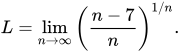
| Final Answer: |
|---|
| The limit of the sequence is Failed to parse (MathML with SVG or PNG fallback (recommended for modern browsers and accessibility tools): Invalid response ("Math extension cannot connect to Restbase.") from server "https://wikimedia.org/api/rest_v1/":): {\displaystyle e^{0}=1.} |