Difference between revisions of "009C Sample Midterm 3, Problem 2"
Jump to navigation
Jump to search
m |
|||
| Line 63: | Line 63: | ||
|- | |- | ||
| | | | ||
| − | ::<math>\sum_{n=2}^{\infty}\frac{1}{(n-1)(n+1)}\,=\,\sum_{n= | + | ::<math>\sum_{n=2}^{\infty}\frac{1}{(n-1)(n+1)}\,=\,\sum_{n=2}^{\infty}\frac{1}{2}\left(\frac{1}{n-1}-\frac{1}{n+1}\right).</math> |
|- | |- | ||
|This means that | |This means that | ||
Revision as of 13:16, 6 February 2016
For each the following series find the sum, if it converges. If you think it diverges, explain why.
- (a) (6 points) Failed to parse (MathML with SVG or PNG fallback (recommended for modern browsers and accessibility tools): Invalid response ("Math extension cannot connect to Restbase.") from server "https://wikimedia.org/api/rest_v1/":): {\displaystyle \frac{1}{2}-\frac{1}{2\cdot3}+\frac{1}{2\cdot3^{2}}-\frac{1}{2\cdot3^{3}}+\frac{1}{2\cdot3^{4}}-\frac{1}{2\cdot3^{5}}+\cdots .}

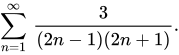
- (b) (6 points) Failed to parse (MathML with SVG or PNG fallback (recommended for modern browsers and accessibility tools): Invalid response ("Math extension cannot connect to Restbase.") from server "https://wikimedia.org/api/rest_v1/":): {\displaystyle \sum_{n=1}^{\infty}\,\frac{3}{(2n-1)(2n+1)}.}
| Foundations: |
|---|
| One of the important series to know is the Geometric series. These are series with a common ratio Failed to parse (MathML with SVG or PNG fallback (recommended for modern browsers and accessibility tools): Invalid response ("Math extension cannot connect to Restbase.") from server "https://wikimedia.org/api/rest_v1/":): {\displaystyle r} between adjacent terms which are usually written |
|
| These are convergent if Failed to parse (MathML with SVG or PNG fallback (recommended for modern browsers and accessibility tools): Invalid response ("Math extension cannot connect to Restbase.") from server "https://wikimedia.org/api/rest_v1/":): {\displaystyle |r|<1} , and divergent if Failed to parse (MathML with SVG or PNG fallback (recommended for modern browsers and accessibility tools): Invalid response ("Math extension cannot connect to Restbase.") from server "https://wikimedia.org/api/rest_v1/":): {\displaystyle |r|\geq1} . If it is convergent, we can find the sum by the formula |
|
| where Failed to parse (MathML with SVG or PNG fallback (recommended for modern browsers and accessibility tools): Invalid response ("Math extension cannot connect to Restbase.") from server "https://wikimedia.org/api/rest_v1/":): {\displaystyle a_{0}} is the first term in the series (if the index starts at Failed to parse (MathML with SVG or PNG fallback (recommended for modern browsers and accessibility tools): Invalid response ("Math extension cannot connect to Restbase.") from server "https://wikimedia.org/api/rest_v1/":): {\displaystyle k=2} or Failed to parse (MathML with SVG or PNG fallback (recommended for modern browsers and accessibility tools): Invalid response ("Math extension cannot connect to Restbase.") from server "https://wikimedia.org/api/rest_v1/":): {\displaystyle k=6} , then "Failed to parse (MathML with SVG or PNG fallback (recommended for modern browsers and accessibility tools): Invalid response ("Math extension cannot connect to Restbase.") from server "https://wikimedia.org/api/rest_v1/":): {\displaystyle a_{0}} " is actually the first term Failed to parse (MathML with SVG or PNG fallback (recommended for modern browsers and accessibility tools): Invalid response ("Math extension cannot connect to Restbase.") from server "https://wikimedia.org/api/rest_v1/":): {\displaystyle a_{2}} or Failed to parse (MathML with SVG or PNG fallback (recommended for modern browsers and accessibility tools): Invalid response ("Math extension cannot connect to Restbase.") from server "https://wikimedia.org/api/rest_v1/":): {\displaystyle a_{6}} , respectively). |
| Another common type of series to evaluate is a telescoping series, where the telescoping better describes the partial sums, denoted Failed to parse (MathML with SVG or PNG fallback (recommended for modern browsers and accessibility tools): Invalid response ("Math extension cannot connect to Restbase.") from server "https://wikimedia.org/api/rest_v1/":): {\displaystyle S_k} . Most of the time, they are presented as a fraction which requires partial fraction decomposition. |
| This can be accomplished fairly quickly via a shortcut when the factors in the denominator are linear and share the same coefficient on . |
| Example. Suppose we wish to decompose the fraction . First, consider the difference |
|
|
| If we combine this to a common denominator, we find |
|
| To have a 1 in the numerator, we would just multiply by Failed to parse (MathML with SVG or PNG fallback (recommended for modern browsers and accessibility tools): Invalid response ("Math extension cannot connect to Restbase.") from server "https://wikimedia.org/api/rest_v1/":): {\displaystyle 1/3,} or the reciprocal of the difference between the two constants. Thus |
|
| Notice the pattern: for any fraction of the form Failed to parse (MathML with SVG or PNG fallback (recommended for modern browsers and accessibility tools): Invalid response ("Math extension cannot connect to Restbase.") from server "https://wikimedia.org/api/rest_v1/":): {\displaystyle \frac{1}{(x+a)(x+b)}} where Failed to parse (MathML with SVG or PNG fallback (recommended for modern browsers and accessibility tools): Invalid response ("Math extension cannot connect to Restbase.") from server "https://wikimedia.org/api/rest_v1/":): {\displaystyle a<b,} we have |
|
| In this manner, we can quickly find that |
|
| As per the so-called telescoping, consider the series defined by |
|
| Using the technique above, we can rewrite the series as |
|
| This means that |
|
| Again, notice the pattern: each time there are exactly two surviving positive terms, and two surviving negative terms in each partial sum. If we then take the limit, we find |
|
Solution:
| (a): |
|---|
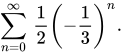
| This is the easier portion of the problem. Each term grows by a ratio of Failed to parse (MathML with SVG or PNG fallback (recommended for modern browsers and accessibility tools): Invalid response ("Math extension cannot connect to Restbase.") from server "https://wikimedia.org/api/rest_v1/":): {\displaystyle 1/3} , and it reverses sign. Thus, there is a common ratio Failed to parse (MathML with SVG or PNG fallback (recommended for modern browsers and accessibility tools): Invalid response ("Math extension cannot connect to Restbase.") from server "https://wikimedia.org/api/rest_v1/":): {\displaystyle r=-1/3} . Also, the first term is Failed to parse (MathML with SVG or PNG fallback (recommended for modern browsers and accessibility tools): Invalid response ("Math extension cannot connect to Restbase.") from server "https://wikimedia.org/api/rest_v1/":): {\displaystyle 1/2} , so we can write the series as a geometric series: |
|
| Then, the series converges to the sum |
|
| (b): |
|---|
| Using the technique in Foundations, we can rewrite the sequence as |
|
|
Writing a few terms out, we find |
|
| Since only one positive term and one negative term survive, we have |
| Failed to parse (MathML with SVG or PNG fallback (recommended for modern browsers and accessibility tools): Invalid response ("Math extension cannot connect to Restbase.") from server "https://wikimedia.org/api/rest_v1/":): {\displaystyle S_k \,=\,\frac{3}{2}\left( 1-\frac{1}{2k+1} \right),} |
| so the series converges to the sum S, where |
|
| Final Answer: |
|---|
| The series in (a) converges to Failed to parse (MathML with SVG or PNG fallback (recommended for modern browsers and accessibility tools): Invalid response ("Math extension cannot connect to Restbase.") from server "https://wikimedia.org/api/rest_v1/":): {\displaystyle 3/8} , while the series in (b) converges to Failed to parse (MathML with SVG or PNG fallback (recommended for modern browsers and accessibility tools): Invalid response ("Math extension cannot connect to Restbase.") from server "https://wikimedia.org/api/rest_v1/":): {\displaystyle 3/2} . |