Difference between revisions of "009C Sample Midterm 3, Problem 2"
Jump to navigation
Jump to search
(Created page with "<span class="exam">For each the following series find the sum, if it converges. If you think it diverges, explain why. ::<span class="exam">(a) (6 points) &...") |
m |
||
| Line 26: | Line 26: | ||
|This can be accomplished fairly quickly via a shortcut when the factors in the denominator are linear and share the same coefficient on <math style="vertical-align: 0%">n</math>. | |This can be accomplished fairly quickly via a shortcut when the factors in the denominator are linear and share the same coefficient on <math style="vertical-align: 0%">n</math>. | ||
|- | |- | ||
| − | |'''Example.''' Suppose we wish to decompose the fraction <math style="vertical-align: - | + | |'''Example.''' Suppose we wish to decompose the fraction <math style="vertical-align: -22%">\frac{4}{(n-2)(n+1)}</math>. First, consider the difference |
|- | |- | ||
| | | | ||
| Line 36: | Line 36: | ||
::<math>\frac{1}{n-2}\cdot\frac{n+1}{n+1}-\frac{1}{n+1}\cdot\frac{n-2}{n-2}\,=\,\frac{n+1-(n-2)}{(n-2)(n+1)}\ =\ \frac{3}{(n-2)(n+1)}.</math> | ::<math>\frac{1}{n-2}\cdot\frac{n+1}{n+1}-\frac{1}{n+1}\cdot\frac{n-2}{n-2}\,=\,\frac{n+1-(n-2)}{(n-2)(n+1)}\ =\ \frac{3}{(n-2)(n+1)}.</math> | ||
|- | |- | ||
| − | |To have a 1 in the numerator, we would just multiply by <math style="vertical-align: | + | |To have a 1 in the numerator, we would just multiply by <math style="vertical-align: -25%">1/3,</math> or the reciprocal of the difference between the two constants. Thus |
|- | |- | ||
| | | | ||
Revision as of 19:56, 26 April 2015
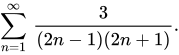
For each the following series find the sum, if it converges. If you think it diverges, explain why.
- (a) (6 points)

- (b) (6 points)
| Foundations: |
|---|
| One of the important series to know is the Geometric series. These are series with a common ratio between adjacent terms which are usually written |
|
| These are convergent if Failed to parse (MathML with SVG or PNG fallback (recommended for modern browsers and accessibility tools): Invalid response ("Math extension cannot connect to Restbase.") from server "https://wikimedia.org/api/rest_v1/":): {\displaystyle |r|<1} , and divergent if Failed to parse (MathML with SVG or PNG fallback (recommended for modern browsers and accessibility tools): Invalid response ("Math extension cannot connect to Restbase.") from server "https://wikimedia.org/api/rest_v1/":): {\displaystyle |r|\geq1} . If it is convergent, we can find the sum by the formula |
|
| where Failed to parse (MathML with SVG or PNG fallback (recommended for modern browsers and accessibility tools): Invalid response ("Math extension cannot connect to Restbase.") from server "https://wikimedia.org/api/rest_v1/":): {\displaystyle a_{0}} is the first term in the series (if the index starts at Failed to parse (MathML with SVG or PNG fallback (recommended for modern browsers and accessibility tools): Invalid response ("Math extension cannot connect to Restbase.") from server "https://wikimedia.org/api/rest_v1/":): {\displaystyle k=2} or Failed to parse (MathML with SVG or PNG fallback (recommended for modern browsers and accessibility tools): Invalid response ("Math extension cannot connect to Restbase.") from server "https://wikimedia.org/api/rest_v1/":): {\displaystyle k=6} , then "Failed to parse (MathML with SVG or PNG fallback (recommended for modern browsers and accessibility tools): Invalid response ("Math extension cannot connect to Restbase.") from server "https://wikimedia.org/api/rest_v1/":): {\displaystyle a_{0}} " is actually the first term Failed to parse (MathML with SVG or PNG fallback (recommended for modern browsers and accessibility tools): Invalid response ("Math extension cannot connect to Restbase.") from server "https://wikimedia.org/api/rest_v1/":): {\displaystyle a_{2}} or Failed to parse (MathML with SVG or PNG fallback (recommended for modern browsers and accessibility tools): Invalid response ("Math extension cannot connect to Restbase.") from server "https://wikimedia.org/api/rest_v1/":): {\displaystyle a_{6}} , respectively). |
| Another common type of series to evaluate is a telescoping series, where the telescoping better describes the partial sums, denoted Failed to parse (MathML with SVG or PNG fallback (recommended for modern browsers and accessibility tools): Invalid response ("Math extension cannot connect to Restbase.") from server "https://wikimedia.org/api/rest_v1/":): {\displaystyle S_k} . Most of the time, they are presented as a fraction which requires partial fraction decomposition. |
| This can be accomplished fairly quickly via a shortcut when the factors in the denominator are linear and share the same coefficient on Failed to parse (MathML with SVG or PNG fallback (recommended for modern browsers and accessibility tools): Invalid response ("Math extension cannot connect to Restbase.") from server "https://wikimedia.org/api/rest_v1/":): {\displaystyle n} . |
| Example. Suppose we wish to decompose the fraction Failed to parse (MathML with SVG or PNG fallback (recommended for modern browsers and accessibility tools): Invalid response ("Math extension cannot connect to Restbase.") from server "https://wikimedia.org/api/rest_v1/":): {\displaystyle \frac{4}{(n-2)(n+1)}} . First, consider the difference |
|
| If we combine this to a common denominator, we find |
|
| To have a 1 in the numerator, we would just multiply by Failed to parse (MathML with SVG or PNG fallback (recommended for modern browsers and accessibility tools): Invalid response ("Math extension cannot connect to Restbase.") from server "https://wikimedia.org/api/rest_v1/":): {\displaystyle 1/3,} or the reciprocal of the difference between the two constants. Thus |
|
| Notice the pattern: for any fraction of the formFailed to parse (MathML with SVG or PNG fallback (recommended for modern browsers and accessibility tools): Invalid response ("Math extension cannot connect to Restbase.") from server "https://wikimedia.org/api/rest_v1/":): {\displaystyle \frac{1}{(x+a)(x+b)}} whereFailed to parse (MathML with SVG or PNG fallback (recommended for modern browsers and accessibility tools): Invalid response ("Math extension cannot connect to Restbase.") from server "https://wikimedia.org/api/rest_v1/":): {\displaystyle a<b,} we have |
|
| In this manner, we can quickly find that |
|
| As per the so-called telescoping, consider the series defined by |
|
| Using the technique above, we can rewrite the series as |
|
| This means that |
|
| Notice the pattern - each time there are exactly two surviving positive terms, and two surviving negative terms. This is exactly the difference between the two factors in the denominator. If we then take the limit, we find |
|

Solution:
| (a): |
|---|
| (b): |
|---|
| Final Answer: |
|---|