Difference between revisions of "022 Exam 1 Sample A, Problem 4"
Jump to navigation
Jump to search
m |
|||
| Line 8: | Line 8: | ||
<br> | <br> | ||
|- | |- | ||
| − | |On the other hand, if the first derivative does not split around <math style="vertical-align: 0%">z</math>, then it will be increasing or decreasing at that point based on the derivative of the adjacent intervals. For example, <math style="vertical-align: -25%">g(x)=x^3</math> has the derivative <math style="vertical-align: -20%">g'(x)=3x^2</math>. Thus, <math style="vertical-align: -30%">g'(0)=0</math>, but is strictly positive every else. As a result, <math style="vertical-align: -20%">g(x)=x^3</math> is increasing on <math style="vertical-align: -20%">(-\infty,\infty)</math>. | + | |On the other hand, if the first derivative does not split around <math style="vertical-align: 0%">z</math>, then it will be increasing or decreasing at that point based on the derivative of the adjacent intervals. For example, <math style="vertical-align: -25%">g(x)=x^3</math> has the derivative <math style="vertical-align: -20%">g'(x)=3x^2</math>. Thus, <math style="vertical-align: -30%">g'(0)=0</math>, but is strictly positive every else. As a result, <math style="vertical-align: -20%">g(x)=x^3</math>  is increasing on <math style="vertical-align: -20%">(-\infty,\infty)</math>. |
|} | |} | ||
| Line 14: | Line 14: | ||
{| class="mw-collapsible mw-collapsed" style = "text-align:left;" | {| class="mw-collapsible mw-collapsed" style = "text-align:left;" | ||
| − | !Find the | + | !Find the Roots of the First Derivative: |
|- | |- | ||
|Note that | |Note that | ||
| + | |- | ||
| + | | | ||
| + | ::<math>h'(x)\,\,=\,\,8x^3-2x\,\,=\,\,2x\left(4x^2-1\right)\,\,=\,\,2x(2x+1)(2x-1),</math> | ||
| + | |- | ||
| + | |so the roots of <math style="vertical-align: -25%">h'(x)</math> are <math style="vertical-align: 0%">0</math>  and <math style="vertical-align: -20%">\pm 1/2</math>. | ||
| + | |} | ||
| + | |||
| + | {| class="mw-collapsible mw-collapsed" style = "text-align:left;" | ||
| + | !Make a Sign Chart and Evaluate: | ||
| + | |- | ||
| + | |We need to test convenient numbers on the intervals separated by the roots. Using the form | ||
| + | |- | ||
| + | | | ||
| + | ::<math>h'(x)\,\,=\,\,2x(2x+1)(2x-1),</math> | ||
| + | |- | ||
| + | |we can test at convenient points to find | ||
| + | |- | ||
| + | | | ||
| + | ::<math>f'(-10)=(-)(-)(-)=(-),\quad f'(-1/4)=(-)(+)(-)=(+),</math> | ||
| + | |- | ||
| + | | | ||
| + | ::<math>f'(1/4)\,\,=(+)(+)(-)=(-), \quad f'(10)=(+)(+)(+)=(+).</math> | ||
| + | |- | ||
| + | |From this, we can build a sign chart:<br> | ||
| + | |- | ||
| + | |<table border="1" cellspacing="0" cellpadding="6" align="center"> | ||
| + | <tr> | ||
| + | <td align = "center"><math> x:</math></td> | ||
| + | <td align = "center"><math> x<-1/2 </math></td> | ||
| + | <td align = "center"><math> x=-1/2 </math></td> | ||
| + | <td align = "center"><math> -1/2<x<0 </math></td> | ||
| + | <td align = "center"><math> x=0</math></td> | ||
| + | <td align = "center"><math>0<x<1/2</math></td> | ||
| + | <td align = "center"><math> x=1/2</math></td> | ||
| + | <td align = "center"><math> x>1/2</math></td> | ||
| + | </tr> | ||
| + | <tr> | ||
| + | <td align = "center"><math> f'(x):</math></td> | ||
| + | <td align = "center"><math> (-) </math></td> | ||
| + | <td align = "center"><math> 0 </math></td> | ||
| + | <td align = "center"><math> (+) </math></td> | ||
| + | <td align = "center"><math> 0 </math></td> | ||
| + | <td align = "center"><math> (-)</math></td> | ||
| + | <td align = "center"><math> 0 </math></td> | ||
| + | <td align = "center"><math> (+) </math></td> | ||
| + | </tr> | ||
| + | </table><br> | ||
| + | |- | ||
| + | |Notice that at each of our roots, the derivative does split (changes sign as <math style="vertical-align: 0%">x</math> passes through each root of <math style="vertical-align: -20%">h'(x)</math>), so the function is neither increasing or decreasing at each root. Thus, <math style="vertical-align: -20%">h(x)</math> is increasing on <math style="vertical-align: -20%">(-1/2,0)\cup(1/2,\infty)</math>, and decreasing on <math style="vertical-align: -20%">(-\infty,-1/2)\cup(0,1/2)</math>. | ||
|} | |} | ||
| + | {| class="mw-collapsible mw-collapsed" style = "text-align:left;" | ||
| + | !Final Answer: | ||
| + | |- | ||
| + | |<math style="vertical-align: -20%">h(x)</math> is increasing on <math style="vertical-align: -20%">(-1/2,0)\cup(1/2,\infty)</math>, and decreasing on <math style="vertical-align: -20%">(-\infty,-1/2)\cup(0,1/2)</math>. | ||
| + | |} | ||
[[022_Exam_1_Sample_A|'''<u>Return to Sample Exam</u>''']] | [[022_Exam_1_Sample_A|'''<u>Return to Sample Exam</u>''']] | ||
Revision as of 21:55, 12 April 2015
Problem 4. Determine the intervals where the function is increasing or decreasing.

| Foundations: |
|---|
| When a first derivative is positive, the function is increasing (heading uphill). When the first derivative is negative, it is decreasing (heading downhill). When the first derivative is , it is not quite so clear. If at a point , and the first derivative splits around it (either for and for , or for and for ), then the point is a local maximum or minimum, respectively, and is neither increasing or decreasing at that point.
|
| On the other hand, if the first derivative does not split around , then it will be increasing or decreasing at that point based on the derivative of the adjacent intervals. For example, has the derivative . Thus, , but is strictly positive every else. As a result, is increasing on . |


Solution:
| Find the Roots of the First Derivative: |
|---|
| Note that |
|
|
| so the roots of are and . |



| Make a Sign Chart and Evaluate: | ||||||||||||||||
|---|---|---|---|---|---|---|---|---|---|---|---|---|---|---|---|---|
| We need to test convenient numbers on the intervals separated by the roots. Using the form | ||||||||||||||||
|
| ||||||||||||||||
| we can test at convenient points to find | ||||||||||||||||
|
| ||||||||||||||||
|
| ||||||||||||||||
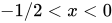
| From this, we can build a sign chart: | ||||||||||||||||
| ||||||||||||||||
| Notice that at each of our roots, the derivative does split (changes sign as Failed to parse (MathML with SVG or PNG fallback (recommended for modern browsers and accessibility tools): Invalid response ("Math extension cannot connect to Restbase.") from server "https://wikimedia.org/api/rest_v1/":): {\displaystyle x} passes through each root of Failed to parse (MathML with SVG or PNG fallback (recommended for modern browsers and accessibility tools): Invalid response ("Math extension cannot connect to Restbase.") from server "https://wikimedia.org/api/rest_v1/":): {\displaystyle h'(x)} ), so the function is neither increasing or decreasing at each root. Thus, Failed to parse (MathML with SVG or PNG fallback (recommended for modern browsers and accessibility tools): Invalid response ("Math extension cannot connect to Restbase.") from server "https://wikimedia.org/api/rest_v1/":): {\displaystyle h(x)} is increasing on Failed to parse (MathML with SVG or PNG fallback (recommended for modern browsers and accessibility tools): Invalid response ("Math extension cannot connect to Restbase.") from server "https://wikimedia.org/api/rest_v1/":): {\displaystyle (-1/2,0)\cup(1/2,\infty)} , and decreasing on Failed to parse (MathML with SVG or PNG fallback (recommended for modern browsers and accessibility tools): Invalid response ("Math extension cannot connect to Restbase.") from server "https://wikimedia.org/api/rest_v1/":): {\displaystyle (-\infty,-1/2)\cup(0,1/2)} . |







| Final Answer: |
|---|
| Failed to parse (MathML with SVG or PNG fallback (recommended for modern browsers and accessibility tools): Invalid response ("Math extension cannot connect to Restbase.") from server "https://wikimedia.org/api/rest_v1/":): {\displaystyle h(x)} is increasing on Failed to parse (MathML with SVG or PNG fallback (recommended for modern browsers and accessibility tools): Invalid response ("Math extension cannot connect to Restbase.") from server "https://wikimedia.org/api/rest_v1/":): {\displaystyle (-1/2,0)\cup(1/2,\infty)} , and decreasing on Failed to parse (MathML with SVG or PNG fallback (recommended for modern browsers and accessibility tools): Invalid response ("Math extension cannot connect to Restbase.") from server "https://wikimedia.org/api/rest_v1/":): {\displaystyle (-\infty,-1/2)\cup(0,1/2)} . |