Difference between revisions of "Math 22 Lagrange Multipliers"
Jump to navigation
Jump to search
| Line 28: | Line 28: | ||
!Solution: | !Solution: | ||
|- | |- | ||
| − | |So, <math>F(x,y,\lambda)=f(x,y)-\lambda g(x,y)=xy-\lambda (x+3y-6)=xy-\lambda x -3\lambda y | + | |So, <math>F(x,y,\lambda)=f(x,y)-\lambda g(x,y)=xy-\lambda (x+3y-6)=xy-\lambda x -3\lambda y+6\lambda</math> |
|- | |- | ||
|<math>F_x(x,y,\lambda)=y-\lambda</math> | |<math>F_x(x,y,\lambda)=y-\lambda</math> | ||
Latest revision as of 09:57, 18 August 2020
Method of Lagrange Multipliers
If has a maximum or minimum subject to the constraint , then it will occur at one of the critical numbers of the function defined by . In this section, we need to set up the system of equations:




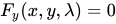

Example: Set up the Lagrange Multipliers:
1) Maximum: and Constraint


| Solution: |
|---|
| So, |




2) Maximum: and Constraint

| Solution: |
|---|
| So, |



This page were made by Tri Phan