Difference between revisions of "Math 22 Functions of Several Variables"
Jump to navigation
Jump to search
| Line 4: | Line 4: | ||
The set <math>D</math> is the domain of <math>f</math>, and the corresponding set of values for <math>f(x,y)</math> is the range of <math>f</math>. Functions of three, four, or more variables are defined similarly. | The set <math>D</math> is the domain of <math>f</math>, and the corresponding set of values for <math>f(x,y)</math> is the range of <math>f</math>. Functions of three, four, or more variables are defined similarly. | ||
| + | '''Exercises 1''' Given <math>f(x,y)=2x+y-3</math>. Evaluate: | ||
| + | '''1)''' <math>f(0,2)</math> | ||
| + | {| class = "mw-collapsible mw-collapsed" style = "text-align:left;" | ||
| + | !Solution: | ||
| + | |- | ||
| + | |<math>f(x,y)=2x+y-3</math> | ||
| + | |- | ||
| + | |So, <math>f(0,2)=2(0)+2-3=-1</math> | ||
| + | |} | ||
| + | |||
| + | '''2)''' <math>f(5,20)</math> | ||
| + | {| class = "mw-collapsible mw-collapsed" style = "text-align:left;" | ||
| + | !Solution: | ||
| + | |- | ||
| + | |<math>f(x,y)=2x+y-3</math> | ||
| + | |- | ||
| + | |So, <math>f(5,20)=2(5)+20-3=27</math> | ||
| + | |} | ||
| + | |||
| + | '''3)''' <math>f(-1,2)</math> | ||
| + | {| class = "mw-collapsible mw-collapsed" style = "text-align:left;" | ||
| + | !Solution: | ||
| + | |- | ||
| + | |<math>f(x,y)=2x+y-3</math> | ||
| + | |- | ||
| + | |So, <math>f(-1,2)=2(-2)+2-3=-5</math> | ||
| + | |} | ||
| + | |||
| + | '''4)''' <math>f(4,2)</math> | ||
| + | {| class = "mw-collapsible mw-collapsed" style = "text-align:left;" | ||
| + | !Solution: | ||
| + | |- | ||
| + | |<math>f(x,y)=2x+y-3</math> | ||
| + | |- | ||
| + | |So, <math>f(4,2)=2(3)+2-3=5</math> | ||
| + | |} | ||
| + | ==The Domain and Range of a Function of Two Variables== | ||
| + | '''Example:''' Find the domain of <math>f(x,y)=\sqrt{9-x^2-y^2}</math> | ||
| + | |||
| + | Notice that : The radicand should be non-negative. So, <math>9-x^2-y^2\ge 0</math>, hence the domain is <math>x^2+y^2\le 9</math>. | ||
| + | |||
| + | Notice: <math>x^2+y^2= 9</math> is the circle center at <math>(0,0)</math>, radius 3. | ||
| + | |||
| + | Since the point <math>(0,0)</math> satisfies the inequality <math>x^2+y^2\le 9</math>. Hence the range is <math>0\le x\le 3</math> | ||
[[Math_22| '''Return to Topics Page''']] | [[Math_22| '''Return to Topics Page''']] | ||
'''This page were made by [[Contributors|Tri Phan]]''' | '''This page were made by [[Contributors|Tri Phan]]''' | ||
Revision as of 08:06, 18 August 2020
Definition of a Function of Two Variables
Let be a set of ordered pairs of real numbers. If to each ordered pair in there corresponds a unique real number , then is a function of and . The set is the domain of , and the corresponding set of values for is the range of . Functions of three, four, or more variables are defined similarly.


Exercises 1 Given . Evaluate:

1)

| Solution: |
|---|
| So, |

2)

| Solution: |
|---|
| So, |

3)

| Solution: |
|---|
| So, |

4)

| Solution: |
|---|
| So, |

The Domain and Range of a Function of Two Variables
Example: Find the domain of
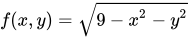
Notice that : The radicand should be non-negative. So, , hence the domain is .


Notice: is the circle center at , radius 3.


Since the point satisfies the inequality . Hence the range is

This page were made by Tri Phan