Difference between revisions of "Math 22 Antiderivatives and Indefinite Integrals"
Jump to navigation
Jump to search
| Line 20: | Line 20: | ||
<math>5.\int x^n dx=\frac{x^{n+1}}{n+1}+C</math> for <math>n\ne -1</math> | <math>5.\int x^n dx=\frac{x^{n+1}}{n+1}+C</math> for <math>n\ne -1</math> | ||
| − | '''Exercises''' Find the indefinite integral | + | '''Exercises 1''' Find the indefinite integral |
'''1)''' <math>\int 7dr</math> | '''1)''' <math>\int 7dr</math> | ||
| Line 49: | Line 49: | ||
|<math>\int 5x^{-3}dx=5\int x^{-3}dx=5\frac{x^{-3+1}}{-3+1}+C=\frac{-5}{2}x^{-2}+C</math> | |<math>\int 5x^{-3}dx=5\int x^{-3}dx=5\frac{x^{-3+1}}{-3+1}+C=\frac{-5}{2}x^{-2}+C</math> | ||
|} | |} | ||
| + | |||
| + | '''Exercises 2''' Solve the initial value problems, given: | ||
| + | |||
| + | '''5)''' <math>f'(x)=\frac{1}{5}x-2</math> and <math>f(10)=-10</math> | ||
| + | {| class = "mw-collapsible mw-collapsed" style = "text-align:left;" | ||
| + | !Solution: | ||
| + | |- | ||
| + | |Notice <math>f(x)=\int f'(x)dx=\int (\frac{1}{5}x-2)dx=\frac{1}{5}\frac{x^2}{2}-2x+C=\frac{1}{10}x^2-2x+C</math> | ||
| + | |- | ||
| + | |So, <math>f(x)=\frac{1}{10}x^2-2x+C</math> | ||
| + | |- | ||
| + | |we are given <math>f(10)=-10</math>, so <math>\frac{1}{10}(10)^2-2(10)+C=10</math> | ||
| + | |- | ||
| + | |Hence, <math>C=20</math> | ||
| + | |- | ||
| + | |Therefore, <math>f(x)=\frac{1}{10}x^2-2x+20</math> | ||
| + | |} | ||
| + | |||
| + | '''6)''' <math>f'(x)=3x^2+4</math> and <math>f(-1)=-6</math> | ||
| + | {| class = "mw-collapsible mw-collapsed" style = "text-align:left;" | ||
| + | !Solution: | ||
| + | |- | ||
| + | |Notice <math>f(x)=\int f'(x)dx=\int (3x^2+4)dx=x^3+4x+C</math> | ||
| + | |- | ||
| + | |So, <math>f(x)=x^3+4x+C</math> | ||
| + | |- | ||
| + | |we are given <math>f(-1)=-6</math>, so <math>(-1)^3+4(-1)+C=-6</math> | ||
| + | |- | ||
| + | |Hence, <math>C=-1</math> | ||
| + | |- | ||
| + | |Therefore, <math>f(x)=x^3+4x-1</math> | ||
| + | |} | ||
| + | |||
[[Math_22| '''Return to Topics Page''']] | [[Math_22| '''Return to Topics Page''']] | ||
'''This page were made by [[Contributors|Tri Phan]]''' | '''This page were made by [[Contributors|Tri Phan]]''' | ||
Latest revision as of 08:33, 12 August 2020
Antiderivatives
A function is an antiderivative of a function when for every in the domain of , it follows that


The antidifferentiation process is also called integration and is denoted by (integral sign). is the indefinite integral of


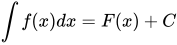
If for all , we can write: for is a constant.

Basic Integration Rules
for is a constant.


![{\displaystyle 3.\int [f(x)+g(x)]dx=\int f(x)dx+\int g(x)dx}](https://wikimedia.org/api/rest_v1/media/math/render/svg/57ea6a04f79a2f0f463ab7302ca859ebbef228f5)
![{\displaystyle 4.\int [f(x)-g(x)]dx=\int f(x)dx-\int g(x)dx}](https://wikimedia.org/api/rest_v1/media/math/render/svg/9c8db5b3d2591b32c575e7aed0dbaa2d3c40ca08)
for


Exercises 1 Find the indefinite integral
1)

| Solution: |
|---|

2)

| Solution: |
|---|

3)

| Solution: |
|---|

4)

| Solution: |
|---|

Exercises 2 Solve the initial value problems, given:
5) and


| Solution: |
|---|
| Notice |
| So, |
| we are given , so |
| Hence, |
| Therefore, |


6) and


| Solution: |
|---|
| Notice |
| So, |
| we are given , so |
| Hence, |
| Therefore, |


This page were made by Tri Phan