Difference between revisions of "Math 22 Limits"
| Line 42: | Line 42: | ||
One-sided Limit is related to unbounded function. | One-sided Limit is related to unbounded function. | ||
| + | |||
| + | In some case, the limit of <math>f(x)</math> can be increase/decrease without bound as <math>x</math> approaches <math>c</math>. We can write <math>\lim_{x\to c} f(x)=\pm\infty</math> | ||
Consider <math>\lim_{x\to 1} \frac {2}{x-1}</math>. By direct substitution, it is of the form <math>\frac {\text{constant}}{0}</math>, so the answer will be either <math>\infty</math> or <math>-\infty</math> | Consider <math>\lim_{x\to 1} \frac {2}{x-1}</math>. By direct substitution, it is of the form <math>\frac {\text{constant}}{0}</math>, so the answer will be either <math>\infty</math> or <math>-\infty</math> | ||
| Line 47: | Line 49: | ||
| − | + | ||
'''This page were made by [[Contributors|Tri Phan]]''' | '''This page were made by [[Contributors|Tri Phan]]''' | ||
Revision as of 07:51, 14 July 2020
The Limit of a Function
Definition of the Limit of a Function If becomes arbitrarily close to a single number as approaches from either side, then which is read as "the limit of as approaches is


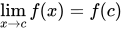
Note: Many times the limit of as approaches is simply , so limit can be evaluate by direct substitution as

Properties of Limits
Let and be real numbers, let be a positive integer, and let and be functions with the following limits and . Then


1. Scalar multiple:
![{\displaystyle \lim _{x\to c}[bf(x)]=bL}](https://wikimedia.org/api/rest_v1/media/math/render/svg/f3002341fe6d51854940848132f27c2f644d1828)
2. Sum or difference:
![{\displaystyle \lim _{x\to c}[f(x)\pm g(x)]=L\pm K}](https://wikimedia.org/api/rest_v1/media/math/render/svg/e5c36ebdc491f73f5d444f33622cd9743a37762c)
3. Product:
![{\displaystyle \lim _{x\to c}[f(x)\cdot g(x)]=L\cdot K}](https://wikimedia.org/api/rest_v1/media/math/render/svg/606de9127f6a543e0d74383e6c01c65e39e8629c)
4. Quotient: Failed to parse (Conversion error. Server ("https://wikimedia.org/api/rest_") reported: "Cannot get mml. Server problem."): {\displaystyle \lim _{x\to c}{\frac {f(x)}{g(x)}}={\frac {L}{K}}}
5. Power:
![{\displaystyle \lim _{x\to c}[f(x)]^{n}=L^{n}}](https://wikimedia.org/api/rest_v1/media/math/render/svg/a6ec6dda0eb89aef9708f2752e9c674a9d85ed90)
6. Radical:
![{\displaystyle \lim _{x\to c}{\sqrt[{n}]{f(x)}}={\sqrt[{n}]{L}}}](https://wikimedia.org/api/rest_v1/media/math/render/svg/124903c0e7c97485a73966e3b8fc2d6fe86ba7d6)
Techniques for Evaluating Limits
1. Direct Substitution: Direct Substitution can be used to find the limit of a Polynomial Function.
Example: Evaluate

2. Dividing Out Technique: When direct substitution fails and numerator or/and denominator can be factored.
Example: Evaluate . Now we can use direct substitution to get the answer.

3. Rationalizing (Using Conjugate): When direct substitution fails and either numerator or denominator has a square root. In this case, we can try to multiply both numerator and denominator by the conjugate.
Example: Evaluate Failed to parse (MathML with SVG or PNG fallback (recommended for modern browsers and accessibility tools): Invalid response ("Math extension cannot connect to Restbase.") from server "https://wikimedia.org/api/rest_v1/":): {\displaystyle \lim_{x\to 0} \frac {\sqrt{x+4}-2}{x}= \lim_{x\to 0} \frac {\sqrt{x+4}-2} {x} \cdot \frac {\sqrt{x+4}+2}{\sqrt{x+4}+2}= \lim_{x\to 0} \frac {(x+4)-4}{x(\sqrt{x+4}+2)}=\lim_{x\to 0} \frac {x}{x(\sqrt{x+4}+2)}=\lim_{x\to 0} \frac {1}{\sqrt{x+4}+2}} . Now we can use direct substitution to get the answer
One-Sided Limits and Unbounded Function
 when a function approaches a different value from the left of Failed to parse (MathML with SVG or PNG fallback (recommended for modern browsers and accessibility tools): Invalid response ("Math extension cannot connect to Restbase.") from server "https://wikimedia.org/api/rest_v1/":): {\displaystyle c}
 than it approaches from the right of Failed to parse (MathML with SVG or PNG fallback (recommended for modern browsers and accessibility tools): Invalid response ("Math extension cannot connect to Restbase.") from server "https://wikimedia.org/api/rest_v1/":): {\displaystyle c}
, the limit does not exists. However, this type of behavior can be described more concisely with
 the concept of a one-sided limit. We denote
 Failed to parse (MathML with SVG or PNG fallback (recommended for modern browsers and accessibility tools): Invalid response ("Math extension cannot connect to Restbase.") from server "https://wikimedia.org/api/rest_v1/":): {\displaystyle \lim_{x\to c^{-}} f(x)=L}
 and Failed to parse (MathML with SVG or PNG fallback (recommended for modern browsers and accessibility tools): Invalid response ("Math extension cannot connect to Restbase.") from server "https://wikimedia.org/api/rest_v1/":): {\displaystyle \lim_{x\to c^{+}} f(x)=K}
One-sided Limit is related to unbounded function.
In some case, the limit of Failed to parse (MathML with SVG or PNG fallback (recommended for modern browsers and accessibility tools): Invalid response ("Math extension cannot connect to Restbase.") from server "https://wikimedia.org/api/rest_v1/":): {\displaystyle f(x)} can be increase/decrease without bound as Failed to parse (MathML with SVG or PNG fallback (recommended for modern browsers and accessibility tools): Invalid response ("Math extension cannot connect to Restbase.") from server "https://wikimedia.org/api/rest_v1/":): {\displaystyle x} approaches Failed to parse (MathML with SVG or PNG fallback (recommended for modern browsers and accessibility tools): Invalid response ("Math extension cannot connect to Restbase.") from server "https://wikimedia.org/api/rest_v1/":): {\displaystyle c} . We can write Failed to parse (MathML with SVG or PNG fallback (recommended for modern browsers and accessibility tools): Invalid response ("Math extension cannot connect to Restbase.") from server "https://wikimedia.org/api/rest_v1/":): {\displaystyle \lim_{x\to c} f(x)=\pm\infty}
Consider Failed to parse (MathML with SVG or PNG fallback (recommended for modern browsers and accessibility tools): Invalid response ("Math extension cannot connect to Restbase.") from server "https://wikimedia.org/api/rest_v1/":): {\displaystyle \lim_{x\to 1} \frac {2}{x-1}} . By direct substitution, it is of the form Failed to parse (MathML with SVG or PNG fallback (recommended for modern browsers and accessibility tools): Invalid response ("Math extension cannot connect to Restbase.") from server "https://wikimedia.org/api/rest_v1/":): {\displaystyle \frac {\text{constant}}{0}} , so the answer will be either Failed to parse (MathML with SVG or PNG fallback (recommended for modern browsers and accessibility tools): Invalid response ("Math extension cannot connect to Restbase.") from server "https://wikimedia.org/api/rest_v1/":): {\displaystyle \infty} or Failed to parse (MathML with SVG or PNG fallback (recommended for modern browsers and accessibility tools): Invalid response ("Math extension cannot connect to Restbase.") from server "https://wikimedia.org/api/rest_v1/":): {\displaystyle -\infty}
This page were made by Tri Phan