Difference between revisions of "009C Sample Midterm 2, Problem 5"
Jump to navigation
Jump to search
| Line 20: | Line 20: | ||
!Step 1: | !Step 1: | ||
|- | |- | ||
| − | | | + | |Assume that the power series <math style="vertical-align: -19px">\sum_{n=0}^\infty c_nx^n</math> converges. |
| + | |- | ||
| + | |Let <math style="vertical-align: 0px">R</math> be the radius of convergence of this power series. | ||
| + | |- | ||
| + | |So, the power series | ||
| + | |- | ||
| + | | <math style="vertical-align: -19px">\sum_{n=0}^\infty c_nx^n</math> | ||
| + | |- | ||
| + | |converges in the interval <math style="vertical-align: -5px">(-R,R).</math> | ||
|} | |} | ||
Revision as of 17:11, 23 April 2017
If converges, does it follow that the following series converges?

(a)
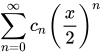
(b)

| Foundations: |
|---|
| If a power series converges, then it has a nonempty interval of convergence. |
Solution:
(a)
| Step 1: |
|---|
| Assume that the power series converges. |
| Let be the radius of convergence of this power series. |
| So, the power series |
| converges in the interval |


| Step 2: |
|---|
(b)
| Step 1: |
|---|
| Step 2: |
|---|
| Final Answer: |
|---|
| (a) converges |
| (b) converges |