Difference between revisions of "009C Sample Midterm 2, Problem 3"
Jump to navigation
Jump to search
(Created page with "<span class="exam">Determine convergence or divergence: <span class="exam">(a) <math>\sum_{n=1}^\infty (-1)^n \sqrt{\frac{1}{n}}</math> <span class="exam">(b) <m...") |
|||
| Line 129: | Line 129: | ||
| | | | ||
<math>\begin{array}{rcl} | <math>\begin{array}{rcl} | ||
| − | \displaystyle{\ln y } & = & \displaystyle{\lim_{n\rightarrow \infty} \frac{\ln \ | + | \displaystyle{\ln y } & = & \displaystyle{\lim_{n\rightarrow \infty} \frac{\ln \big(\frac{n}{n+1}\big)}{\frac{1}{n}}}\\ |
&&\\ | &&\\ | ||
| − | & = & \displaystyle{\lim_{x\rightarrow \infty} \frac{\ln \ | + | & = & \displaystyle{\lim_{x\rightarrow \infty} \frac{\ln \big(\frac{x}{x+1}\big)}{\frac{1}{x}}}\\ |
&&\\ | &&\\ | ||
| − | & \overset{L'H}{=} & \displaystyle{\lim_{x\rightarrow \infty} \frac{\frac{1}{\ | + | & \overset{L'H}{=} & \displaystyle{\lim_{x\rightarrow \infty} \frac{\frac{1}{\big(\frac{x}{x+1}\big)}\frac{1}{(x+1)^2}}{\big(-\frac{1}{x^2}\big)}}\\ |
&&\\ | &&\\ | ||
& = & \displaystyle{\lim_{x\rightarrow \infty} \frac{-x}{x+1}}\\ | & = & \displaystyle{\lim_{x\rightarrow \infty} \frac{-x}{x+1}}\\ | ||
Revision as of 10:33, 14 April 2017
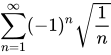
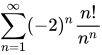
Determine convergence or divergence:
(a)
(b)
| Foundations: |
|---|
| 1. Alternating Series Test |
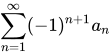
| Let be a positive, decreasing sequence where |
| Then, and |
| converge. |
| 2. Ratio Test |
| Let be a series and |
| Then, |
|
If the series is absolutely convergent. |
|
If the series is divergent. |
|
If the test is inconclusive. |
| 3. If a series absolutely converges, then it also converges. |




Solution:
(a)
| Step 1: |
|---|
| First, we have |
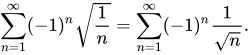
| Step 2: |
|---|
| We notice that the series is alternating. |
| Let |
| First, we have |
| for all |
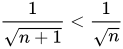
| The sequence is decreasing since |
| for all |
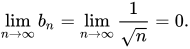
| Also, |
| Therefore, the series converges by the Alternating Series Test. |



(b)
| Step 1: |
|---|
| We begin by using the Ratio Test. |
| We have |
|
|

| Step 2: |
|---|
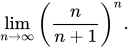
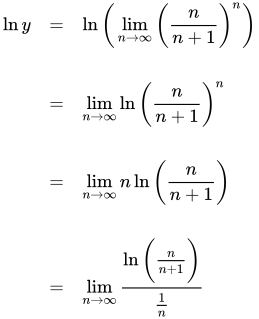
| Now, we need to calculate |
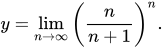
| Let |
| Then, taking the natural log of both sides, we get |
|
|
| since we can interchange limits and continuous functions. |
| Now, this limit has the form |
| Hence, we can use L'Hopital's Rule to calculate this limit. |

| Step 3: |
|---|
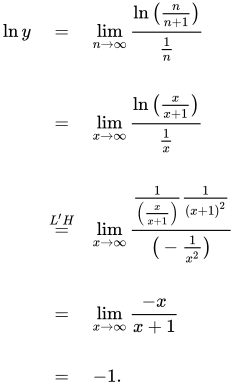
| Now, we have |
|
|
| Step 4: |
|---|
| Since we know |
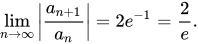
| Now, we have |
| Since the series is absolutely convergent by the Ratio Test. |
| Therefore, the series converges. |



| Final Answer: |
|---|
| (a) converges (by the Alternating Series Test) |
| (b) converges (by the Ratio Test) |