Difference between revisions of "009B Sample Final 1, Problem 1"
Jump to navigation
Jump to search
| Line 13: | Line 13: | ||
|Recall: | |Recall: | ||
|- | |- | ||
| − | |'''1.''' The height of each rectangle in the lower Riemann sum is given by choosing the minimum <math style="vertical-align: -5px">y</math> value of the left and right endpoints of the rectangle. | + | | |
| + | ::'''1.''' The height of each rectangle in the lower Riemann sum is given by choosing the minimum | ||
| + | |- | ||
| + | | | ||
| + | :::<math style="vertical-align: -5px">y</math> value of the left and right endpoints of the rectangle. | ||
| + | |- | ||
| + | | | ||
| + | ::'''2.''' The height of each rectangle in the upper Riemann sum is given by choosing the maximum | ||
|- | |- | ||
| − | | | + | | |
| + | :::<math style="vertical-align: -5px">y</math> value of the left and right endpoints of the rectangle. | ||
|- | |- | ||
| − | |'''3.''' The area of the region is given by <math style="vertical-align: -14px">\int_a^b y~dx</math> for appropriate values <math style="vertical-align: -4px">a,b</math> | + | | |
| + | ::'''3.''' The area of the region is given by <math style="vertical-align: -14px">\int_a^b y~dx</math> for appropriate values <math style="vertical-align: -4px">a,b.</math> | ||
|} | |} | ||
| Line 29: | Line 38: | ||
|We need to set these two equations equal in order to find the intersection points of these functions. | |We need to set these two equations equal in order to find the intersection points of these functions. | ||
|- | |- | ||
| − | |So, we let | + | |So, we let |
|- | |- | ||
| − | | | + | | |
| + | ::<math style="vertical-align: -5px">2(-x^2+9)=0.</math> | ||
|- | |- | ||
| − | | | + | |Solving for <math style="vertical-align: 0px">x,</math> we get <math style="vertical-align: 0px">x=\pm 3.</math> |
| + | |- | ||
| + | |This means that we need to calculate the Riemann sums over the interval <math style="vertical-align: -5px">[-3,3].</math> | ||
|} | |} | ||
| Line 41: | Line 53: | ||
|Since the length of our interval is <math style="vertical-align: 0px">6</math> and we are using <math style="vertical-align: 0px">3</math> rectangles, | |Since the length of our interval is <math style="vertical-align: 0px">6</math> and we are using <math style="vertical-align: 0px">3</math> rectangles, | ||
|- | |- | ||
| − | |each rectangle will have width <math style="vertical-align: 0px">2</math>  | + | |each rectangle will have width <math style="vertical-align: 0px">2.</math>  |
|- | |- | ||
|Thus, the lower Riemann sum is | |Thus, the lower Riemann sum is | ||
| Line 56: | Line 68: | ||
|As in Part (a), the length of our inteval is <math style="vertical-align: 0px">6</math> and | |As in Part (a), the length of our inteval is <math style="vertical-align: 0px">6</math> and | ||
|- | |- | ||
| − | |each rectangle will have width <math style="vertical-align: 0px">2</math> | + | |each rectangle will have width <math style="vertical-align: 0px">2.</math> (See Step 1 and 2 for '''(a)''') |
|} | |} | ||
Revision as of 12:42, 18 April 2016
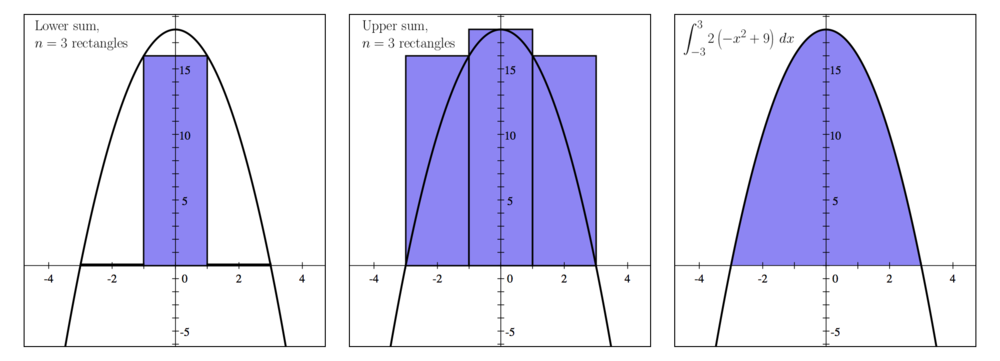
Consider the region bounded by the following two functions:
- Failed to parse (MathML with SVG or PNG fallback (recommended for modern browsers and accessibility tools): Invalid response ("Math extension cannot connect to Restbase.") from server "https://wikimedia.org/api/rest_v1/":): {\displaystyle y=2(-x^2+9)} and Failed to parse (MathML with SVG or PNG fallback (recommended for modern browsers and accessibility tools): Invalid response ("Math extension cannot connect to Restbase.") from server "https://wikimedia.org/api/rest_v1/":): {\displaystyle y=0.}
- a) Using the lower sum with three rectangles having equal width, approximate the area.
- b) Using the upper sum with three rectangles having equal width, approximate the area.
- c) Find the actual area of the region.
| Foundations: |
|---|
| Recall: |
|
|
|
|
|
Solution:
(a)
| Step 1: |
|---|
| We need to set these two equations equal in order to find the intersection points of these functions. |
| So, we let |
|
| Solving for Failed to parse (MathML with SVG or PNG fallback (recommended for modern browsers and accessibility tools): Invalid response ("Math extension cannot connect to Restbase.") from server "https://wikimedia.org/api/rest_v1/":): {\displaystyle x,} we get Failed to parse (MathML with SVG or PNG fallback (recommended for modern browsers and accessibility tools): Invalid response ("Math extension cannot connect to Restbase.") from server "https://wikimedia.org/api/rest_v1/":): {\displaystyle x=\pm 3.} |
| This means that we need to calculate the Riemann sums over the interval Failed to parse (MathML with SVG or PNG fallback (recommended for modern browsers and accessibility tools): Invalid response ("Math extension cannot connect to Restbase.") from server "https://wikimedia.org/api/rest_v1/":): {\displaystyle [-3,3].} |
| Step 2: |
|---|
| Since the length of our interval is Failed to parse (MathML with SVG or PNG fallback (recommended for modern browsers and accessibility tools): Invalid response ("Math extension cannot connect to Restbase.") from server "https://wikimedia.org/api/rest_v1/":): {\displaystyle 6} and we are using Failed to parse (MathML with SVG or PNG fallback (recommended for modern browsers and accessibility tools): Invalid response ("Math extension cannot connect to Restbase.") from server "https://wikimedia.org/api/rest_v1/":): {\displaystyle 3} rectangles, |
| each rectangle will have width Failed to parse (MathML with SVG or PNG fallback (recommended for modern browsers and accessibility tools): Invalid response ("Math extension cannot connect to Restbase.") from server "https://wikimedia.org/api/rest_v1/":): {\displaystyle 2.} |
| Thus, the lower Riemann sum is |
|
(b)
| Step 1: |
|---|
| As in Part (a), the length of our inteval is Failed to parse (MathML with SVG or PNG fallback (recommended for modern browsers and accessibility tools): Invalid response ("Math extension cannot connect to Restbase.") from server "https://wikimedia.org/api/rest_v1/":): {\displaystyle 6} and |
| each rectangle will have width Failed to parse (MathML with SVG or PNG fallback (recommended for modern browsers and accessibility tools): Invalid response ("Math extension cannot connect to Restbase.") from server "https://wikimedia.org/api/rest_v1/":): {\displaystyle 2.} (See Step 1 and 2 for (a)) |
| Step 2: |
|---|
| Thus, the upper Riemann sum is |
|
(c)
| Step 1: |
|---|
| To find the actual area of the region, we need to calculate |
|
| Step 2: |
|---|
| We integrate to get |
|
| Final Answer: |
|---|
| (a) Failed to parse (MathML with SVG or PNG fallback (recommended for modern browsers and accessibility tools): Invalid response ("Math extension cannot connect to Restbase.") from server "https://wikimedia.org/api/rest_v1/":): {\displaystyle 32} |
| (b) Failed to parse (MathML with SVG or PNG fallback (recommended for modern browsers and accessibility tools): Invalid response ("Math extension cannot connect to Restbase.") from server "https://wikimedia.org/api/rest_v1/":): {\displaystyle 96} |
| (c) Failed to parse (MathML with SVG or PNG fallback (recommended for modern browsers and accessibility tools): Invalid response ("Math extension cannot connect to Restbase.") from server "https://wikimedia.org/api/rest_v1/":): {\displaystyle 72} |
