Difference between revisions of "009B Sample Final 1, Problem 3"

From Math Wiki
Jump to navigation Jump to search
(Created page with "<span class="exam">Consider the area bounded by the following two functions: ::::::<math>y=\sin x</math> and <math style="vertical-align: -13px">y=\frac{2}{\pi}x.</math> <sp...")
 
Line 31: Line 31:
 
|First, we graph these two functions.
 
|First, we graph these two functions.
 
|-
 
|-
|Insert graph here
+
|[[File:9BF1 3 GP.png|center|800px]]|}
|}


{| class="mw-collapsible mw-collapsed" style = "text-align:left;"
 
{| class="mw-collapsible mw-collapsed" style = "text-align:left;"

Revision as of 22:50, 26 February 2016

Consider the area bounded by the following two functions:

Failed to parse (Conversion error. Server ("https://wikimedia.org/api/rest_") reported: "Cannot get mml. Server problem."): {\displaystyle y=\sin x} and

a) Find the three intersection points of the two given functions. (Drawing may be helpful.)

b) Find the area bounded by the two functions.

Foundations:  
Recall:
1. You can find the intersection points of two functions, say
by setting and solving for .
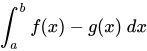
2. The area between two functions, and Failed to parse (Conversion error. Server ("https://wikimedia.org/api/rest_") reported: "Cannot get mml. Server problem."): {\displaystyle g(x)} , is given by
for , where is the upper function and Failed to parse (Conversion error. Server ("https://wikimedia.org/api/rest_") reported: "Cannot get mml. Server problem."): {\displaystyle g(x)} is the lower function.

Solution:

(a)

Step 1:  
First, we graph these two functions.
9BF1 3 GP.png
|}
Step 2:  
Setting Failed to parse (Conversion error. Server ("https://wikimedia.org/api/rest_") reported: "Cannot get mml. Server problem."): {\displaystyle \sin x={\frac {2}{\pi }}x} , we get three solutions:
So, the three intersection points are .
You can see these intersection points on the graph shown in Step 1.

(b)

Step 1:  
Using symmetry of the graph, the area bounded by the two functions is given by
Step 2:  
Lastly, we integrate to get
Failed to parse (MathML with SVG or PNG fallback (recommended for modern browsers and accessibility tools): Invalid response ("Math extension cannot connect to Restbase.") from server "https://wikimedia.org/api/rest_v1/":): {\displaystyle \begin{array}{rcl} \displaystyle{2\int_0^{\frac{\pi}{2}}\bigg(\sin (x)-\frac{2}{\pi}x\bigg)~dx} & {=} & \displaystyle{2\bigg(-\cos (x)-\frac{x^2}{\pi}\bigg)\bigg|_0^{\frac{\pi}{2}}}\\ &&\\ & = & \displaystyle{2\bigg(-\cos \bigg(\frac{\pi}{2}\bigg)-\frac{1}{\pi}\bigg(\frac{\pi}{2}\bigg)^2\bigg)}-2(-\cos(0))\\ &&\\ & = & \displaystyle{2\bigg(-\frac{\pi}{4}\bigg)+2}\\ &&\\ & = & \displaystyle{-\frac{\pi}{2}+2}.\\ \end{array}}
Final Answer:  
(a)  Failed to parse (MathML with SVG or PNG fallback (recommended for modern browsers and accessibility tools): Invalid response ("Math extension cannot connect to Restbase.") from server "https://wikimedia.org/api/rest_v1/":): {\displaystyle (0,0),\bigg(\frac{\pi}{2},1\bigg),\bigg(\frac{-\pi}{2},-1\bigg)}
(b)  Failed to parse (MathML with SVG or PNG fallback (recommended for modern browsers and accessibility tools): Invalid response ("Math extension cannot connect to Restbase.") from server "https://wikimedia.org/api/rest_v1/":): {\displaystyle -\frac{\pi}{2}+2}

Return to Sample Exam