Difference between revisions of "009B Sample Midterm 2, Problem 1"
Jump to navigation
Jump to search
(Created page with "<span class="exam"> Consider the region <math style="vertical-align: 0px">S</math> bounded by <math style="vertical-align: -13px">x=1,x=5,y=\frac{1}{x^2}</math> and the <math>...") |
|||
| Line 9: | Line 9: | ||
!Foundations: | !Foundations: | ||
|- | |- | ||
| − | | | + | |See the page on [[Riemann_Sums|'''Riemann Sums''']]. |
|} | |} | ||
Revision as of 23:59, 2 February 2016
Consider the region bounded by and the -axis.


- a) Use four rectangles and a Riemann sum to approximate the area of the region . Sketch the region and the rectangles and indicate whether your rectangles overestimate or underestimate the area of .
- b) Find an expression for the area of the region as a limit. Do not evaluate the limit.
| Foundations: |
|---|
| See the page on Riemann Sums. |
Solution:
(a)
| Step 1: |
|---|
| Let . Since our interval is and we are using 4 rectangles, each rectangle has width 1. Since the problem doesn't specify, we can choose either right- or left-endpoints. Choosing left-endpoints, the Riemann sum is |
| . |

![{\displaystyle [1,5]}](https://wikimedia.org/api/rest_v1/media/math/render/svg/83817b569bd3cb127c2630acacaddd2dbd6945c0)

| Step 2: |
|---|
| Thus, the left-endpoint Riemann sum is |
| . |
| The left-endpoint Riemann sum overestimates the area of . |

(b)
| Step 1: |
|---|
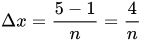
| Let be the number of rectangles used in the left-endpoint Riemann sum for . |
| The width of each rectangle is . |

| Step 2: |
|---|
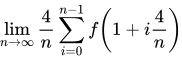
| So, the left-endpoint Riemann sum is |
| . |
| Now, we let go to infinity to get a limit. |
| So, the area of is equal to . |

| Final Answer: |
|---|
| (a) The left-endpoint Riemann sum is , which overestimates the area of . |
| (b) Using left-endpoint Riemann sums: |
