Difference between revisions of "009A Sample Final A, Problem 7"
Jump to navigation
Jump to search
m |
m |
||
| (One intermediate revision by the same user not shown) | |||
| Line 21: | Line 21: | ||
!Step 2: | !Step 2: | ||
|- | |- | ||
| − | |'''Form the Equations:''' Notice that we need fencing between each of the pens | + | |'''Form the Equations:''' Notice that we need fencing between each of the pens, so we require a total of <math style="vertical-align: 0%;">5</math> pieces of length <math style="vertical-align: -18%;">y</math>. We also need <math style="vertical-align: 0%;">2</math> pieces of length <math style="vertical-align: 0%;">x</math> for each pen, which means there are a total of <math style="vertical-align: -5%;">4\cdot 2</math>   pieces required of length <math style="vertical-align: 0%;">x</math>. Together, we need a total length of <math style="vertical-align: -18%;">L=8x+5y</math>. |
|- | |- | ||
|On the other hand, we know that each pen has a fixed area of <math style="vertical-align: 0%;">500</math> square feet. Thus, we also know that <math style="vertical-align: -18%;">xy=500</math>. | |On the other hand, we know that each pen has a fixed area of <math style="vertical-align: 0%;">500</math> square feet. Thus, we also know that <math style="vertical-align: -18%;">xy=500</math>. | ||
| Line 29: | Line 29: | ||
!Step 3: | !Step 3: | ||
|- | |- | ||
| − | |'''Optimize:''' Since <math style="vertical-align: -18%;">xy=500</math>, we also know <math style="vertical-align: - | + | |'''Optimize:''' Since <math style="vertical-align: -18%;">xy=500</math>, we also know <math style="vertical-align: -21%;">y=500/x</math>. Plugging this into our equation for length, we have |
|- | |- | ||
| <math>L(x) = 8x + 5\cdot \frac{500}{x} = 8x + \frac{2500}{x}.</math> | | <math>L(x) = 8x + 5\cdot \frac{500}{x} = 8x + \frac{2500}{x}.</math> | ||
| Line 45: | Line 45: | ||
| <math>y =\frac{500}{25\sqrt{2}} = \frac{500\sqrt{2}}{25} = 20\sqrt{2}. </math> | | <math>y =\frac{500}{25\sqrt{2}} = \frac{500\sqrt{2}}{25} = 20\sqrt{2}. </math> | ||
|- | |- | ||
| − | |Thus, the least amount of fencing is used when we size our <math style="vertical-align: 0%;">500</math> sq. ft. pens as <math style="vertical-align: -8%;">20\sqrt{2}</math> feet by <math style="vertical-align: - | + | |Thus, the least amount of fencing is used when we size our <math style="vertical-align: 0%;">500</math> sq. ft. pens as <math style="vertical-align: -8%;">20\sqrt{2}</math> feet by <math style="vertical-align: -22%;">25/\sqrt{2}</math> feet. |
|} | |} | ||
[[009A_Sample_Final_A|'''<u>Return to Sample Exam</u>''']] | [[009A_Sample_Final_A|'''<u>Return to Sample Exam</u>''']] | ||
Latest revision as of 09:53, 2 April 2015

7. A farmer wishes to make 4 identical rectangular pens, each with
500 sq. ft. of area. What dimensions for each pen will use the least
amount of total fencing?
| Foundations: |
|---|
| As a word problem, we must begin by assigning variables in order to construct useful equation(s). As an optimization problem, we will be taking a derivative of one of our equations in order to find an extreme point. |
Solution:
| Step 1: |
|---|
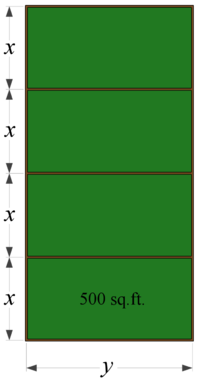
| Declare Variables: We are attempting to find the dimensions of a single pen, such that we use as little fencing as possible for all four pens. Let's use and Failed to parse (MathML with SVG or PNG fallback (recommended for modern browsers and accessibility tools): Invalid response ("Math extension cannot connect to Restbase.") from server "https://wikimedia.org/api/rest_v1/":): {\displaystyle y} as indicated in the image, and simply call the length of fencing required Failed to parse (MathML with SVG or PNG fallback (recommended for modern browsers and accessibility tools): Invalid response ("Math extension cannot connect to Restbase.") from server "https://wikimedia.org/api/rest_v1/":): {\displaystyle L} . |

| Step 2: |
|---|
| Form the Equations: Notice that we need fencing between each of the pens, so we require a total of Failed to parse (MathML with SVG or PNG fallback (recommended for modern browsers and accessibility tools): Invalid response ("Math extension cannot connect to Restbase.") from server "https://wikimedia.org/api/rest_v1/":): {\displaystyle 5} pieces of length Failed to parse (MathML with SVG or PNG fallback (recommended for modern browsers and accessibility tools): Invalid response ("Math extension cannot connect to Restbase.") from server "https://wikimedia.org/api/rest_v1/":): {\displaystyle y} . We also need Failed to parse (MathML with SVG or PNG fallback (recommended for modern browsers and accessibility tools): Invalid response ("Math extension cannot connect to Restbase.") from server "https://wikimedia.org/api/rest_v1/":): {\displaystyle 2} pieces of length Failed to parse (MathML with SVG or PNG fallback (recommended for modern browsers and accessibility tools): Invalid response ("Math extension cannot connect to Restbase.") from server "https://wikimedia.org/api/rest_v1/":): {\displaystyle x} for each pen, which means there are a total of Failed to parse (MathML with SVG or PNG fallback (recommended for modern browsers and accessibility tools): Invalid response ("Math extension cannot connect to Restbase.") from server "https://wikimedia.org/api/rest_v1/":): {\displaystyle 4\cdot 2} pieces required of length Failed to parse (MathML with SVG or PNG fallback (recommended for modern browsers and accessibility tools): Invalid response ("Math extension cannot connect to Restbase.") from server "https://wikimedia.org/api/rest_v1/":): {\displaystyle x} . Together, we need a total length of Failed to parse (MathML with SVG or PNG fallback (recommended for modern browsers and accessibility tools): Invalid response ("Math extension cannot connect to Restbase.") from server "https://wikimedia.org/api/rest_v1/":): {\displaystyle L=8x+5y} . |
| On the other hand, we know that each pen has a fixed area of Failed to parse (MathML with SVG or PNG fallback (recommended for modern browsers and accessibility tools): Invalid response ("Math extension cannot connect to Restbase.") from server "https://wikimedia.org/api/rest_v1/":): {\displaystyle 500} square feet. Thus, we also know that Failed to parse (MathML with SVG or PNG fallback (recommended for modern browsers and accessibility tools): Invalid response ("Math extension cannot connect to Restbase.") from server "https://wikimedia.org/api/rest_v1/":): {\displaystyle xy=500} . |
| Step 3: |
|---|
| Optimize: Since Failed to parse (MathML with SVG or PNG fallback (recommended for modern browsers and accessibility tools): Invalid response ("Math extension cannot connect to Restbase.") from server "https://wikimedia.org/api/rest_v1/":): {\displaystyle xy=500} , we also know Failed to parse (MathML with SVG or PNG fallback (recommended for modern browsers and accessibility tools): Invalid response ("Math extension cannot connect to Restbase.") from server "https://wikimedia.org/api/rest_v1/":): {\displaystyle y=500/x} . Plugging this into our equation for length, we have |
| Failed to parse (MathML with SVG or PNG fallback (recommended for modern browsers and accessibility tools): Invalid response ("Math extension cannot connect to Restbase.") from server "https://wikimedia.org/api/rest_v1/":): {\displaystyle L(x) = 8x + 5\cdot \frac{500}{x} = 8x + \frac{2500}{x}.} |
| We now take the derivative to find |
| Failed to parse (MathML with SVG or PNG fallback (recommended for modern browsers and accessibility tools): Invalid response ("Math extension cannot connect to Restbase.") from server "https://wikimedia.org/api/rest_v1/":): {\displaystyle L'(x)=8-\frac{2500}{x^2}= \frac{8x^2-2500}{x^2}.} |
| The denominator can never be zero, and if we set the numerator to zero we find |
| Failed to parse (MathML with SVG or PNG fallback (recommended for modern browsers and accessibility tools): Invalid response ("Math extension cannot connect to Restbase.") from server "https://wikimedia.org/api/rest_v1/":): {\displaystyle x=\pm\sqrt{\frac{2500}{8}} = \pm\frac{50}{2\sqrt{2}} =\pm\frac{\,\,25}{\sqrt{2}}.} |
| Of course, we can't have negative fencing lengths, so we can ignore the negative root. Finally, we use the area relation to find |
| Failed to parse (MathML with SVG or PNG fallback (recommended for modern browsers and accessibility tools): Invalid response ("Math extension cannot connect to Restbase.") from server "https://wikimedia.org/api/rest_v1/":): {\displaystyle y =\frac{500}{25\sqrt{2}} = \frac{500\sqrt{2}}{25} = 20\sqrt{2}. } |
| Thus, the least amount of fencing is used when we size our Failed to parse (MathML with SVG or PNG fallback (recommended for modern browsers and accessibility tools): Invalid response ("Math extension cannot connect to Restbase.") from server "https://wikimedia.org/api/rest_v1/":): {\displaystyle 500} sq. ft. pens as Failed to parse (MathML with SVG or PNG fallback (recommended for modern browsers and accessibility tools): Invalid response ("Math extension cannot connect to Restbase.") from server "https://wikimedia.org/api/rest_v1/":): {\displaystyle 20\sqrt{2}} feet by Failed to parse (MathML with SVG or PNG fallback (recommended for modern browsers and accessibility tools): Invalid response ("Math extension cannot connect to Restbase.") from server "https://wikimedia.org/api/rest_v1/":): {\displaystyle 25/\sqrt{2}} feet. |